-
Maternal Health Knowledge Is Strong but Gaps Remain, Survey Finds
Many Americans remain unclear about some specific maternal health recommendations, according to a new APPC survey.

-
Public Knowledge High on Smoking and Alcohol Risks During Pregnancy
According to a new Annenberg Public Policy Center survey, most people are uncertain about which vaccinations are safe and recommended for pregnant people.

-
More People Need to Know How to Prevent SIDS, Survey Shows
New APPC survey reveals that many Americans are unaware of two factors that can reduce a baby's risk of Sudden Infant Death Syndrome (SIDS): putting the baby to sleep on their back and reducing their exposure to second hand smoke.

-
Characteristics of Adolescents’ and Young Adults’ Exposure to and Engagement with Nicotine and Tobacco Product Content on Social Media
Abstract To inform policy and messaging, this study examined characteristics of adolescents’ and young adults’ (AYAs’) exposure to and engagement with nicotine and tobacco product (NTP) social media (SM) content. In this…
-
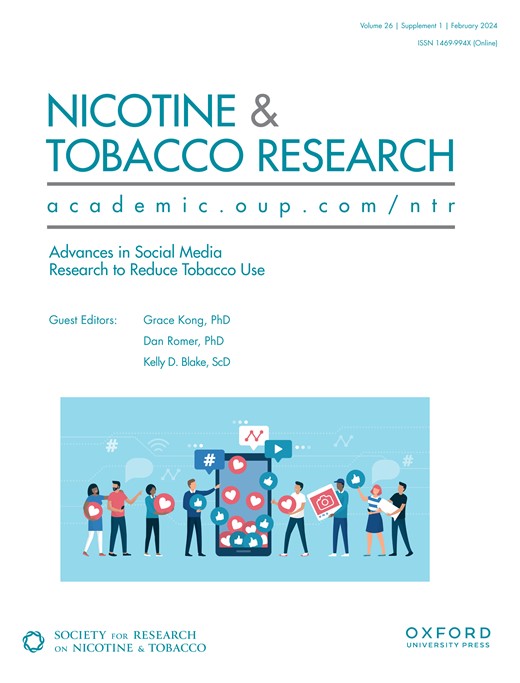
Advances in Social Media Research to Reduce Tobacco Use
Social media is a broad term used to refer to websites and applications that are text-, image-, and video-based, enabling users to connect and interact with their social network and the broader…
-
Tobacco, nicotine and counter-marketing promotions using Instagram’s branded content tool
Abstract Background The social media conglomerate, Meta, has a policy prohibiting promotion of tobacco products, vaporisers, electronic cigarettes or other products that simulate smoking via their branded content tools. This study examines if…
-
Tobacco promotion restriction policies on social media
Tobacco promotion is prolific on social media, with each platform setting their own restrictions on tobacco promotion and sales. We evaluated the policies related to tobacco product promotion and sales on 11…

-
Predicting cigarette use initiation and dependence in adolescence using an affect-driven exploration model
Adolescent decisions, especially in novel contexts, are often guided by affective evaluations (i.e., feelings associated with a stimulus) rather than knowledge of the risks and probabilities of different outcomes. In this study,…

-
Selection versus socialization effects of peer norms on adolescent cigarette use
Abstract Adolescent smokers tend to have friends who also smoke. This association has been attributed to peer socialization and peer selection effects. However, evidence regarding timing and relative magnitude of these effects…
-
Brazil’s efforts to reduce cigarette use illustrate both the potential successes and challenges of this goal
Reducing the use of tobacco and cigarettes in particular is a worldwide objective. The World Health Organization (WHO) Framework Convention on Tobacco Control1 (adopted in 2003), along with the WHO Global Action…
