-
Crisis or self-correction: Rethinking media narratives about the well-being of science
Abstract After documenting the existence and exploring some implications of three alternative news narratives about science and its challenges, this essay outlines ways in which those who communicate science can more accurately…

-
Expert Panel Proposes Common Authorship Standards to Promote Integrity in Science
Scholars, editors, and scientists at a National Academy of Sciences-Sunnylands-APPC retreat proposed uniform standards and greater transparency to clarify the roles of authors across different journals, fields, and cultures.

-
Transparency in authors’ contributions and responsibilities to promote integrity in scientific publication
In keeping with the growing movement in scientific publishing toward transparency in data and methods, we propose changes to journal authorship policies and procedures to provide insight into which author is responsible for which contributions, better assurance that the list is complete, and clearly articulated standards to justify earning authorship credit. To accomplish these goals, we recommend that journals adopt common and transparent standards for authorship, outline responsibilities for corresponding authors, adopt the Contributor Roles Taxonomy (CRediT) methodology for attributing contributions, include this information in article metadata, and require authors to use the ORCID persistent digital identifier.
-
Social Media Can Complement Surveys on Public Health Issues
An analysis of Twitter posts during the Zika outbreak in 2016 shows a correlation between Twitter topics and the results of nationwide U.S. surveys, according to researchers at APPC and the University of Illinois.

-
Understanding Evolution Leads to Greater Acceptance of It
Research from two APPC distinguished research fellows shows that Americans' understanding of evolution - as well as their politics and/or religion - is tied to their acceptance or rejection of it.

-
Associations of Topics of Discussion on Twitter With Survey Measures of Attitudes, Knowledge, and Behaviors Related to Zika
The results demonstrated that it is possible to uncover topics of discussions from Twitter communications that are associated with the Zika-related attitudes, knowledge, and behaviors of populations over time. Social media data can be used as a complementary source of information alongside traditional data sources to gauge the patterns of attitudes, knowledge, and behaviors in a population.
-
No Missing Link: Knowledge Predicts Acceptance of Evolution in the United States
Most Americans reject some or all parts of evolutionary theory, contrary to the scientific consensus. Americans’ attitudes toward evolution at least partially depend on their religious or political values, and prior work has argued that knowledge of the theory plays a negligible role. But there have been no systematic, large-scale attempts to measure the public's knowledge of evolutionary theory, which means that claims about a lack of significant impact of evolution knowledge on evolution acceptance may be premature.
-
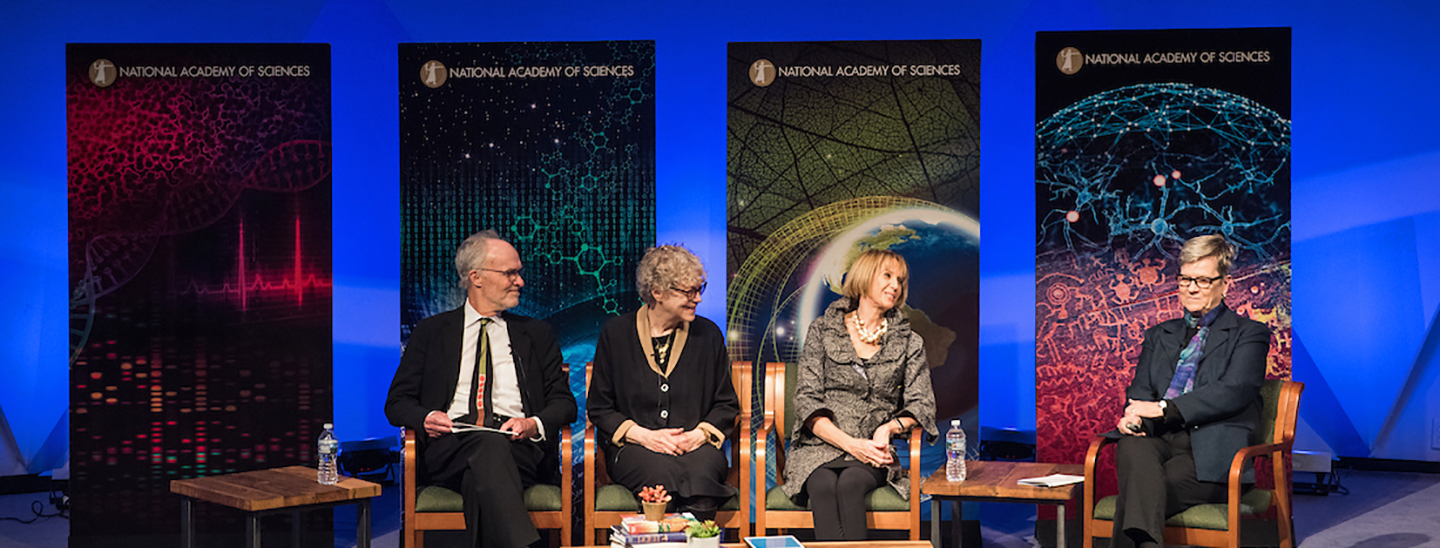
Video: Jamieson Moderates Sackler Panel on Threats to Science’s Reputation
APPC Director Kathleen Hall Jamieson moderated a panel focusing on threats to science's reputation at the National Academy of Sciences Arthur M. Sackler Colloquium on the Science of Science Communication.
-
Marin Allen of the NIH Joins Policy Center as Visiting Scholar
Marin P. Allen, a former top communication official at the National Institutes of Health, has joined APPC as a 2017-18 visiting scholar and is teaching a course in health communication at the Annenberg School.

-
The Role of Language in Discussing the Life Sciences
In an article for the journal Politics and the Life Sciences, Kathleen Hall Jamieson looks at the role that language plays when science is conveyed to the public. Examples include the outbreak of "mad cow" disease in Britain.