In a new paper published in Human Communication Research, researchers at the Annenberg Public Policy Center and the Ohio State University show that gun injury rates are a more sensitive indicator of the trend in gun violence than gun homicide rates.

In a new paper published in Human Communication Research, researchers at the Annenberg Public Policy Center and the Ohio State University show that gun injury rates are a more sensitive indicator of the trend in gun violence than gun homicide rates.

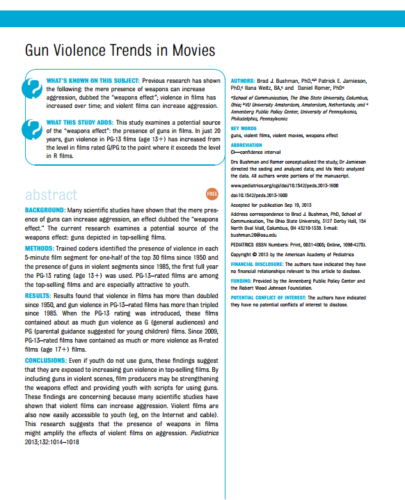
Parents can become desensitized to violence and sex in movies after watching only a few scenes with disturbing content, according to a new study published in Pediatrics that was conducted by researchers at the Annenberg Public Policy Center. The study comes as scenes of sex and violence become more prevalent in movies aimed at youth. A 2013 study in Pediatrics from APPC researchers showed that the amount of violence in PG-13 movies tripled in the most popular movies since 1985.
A new study published in the online journal Media and Communication finds that Americans’ answer to one of the long-running questions in a Gallup poll – are you afraid to walk alone in your neighborhood at night? – may be influenced by the amount of violence shown on popular prime-time television dramas.

Doctoral candidate Karin Fikkers, from the University of Amsterdam, has been studying at the Annenberg School for Communication this winter as part of an exchange program with the Amsterdam School of Communication Research. She talks about her research and the differences between studying in the Netherlands and the United States.
Nearly 90 percent of the top-grossing movies over a 25-year period show main characters acting violently, and in 77 percent of the movies those characters also engage in sex-, alcohol- or tobacco-related behavior, a new study has shown. The study published in Pediatrics, by researchers at the Annenberg Public Policy Center, found that more than half of the biggest PG-13 movies featured a main character acting violently and involved in either drinking, sexual behavior or smoking within a five-minute segment.