-
States Differ Widely in Requirements for Young Driver Training
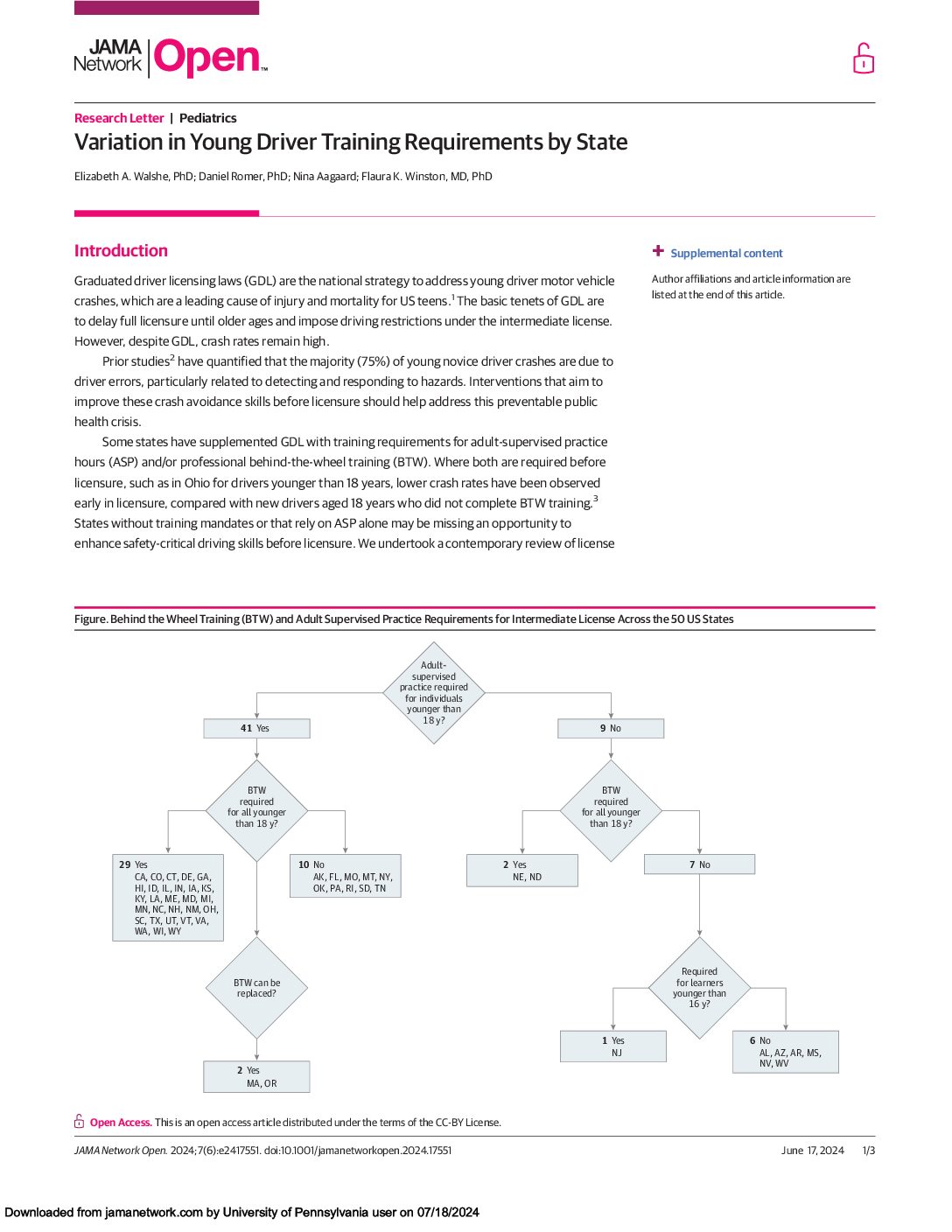
State requirements vary widely for young driver training and a new study in JAMA Open suggests that more states should require more young driver training before granting licenses.

-
Variation in Young Driver Training Requirements by State
Introduction Graduated driver licensing laws (GDL) are the national strategy to address young driver motor vehicle crashes, which are a leading cause of injuryand mortality for US teens. The basic tenets of…
-
APPC Celebrates 30 Years of Research and Engagement That Matter
The Annenberg Public Policy Center celebrated its 30th anniversary by honoring the work of its former postdoctoral and FactCheck.org fellows and opening a new Climate Communication division.

-
Driving Skills at Licensure and Time to First Crash
BACKGROUND AND OBJECTIVES Young drivers are overrepresented in crashes, and newly licensed drivers are at high risk, particularly in the months immediately post-licensure. Using a virtual driving assessment (VDA) implemented in the…
-
Virtual Driving Assessment Predicts Risk of Crashing for Newly Licensed Teen Drivers
New research found that driving skills measured at the time of licensure on a virtual driving assessment, exposing drivers to common crash scenarios, helps predict crash risk.

-
An event-based magnetoencephalography study of simulated driving: Establishing a novel paradigm to probe the dynamic interplay of executive and motor function
Magnetoencephalography (MEG) is particularly well-suited to the study of human motor cortex oscillatory rhythms and motor control. However, the motor tasks studied to date are largely overly simplistic. This study describes a…

-
Adolescents’ own views on their risk behaviors, and the potential effects of being labeled as risk-takers: A commentary and review
Adolescents are stereotypically viewed as risk-takers (“stereotypical risk-takers”) in science, mainstream media, fictional literature and in everyday life. However, increasing research suggests that adolescents do not always engage in “heightened” risk-taking, and…

-
Novel use of a virtual driving assessment to classify driver skill at the time of licensure
Highlights A population-based analysis of 33,249 virtual driving assessments of new drivers at the time of licensure revealed 20 Skill Clusters that were then grouped into 4 major summary “Driving Classes”. These…

-
Licensing examination and crash outcomes postlicensure in young drivers
Key Points Question: Do drivers younger than 18 years and subject to comprehensive licensing policy (graduated driver licensing laws, mandatory driver education and training) have better licensing and crash outcomes compared with drivers…

-
Drivers Licensed at 18 Crash More Than Younger Drivers With Driver Training
Younger drivers subject to mandatory driver education and Graduated Driver Licensing restrictions were less likely to crash than those licensed at 18 who were exempt from these requirements.