The Make America Healthy Again (MAHA) movement emerged as part of Donald Trump’s 2024 presidential campaign following former presidential candidate Robert F. Kennedy Jr.’s endorsement of Trump. Kennedy has predicted that the movement will be a factor in the forthcoming 2026 midterms. Now serving as U.S. Secretary of Health and Human Services, RFK Jr., who has been campaigning for Republicans, told the Daily Signal in August: “Everywhere we go, we’re seeing incredible enthusiasm from the MAHA movement for this administration, so I think it’s going to be an important factor [in the midterms].”
In two nationally representative surveys this year, the Annenberg Public Policy Center (APPC) asked a panel of U.S. adults about MAHA-related policies, developing a portrait of MAHA supporters’ policy preferences. One Annenberg Science and Public Health (ASAPH) survey was conducted April 14-28, 2026, among 1,639 adults; the second was conducted Aug. 4-17, 2026, among 1,904 adults. See the end of this release or the topline for more information.
“The findings suggest that it’s important to distinguish support for MAHA from support for specific MAHA policies,” said Laura A. Gibson, an APPC research analyst. “Many people who say they don’t support the movement nonetheless share its concerns about additives, chemicals, and highly processed foods.”
The findings come amid possible signs of fracturing in the MAHA coalition’s support for the Trump administration. On Oct. 8, a group of MAHA loyalists issued a “scorecard” in which they said that the administration had “partially kept” five promises to Make America Healthy Again but had broken 37 others.
A quarter of Americans support MAHA
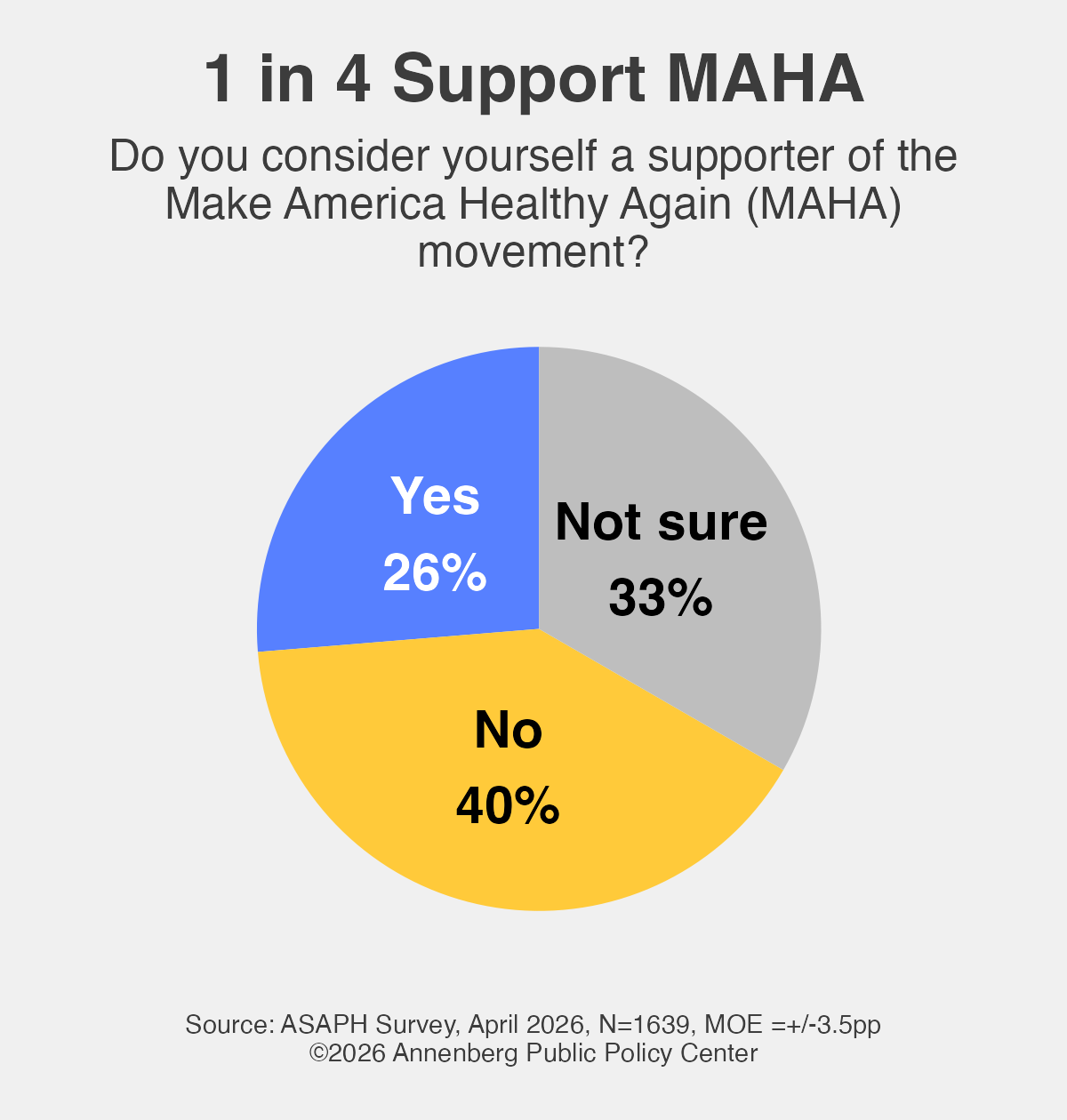 In our April survey, 1 in 4 (26%) respondents say they are supporters of MAHA, 40% say they are not supporters of MAHA, and a third (33%) say they are not sure whether they support MAHA. (A different survey in April, by the Kaiser Family Foundation, found more people (41%) who said they are MAHA supporters and more (58%) who said they are not. In APPC’s survey, support and nonsupport both are lower because it included an explicit “or are you not sure” option.)
Politically, MAHA supporters are more likely than nonsupporters to identify themselves as Republicans or Republican-leaning independents and to have a household income between $50,000 to $100,000 (middle income). About half of Republicans and Republican-leaners say they are MAHA supporters (51%), compared with 8% of Democrats and Democrat-leaners, and 16% of independents. Among Democrats, two in three (67%) say they do not support MAHA, compared with 14% of Republicans and 34% of independents. Just over half of independents (51%) report being not sure whether they support MAHA, compared with 35% of Republicans and 24% of Democrats.
Half of respondents with a household income over $100,000 say they are not MAHA supporters (50%), compared with 39% of those with a household income less than $50,000 and 32% of those with middle income. Just over a third of respondents with a middle income said they are MAHA supporters (37%), compared with 22% of those with a higher income and 21% with a lower income.
What do people in the MAHA movement support?
We asked about 17 health policy positions associated with the MAHA movement, some of which have become or are in the process of becoming official U.S. MAHA policy. We consulted several sources to build our list, including the 2025 executive order establishing the Make America Healthy Again Commission, the administration’s MAHA strategy, and the MAHA Action Candidate Pledge. Policy items included regulating additives in food, banning glyphosate (the active ingredient in the weed killer Roundup), labeling ultra-processed foods, and reducing the number of childhood vaccines recommended by the CDC.
The graphics here show the findings by total respondents; those who say they are a supporter of the MAHA movement; those who say they are not a supporter of MAHA; and those who are not sure whether they support MAHA. The results described in the text focus on those who explicitly say they do – and those who say they do not – support MAHA.
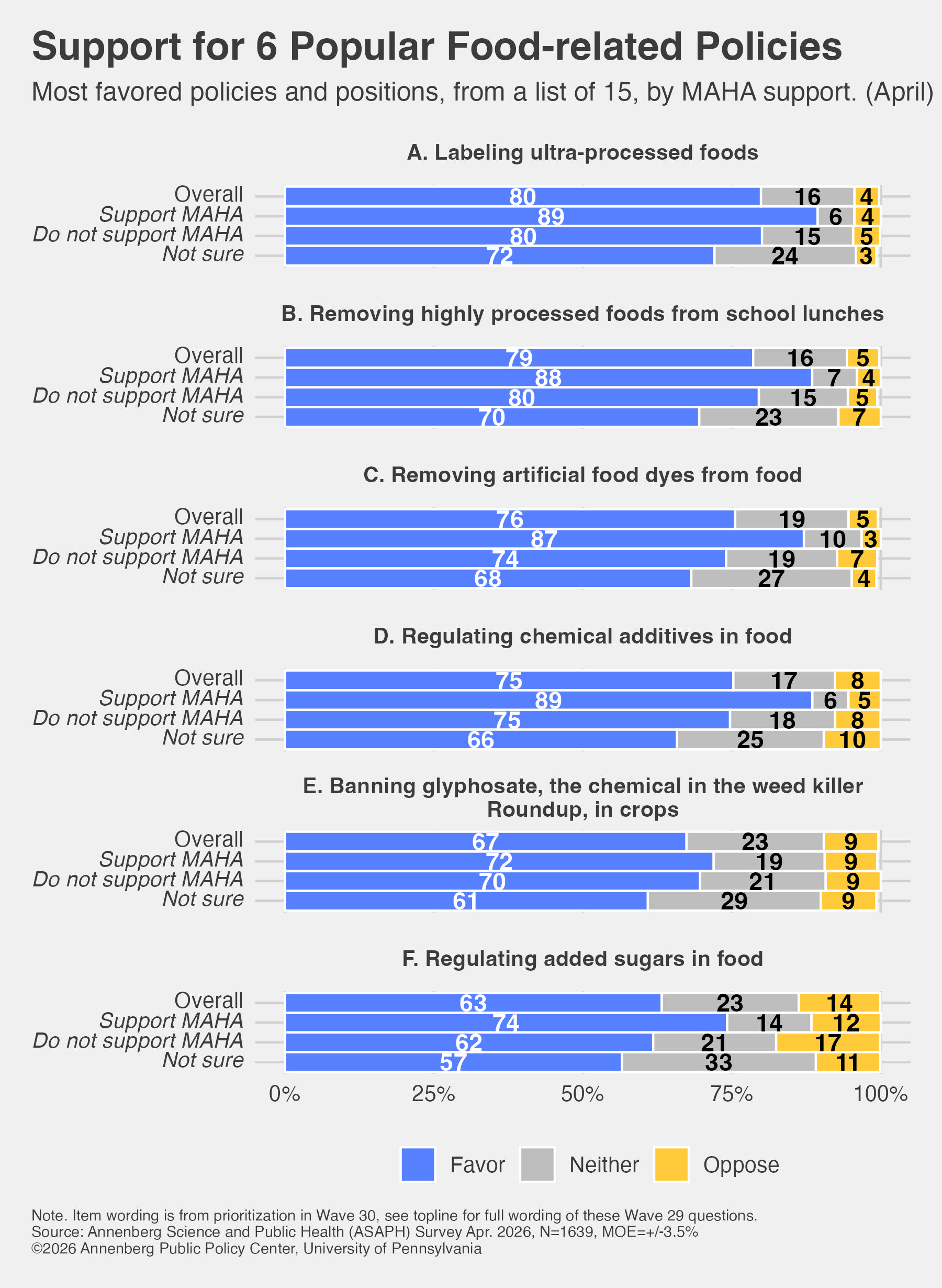
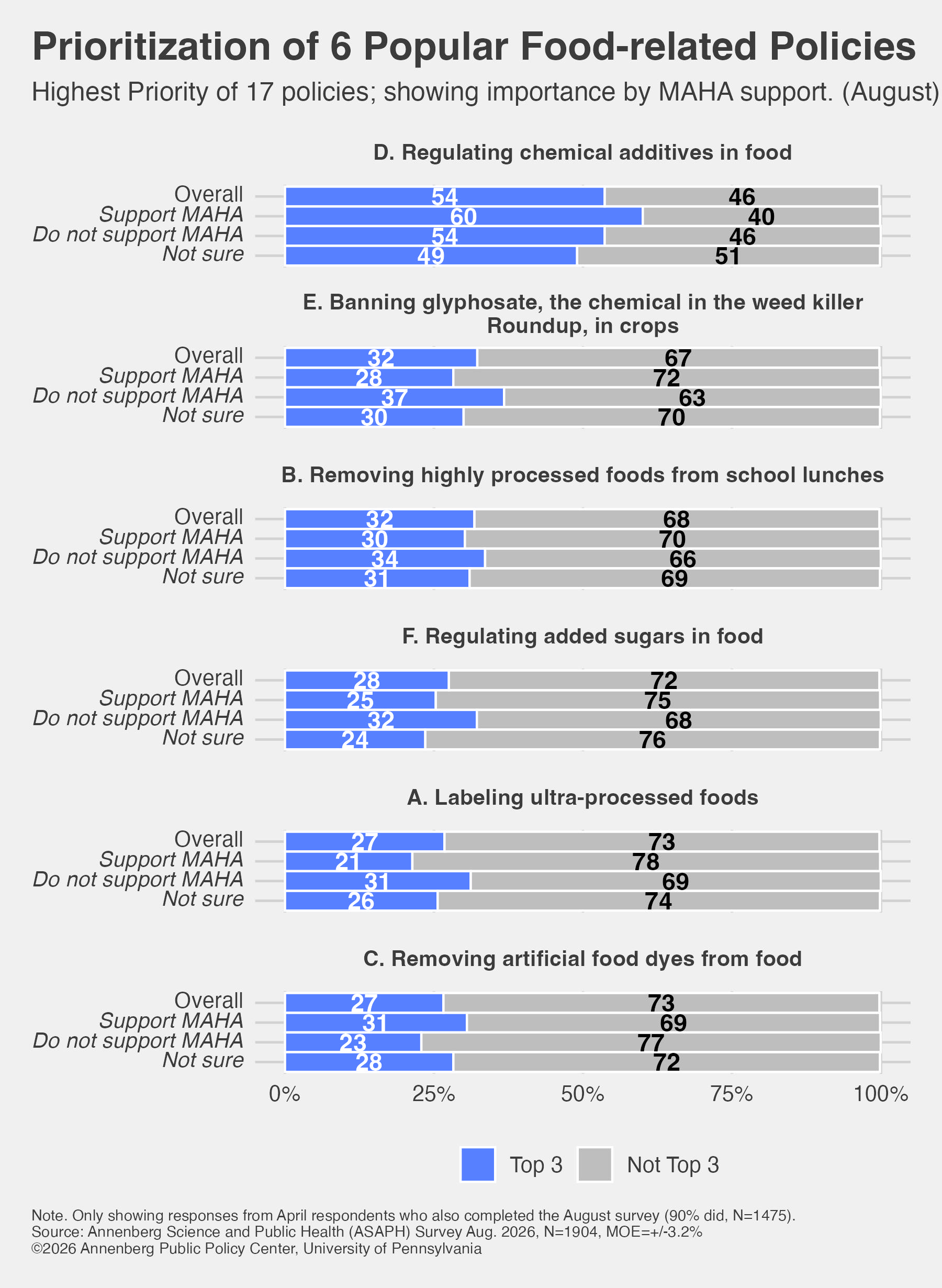
Across all groups, favorability is high for all six of the MAHA agenda issues about regulating chemicals and additives in foods and processed foods. On average, 73% of all respondents favor these issues (83% of MAHA supporters and 73% of non-MAHA supporters). When asked to prioritize the 17 MAHA agenda issues, more MAHA supporters and nonsupporters selected these six items as being among their “Top 3” health issues (21%-60% selected them) than the other 11 MAHA proposals (2%-18%).
Regulating chemical additives in food was the leading priority for MAHA supporters, nonsupporters, and those unsure about MAHA. Removing highly processed foods from school lunches also ranked near the top for all three groups. Banning glyphosate was also a top priority. (For more detail on attitudes toward glyphosate, see the APPC release in August.) The only significant difference in priorities between MAHA supporters and nonsupporters is in labeling ultra-processed foods: More nonsupporters put it in their Top 3 (31%) than MAHA supporters (21%).
MAHA supporters trust their personal healthcare providers
Support for MAHA does not suggest a broad distrust of medical professionals. Like survey respondents who do not support MAHA, MAHA supporters are overwhelmingly confident that their own doctor, nurse, or other primary healthcare provider is offering them trustworthy public health information (85% MAHA supporters and 91% nonsupporters, a statistically significant difference).
The April survey found a similar pattern when respondents were asked to choose between relying on trained medical professionals and relying primarily on their own judgment when making medical care and food choices for their family. Overall, 81% of U.S. adults chose doctors and health professionals over their own judgment. There was a significant difference between MAHA supporters and nonsupporters but both showed overall high rates of support for medical professionals (69% of MAHA supporters and 88% of nonsupporters).
Similar perceptions of the CDC and FDA – but not the NIH
Similar proportions of MAHA supporters and nonsupporters say they are confident that the Food and Drug Administration (FDA) provides the public with trustworthy information about matters concerning public health (57% and 58%, respectively), according to our August survey. Similar proportions also are confident in the Centers for Disease Control and Prevention (CDC) – 58% of MAHA supporters and 62% of nonsupporters. Fewer MAHA supporters, however, say they are very confident: 6% compared with 16% of nonsupporters.
A significant difference between MAHA supporters and nonsupporters involves confidence in the National Institutes of Health (NIH). Only half of MAHA supporters express confidence in NIH, compared with 63% of nonsupporters.
The greatest difference between MAHA supporters and nonsupporters concerns confidence in HHS Secretary Robert F. Kennedy Jr. as a source of trustworthy public health information. In August, 75% of MAHA supporters say they are confident that Kennedy is providing trustworthy information about public health, compared with 12% of nonsupporters.
Favorability toward the political figures most closely associated with the movement shows similarly large differences. Sixty-two percent of MAHA supporters have a favorable opinion of Kennedy, compared with 4% of non-MAHA supporters. And 65% of MAHA supporters have a favorable opinion of President Donald Trump, compared with 5% of non-MAHA supporters.
“This pattern suggests that MAHA support is much more strongly associated with attitudes toward Kennedy himself than with rejection of the federal public health agencies he oversees,” said Ken Winneg, APPC’s managing director of survey research.
MAHA supporters trust their personal healthcare providers
Support for MAHA does not suggest a broad distrust of medical professionals. Like survey respondents who do not support MAHA, MAHA supporters are overwhelmingly confident that their own doctor, nurse, or other primary healthcare provider is offering them trustworthy public health information (85% MAHA supporters and 91% nonsupporters, a statistically significant difference).
The April survey found a similar pattern when respondents were asked to choose between relying on trained medical professionals and relying primarily on their own judgment when making medical care and food choices for their family. Overall, 81% of U.S. adults chose doctors and health professionals over their own judgment. There was a significant difference between MAHA supporters and nonsupporters but both showed overall high rates of support for medical professionals (69% of MAHA supporters and 88% of nonsupporters).
Similar perceptions of the CDC and FDA but not the NIH
Similar proportions of MAHA supporters and nonsupporters say they are confident that the Food and Drug Administration (FDA) provides the public with trustworthy information about matters concerning public health (57% and 58%, respectively), according to our August survey. Similar proportions also are confident in the Centers for Disease Control and Prevention (CDC) – 58% of MAHA supporters and 62% of nonsupporters. Fewer MAHA supporters, however, say they are very confident: 6% compared with 16% of nonsupporters.
A significant difference between MAHA supporters and nonsupporters involves confidence in the National Institutes of Health (NIH). Only half of MAHA supporters express confidence in NIH, compared with 63% of nonsupporters.
The greatest difference between MAHA supporters and nonsupporters concerns confidence in HHS Secretary Robert F. Kennedy Jr. as a source of trustworthy public health information. In August, 75% of MAHA supporters say they are confident that Kennedy is providing trustworthy information about public health, compared with 12% of nonsupporters.
Favorability toward the political figures most closely associated with the movement shows similarly large differences. Sixty-two percent of MAHA supporters have a favorable opinion of Kennedy, compared with 4% of non-MAHA supporters. And 65% of MAHA supporters have a favorable opinion of President Donald Trump, compared with 5% of non-MAHA supporters.
“This pattern suggests that MAHA support is much more strongly associated with attitudes toward Kennedy himself than with rejection of the federal public health agencies he oversees,” said Ken Winneg, APPC’s managing director of survey research.
Vaccine policies show some of the greatest differences
In general, policies regarding vaccines produce some of the sharpest differences between MAHA supporters and nonsupporters. But the vaccine-related policies are less popular than the six food-related policies – and even among MAHA supporters, most get barely a majority in favorability.
Among all of the vaccine policies, the biggest gap in favorability between MAHA supporters and nonsupporters is for reducing the number of childhood vaccines recommended by the CDC, favored by 53% of MAHA supporters but 7% of nonsupporters. Replacing vaccine requirements with shared clinical decision-making shows a similar split (53% of MAHA supporters favor it vs. 15% of nonsupporters). Ending vaccine mandates in schools garners less support among both MAHA supporters (35%) and MAHA nonsupporters (4%).
MAHA supporters are much more likely than nonsupporters to rank reducing the number of CDC-recommended childhood vaccines among their Top 3 issues (17% vs. 6%). Even so, with only 17% of MAHA supporters putting it among their Top 3 issues, it is a lower priority than the food-related policies, which receive from 21%-60% support.
Low priorities: Raw milk sales and ending public water fluoridation
In addition to asking which three policies were the most important, the August survey asked which three policies were the least important. Making it easier to sell raw milk was the lowest priority among the 17 policies across all groups. It was among the bottom three issues for 31% of MAHA supporters and 38% for MAHA nonsupporters. Ending fluoridation was also a low priority: It was among the bottom three issues for 24% of MAHA supporters and 31% of nonsupporters.
About the survey
The survey data come from the 29th and 30th waves of the ASAPH survey, a nationally representative panel of U.S. adults conducted for the Annenberg Public Policy Center by SSRS, an independent research company. Interviews for wave 29 were conducted by web and telephone April 14-28, 2026, among 1,639 U.S. adults. The margin of sampling error is ±3.5 percentage points at the 95% confidence level. Wave 30 included 1,904 U.S. adults and was conducted Aug. 4-17, 2026. Reported August data are limited to the 1,475 respondents who also completed the April survey (90% of April respondents did) with a margin of sampling error of ±3.5 percentage points. Data were weighted to represent the U.S. adult population.
For more information, download the topline and methodology reports.
The Annenberg Public Policy Center has been tracking the American public’s knowledge, beliefs, and behaviors regarding vaccination, Covid-19, flu, RSV, climate and other consequential health issues through its Annenberg Science and Public Health (ASAPH) survey panel. In addition to Gibson and Winneg, the ASAPH survey team includes Patrick E. Jamieson, director of the Annenberg Health and Risk Communication Institute, which oversees the survey; research analyst Shawn Patterson Jr.; and Kathleen Hall Jamieson, APPC director emerita.
See other recent Annenberg health survey news releases:
- 988 Lifeline: Knowledge of the 988 Suicide Lifeline remains low (Oct. 9, 2026)
- RFK Jr. and the measles vaccine: About 1 in 3 Americans Say RFK Jr. Recommends Measles Vaccine (Sept. 29, 2026)
- Confidence in public health officials: Public confidence in Fauci declines since spring, but still exceeds RFK Jr. (Sept. 9, 2026)
- Confidence in healthcare providers: Public confidence in one’s own healthcare provider remains high (Aug. 31, 2026)
- Banning glyphosate: Bipartisan majorities in U.S. favor banning glyphosate (Aug. 20, 2026)
The Annenberg Public Policy Center was established in 1993 to educate the public and policy makers about communication’s role in advancing public understanding of political, science, and health issues at the local, state, and federal levels.