Americans’ confidence in their own healthcare providers remains high, according to a longitudinal, nationally representative survey conducted by the Annenberg Public Policy Center (APPC) of the University of Pennsylvania from April 2021 to August 2026.
In contrast, confidence in the U.S. Centers for Disease Control and Prevention (CDC), the Food and Drug Administration (FDA), and the National Institutes of Health (NIH) as sources of trustworthy public health information has declined significantly since the beginning of President Donald J. Trump’s second term and Robert F. Kennedy, Jr.’s confirmation as Health and Human Services (HHS) Secretary overseeing these agencies in February 2025, with the decline occurring in 2025.
This year, prior to the August 2026 survey, both FDA commissioner Dr. Marty Makary and the agency’s vaccine and biologics division head, Dr. Vinay Prasad, left the agency. Makary stepped down in May and Prasad resigned in March. Other major departures from leading U.S. public health agencies include two in August 2025. The CDC director, Dr. Susan Monarez, was fired and the CDC’s deputy director and chief medical officer, Dr. Debra Houry, resigned.
Since completion of the current survey, Trump nominated Dr. Heidi Overton to become the new FDA commissioner. Overton is deputy director of the White House Domestic Policy Council.
“It is critical for the public to have a reliable source for healthcare information,” said Ken Winneg, APPC’s managing director of survey research, “so it’s a relief to see high and consistent trust in their personal healthcare providers.”
The current survey was conducted Aug. 4-17, 2026, among 1,904 U.S. adults. See the end of this news release and the topline for further details.
Americans continue to have the most confidence in their own healthcare providers
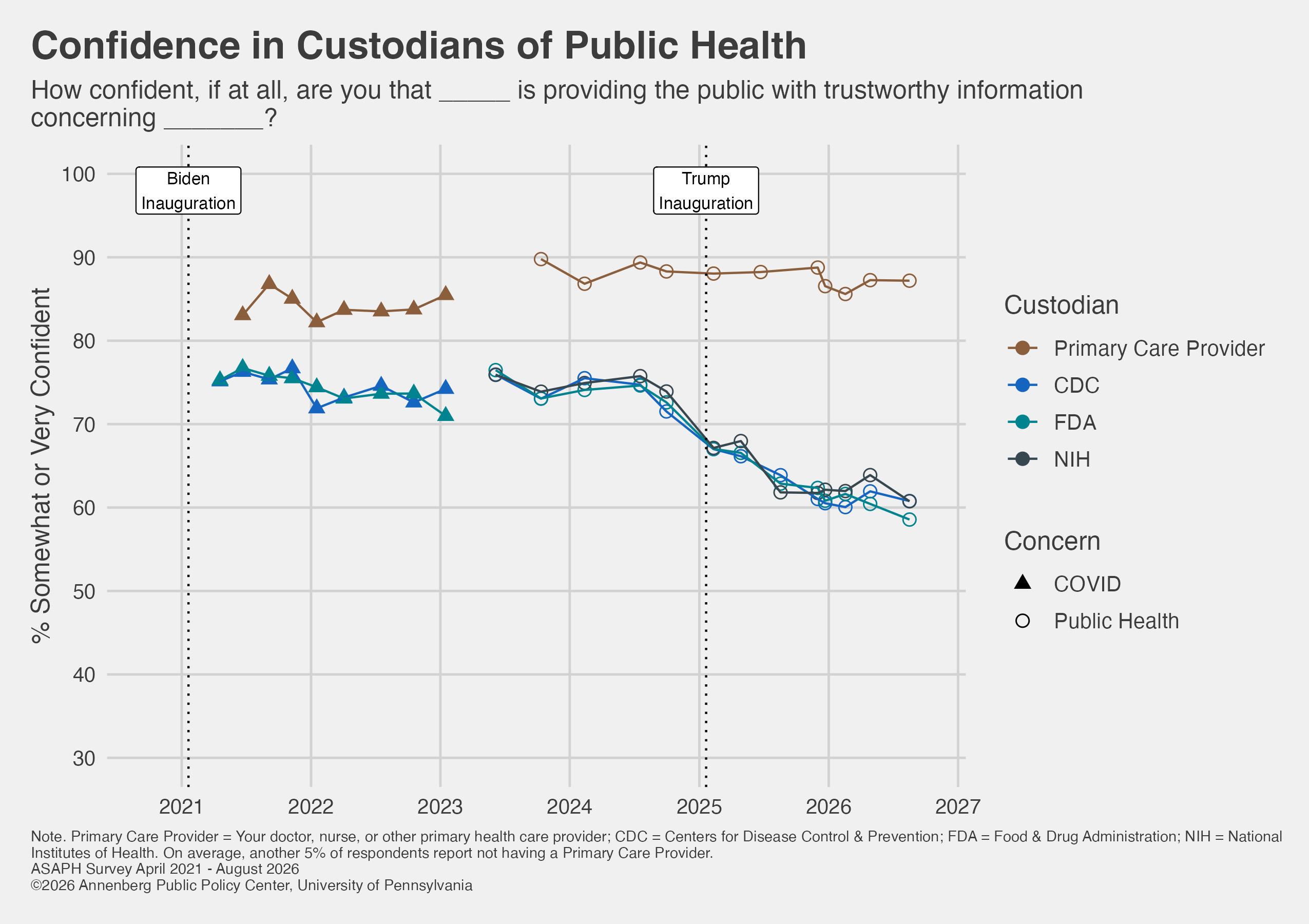
The latest analyses show that Americans continue to express high levels of confidence in their own healthcare providers, despite a decline in confidence in federal health agencies over the course of 2025. Contrary to assertions by U.S. health officials,* public confidence in one’s personal healthcare provider has remained both high and stable.
In August 2026, 87% of respondents say they are confident that their doctor, nurse, or other primary healthcare provider is providing trustworthy information about matters of public health, which is statistically unchanged from 88% in September 2024. Nearly half (46%) say they are very confident and 42% say they are somewhat confident in their provider, while just 8% say they are not confident, and 4% report not having a provider. Data from 2023 show similar confidence levels (87%-90%). Earlier data from 2021-22 – when the question concerned providing trustworthy information about the means of preventing and treating Covid-19, rather than about matters concerning public health – confidence was slightly lower, at 82-87%, though still higher than for the federal agencies.
 * On December 4, 2025, in response to NBC News’ Anne Thompson asking about APPC’s previously reported 2025 decline in trust in the FDA, then FDA commissioner Marty Makary cited a 2024 study published in JAMA Network Open showing a decline in trust in hospitals and doctors. The inference Makary invited was that the decline in trust of federal health agencies that our survey identified reflected an overall decline in trust of healthcare providers. The decline he cited in trust of hospitals and doctors from April 2020-January 2024 was predominantly during the Covid-19 pandemic. Suggesting that this is an ongoing trend of increasing disillusionment with the medical community (including federal health agencies) does not fit with the fairly flat lines we see for trust in healthcare providers from 2023 on in both the APPC dataset and the dataset from which the 2024 JAMA Network Open study was drawn. See our appendix, A Comparison of Confidence in Custodians of Public Health, for comparison graphs and a more detailed description of the two datasets.
Confidence in U.S. public health agencies declined from 2024 to 2026
In contrast to confidence in healthcare providers, confidence that the CDC, FDA, and NIH are providing the public with trustworthy information about matters concerning public health declined significantly from stable highs of 72-76% in 2024 to 59-64% in 2026. Data from 2021, when we asked about confidence to provide the public with trustworthy information about the means of preventing and treating C2OVID-19, show similar confidence levels to 2024 (71-77%).
- CDC: In August 2026, 61% expressed confidence in the CDC, significantly below the 72% who expressed confidence in the CDC in September 2024. The proportion of people who say they are “very confident” in the CDC declined significantly from 29% in September 2024 to 13% in August 2026.
- FDA: Confidence in the FDA is 59% in August 2026, also significantly below the 73% expressing confidence in September 2024. The proportion of people who say they are very confident in the FDA declined significantly from 23% in September 2024 to 11% in August 2026 as well.
- NIH: Confidence in the NIH also declined significantly to 61% in August 2026 from 74% in September 2024. The proportion of people who say they are very confident in the NIH declined significantly from 27% in September 2024 to 12% in August 2026 as well.
Speaking at a Tampa, Fla., elementary school on Aug. 26, 2026, Kennedy told reporter Mitch Perry of the nonprofit Florida Phoenix that “we are actually restoring faith in the public health agencies so people will take our advice, and our advice is that people should get the measles vaccination.”
“We don’t see evidence in our data that the Trump administration is restoring trust in the federal health agencies,” said Laura A. Gibson, an APPC research analyst.
Although there has been a significant confidence gap between Americans’ perceptions of their personal healthcare providers and their perceptions of the three national public health institutions since we first asked the “trustworthy information concerning matters of public health” question in June 2023, the gap grew significantly in 2025 to the levels seen now, in 2026. The August 2026 findings show a substantial 26-28 percentage point gap between Americans’ confidence in their personal healthcare providers and their confidence in the three federal public health agencies. By contrast, in September 2024 the confidence gap was just 14-16 percentage points.
“It is concerning to see the gap between confidence in the federal public health agencies and confidence in healthcare providers double over the course of 2025 and not recover since,” said Patrick E. Jamieson, director of APPC’s Annenberg Health and Risk Communication Institute, which oversees the health surveys.
About the survey
The latest Annenberg Science and Public Health (ASAPH) survey was conducted for the Annenberg Public Policy Center by SSRS, an independent research company. Interviews were conducted by web and telephone among a nationally representative probability sample drawn from the SSRS Opinion Panel. Data were weighted to represent the U.S. adult population.
The August 2026 survey, conducted August 4-17, 2026, among 1,904 U.S. adults, has an estimated margin of sampling error of ±3.2 percentage points at the 95% confidence level. The September 2024 survey was conducted September 13-30, 2024, among 1,744 U.S. adults, with an estimated margin of sampling error ±3.5 percentage points.
For additional information, download the topline and methodology report.
The policy center has been tracking the American public’s knowledge, beliefs, and behaviors regarding vaccination, Covid-19, flu, RSV, and other consequential health issues through its Annenberg Science and Public Health (ASAPH) survey and other national samples since April 2021. The ASAPH and other health surveys are conducted under the auspices of APPC’s Annenberg Health and Risk Communication Institute (AHRCI) by a team that includes Jamieson, Winneg, Gibson, and APPC research analyst Shawn Patterson, Jr.
See other recent Annenberg health survey news releases:
- Banning glyphosate: Bipartisan majorities in U.S. favor banning glyphosate (Aug. 20, 2026)
- Recommended vaccines during pregnancy: Most Americans are unsure which vaccines the CDC recommends during pregnancy (July 22, 2026)
- Fluoridation of drinking water: Americans split on fluoridation; opposition by MAHA supporters notable (June 11, 2026)
- Confidence in scientists: Stark divide: Americans more confident in career scientists at U.S. health agencies than leaders (March 5, 2026)
- Confidence in U.S. health agencies: Public confidence in U.S. health agencies slides, fueled by declines among Democrats (Sept. 18, 2025)
The Annenberg Public Policy Center was established in 1993 to educate the public and policy makers about communication’s role in advancing public understanding of political, science, and health issues at the local, state, and federal levels.