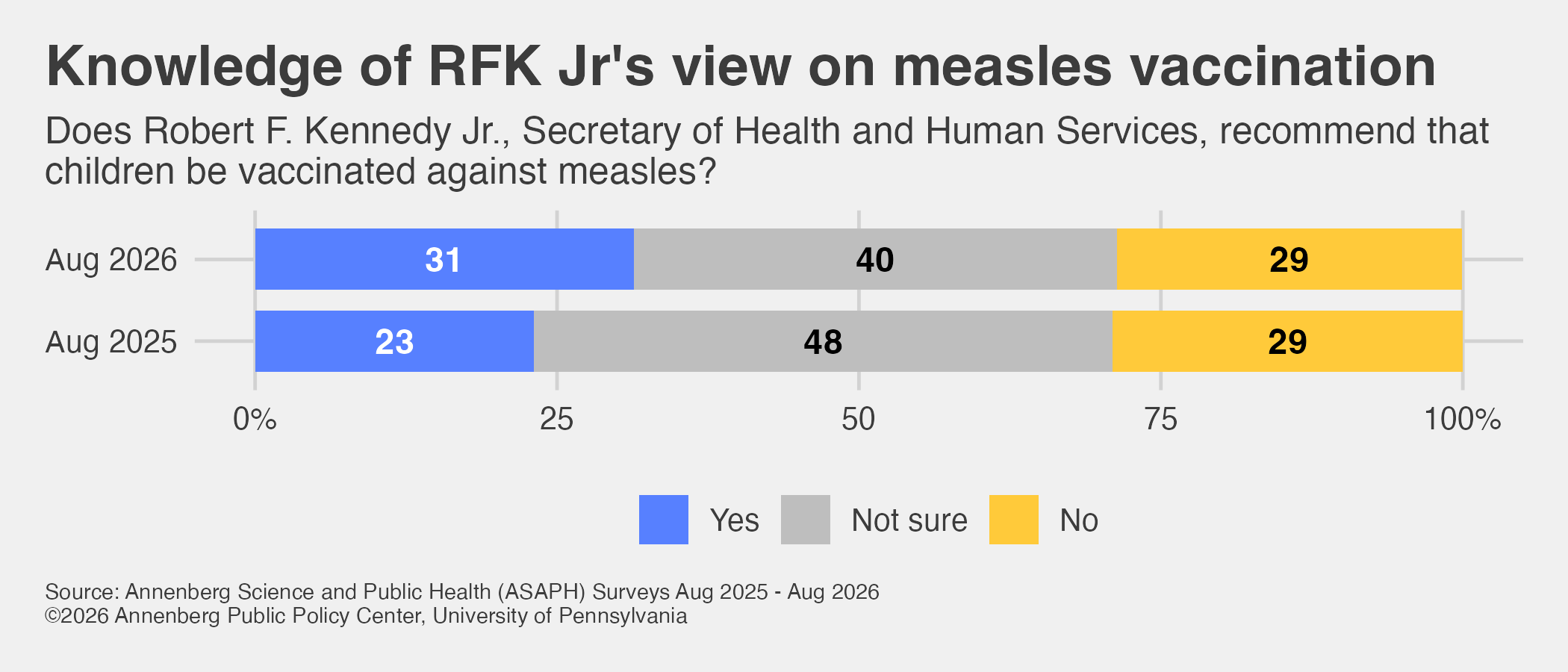
The number of measles cases in the United States is at the highest level in decades, attributed to a decrease in vaccination against measles. And while U.S. Health and Human Services Secretary Robert F. Kennedy Jr. told American parents on Aug. 2 that they should get their children vaccinated against measles, the public remains evenly divided on whether or not he recommends the MMR (measles, mumps, and rubella) vaccine.
According to the latest nationally representative survey from the Annenberg Public Policy Center (APPC) of the University of Pennsylvania, conducted Aug. 4-17, 2026, among more than 1,900 U.S. adults, the proportion of adults who say Kennedy recommends that children be vaccinated against measles is just under a third, at 31%. While this represents a significant increase since August 2025, when 23% of Americans thought he recommended measles vaccination for children, most people either still think that Kennedy does not recommend the vaccine (29%) or are unsure whether or not he recommends it (40%). The public is evenly divided between those who think Kennedy does (31%) or does not (29%) recommend the vaccine.
A longtime vaccine skeptic, Kennedy has as HHS secretary made misleading and unsupported claims about the MMR vaccine, the measles, and vaccination in general, according to FactCheck.org, a project of APPC. He also has downplayed the risks of measles and the 2025 measles outbreak in Texas.
“As measles cases rise and the U.S. is poised to lose its measles elimination status, this country is paying the price for skepticism about vaccination against measles that RFK Jr. played a central role in promoting,” said Kathleen Hall Jamieson, APPC’s director emerita. “His ability to address the current U.S. measles outbreaks is hampered by the fact that most adults are either unsure about his stand on childhood vaccination against measles or believe that he does not recommend it.”
Most Americans agree with the American Academy of Pediatrics there is no link between vaccines and autism
On Nov. 19, 2025, the U.S. Centers for Disease Control and Prevention (CDC) changed the language on its “Autism and Vaccines” website page from “studies have shown there is no link between receiving vaccines and developing autism spectrum disorder (ASD)” to “The claim ‘vaccines do not cause autism’ is not an evidence-based claim because studies have not ruled out the possibility that infant vaccines cause autism.”
In our survey, we asked respondents which came closer to their view: “Studies have repeatedly found no credible link between life-saving childhood vaccines and autism” – a statement put out by the American Academy of Pediatrics (AAP) – or “The claim ‘vaccines do not cause autism’ is not an evidence-based claim because studies have not ruled out the possibility that infant vaccines cause autism,” which is the statement on the CDC’s web page. A majority of respondents (55%) say their view is closer to the AAP’s view, while only 18% say their view is closer to the CDC’s. A quarter (27%) say they are not sure which statement comes closer to their own view.
Annenberg researchers have found that holding false beliefs about vaccines, including that the MMR vaccine causes autism, is associated with a reduced likelihood of recommending the MMR vaccine and with reluctance to take or recommend some other vaccines, as well.
“Measles is highly contagious,” says APPC research analyst Laura A. Gibson. “As we’ve seen this year, communities that don’t maintain 95% vaccination rates are at risk for outbreaks.”
Nearly 7 in 10 do not believe childhood vaccines cause autism
A majority (68%) of respondents say that it is false to state that “vaccines given to children for diseases like measles, mumps, and rubella cause autism,” while 13% say that statement is true and 19% are not sure. These percentages are statistically unchanged since 2022. In June of 2021, however, significantly more (74%) thought it was false to claim there is a link between vaccines and autism.
Just over half (52%) think that children who are fully vaccinated are “about as likely” to show signs of autism as children who are not fully vaccinated, while 9% think fully vaccinated children are “more likely,” 12% believe they are “less likely,” and 28% are not sure of the likelihood. Those saying fully vaccinated children are “more likely” to show signs of autism has decreased from 12% in February 2026.
“This small decrease in endorsing a link between vaccination and autism is good news in our survey data,” says Ken Winneg, APPC’s managing director of survey research. “However, when looking at the same people over time, there is no relationship between accurate change in knowledge of RFK Jr.’s recommendations and decreases in endorsing this misbelief.”
RFK Jr.’s favorability remains low, with more “very unfavorable”
Fewer than one in four (23%) say their view of Robert F. Kennedy Jr. is favorable, unchanged from August 2025. In all, half (50%) say they have an unfavorable opinion of him, with 42% saying they are “very unfavorable” and 8% “somewhat unfavorable.” While the public’s overall unfavorable rating of Kennedy has not changed since August 2025, significantly more people say they are “very unfavorable” in 2026 than in 2025 (42% vs. 37%).
About the survey
The latest wave of the Annenberg Science and Public Health (ASAPH) survey was conducted for the Annenberg Public Policy Center by SSRS, an independent research company. Interviews were conducted by web and telephone among a nationally representative probability sample drawn from the SSRS Opinion Panel, with the data weighted to represent the U.S. adult population. The survey was fielded Aug. 4-17, 2026, among 1,904 U.S. adults. The margin of sampling error is ±3.2 percentage points at the 95% confidence level.
For additional information, download the topline and methodology report.
The policy center has been tracking the American public’s knowledge, beliefs, and behaviors regarding vaccination, Covid-19, flu, RSV, and other consequential health issues through its Annenberg Science and Public Health (ASAPH) survey and other national samples since April 2021. The ASAPH and other health surveys are conducted under the auspices of APPC’s Annenberg Health and Risk Communication Institute (AHRCI) by a team that includes Patrick E. Jamieson, director of APPC’s Annenberg Health and Risk Communication Institute, which oversees the health surveys; Ken Winneg, APPC’s managing director of survey research; and APPC research analyst Laura A. Gibson.
See other recent Annenberg health survey news releases:
- Climate change and illness: In hottest summer on record, 2 in 3 Americans say climate change is increasing heat-related illnesses (Sept. 17, 2026)
- Controlling mosquitoes: Most Americans know how to control mosquitoes; Many unsure how to use insect repellent. (Sept. 10, 2026)
- Confidence in public health officials: Public confidence in Fauci declines since spring, but still exceeds RFK Jr. (Sept. 9, 2026)
- Confidence in healthcare providers: Public confidence in one’s own healthcare provider remains high (Aug. 31, 2026)
- Banning glyphosate: Bipartisan majorities in U.S. favor banning glyphosate (Aug. 20, 2026)
The Annenberg Public Policy Center was established in 1993 to educate the public and policy makers about communication’s role in advancing public understanding of political, science, and health issues at the local, state, and federal levels.
Cover image: San Diego, California – Health and Human Services Secretary Robert F. Kennedy Jr. at a press event announcing grants for dental services for patients with neurodevelopmental disorders at Neighorhood Healthcare in Escondido on Wednesday, Sept. 23, 2026. (Photo by Kristian Carreon/The San Diego Union-Tribune via Getty Images)