Americans’ confidence in Dr. Anthony Fauci as a source of trustworthy public health information declined over the four months from April to August 2026 in a survey conducted after he appeared before the U.S. Senate Homeland Security Committee but declined to answer its questions, invoking his 5th Amendment protection against self-incrimination.
Fauci, a former director of the National Institute of Allergy and Infectious Diseases (NIAID), part of the National Institutes of Health (NIH), served as the public face of the U.S. response to the Covid-19 pandemic. Homeland Security Committee chair Sen. Rand Paul (R., Ky.) has repeatedly said Fauci belongs in jail and has accused him of covering up the possibility that the pandemic originated with a lab leak in Wuhan, China. Paul has blamed Fauci for millions of pandemic-related deaths.
A nationally representative survey was conducted by the Annenberg Public Policy Center (APPC) of the University of Pennsylvania Aug. 4-17, 2026, following Fauci’s July 29 testimony before the congressional committee. The survey period included the day of, and after, the committee’s Aug. 6 vote to hold Fauci in contempt of Congress for refusing to answer its questions.
Half in U.S. remain confident in Fauci, more than in Robert F. Kennedy Jr.
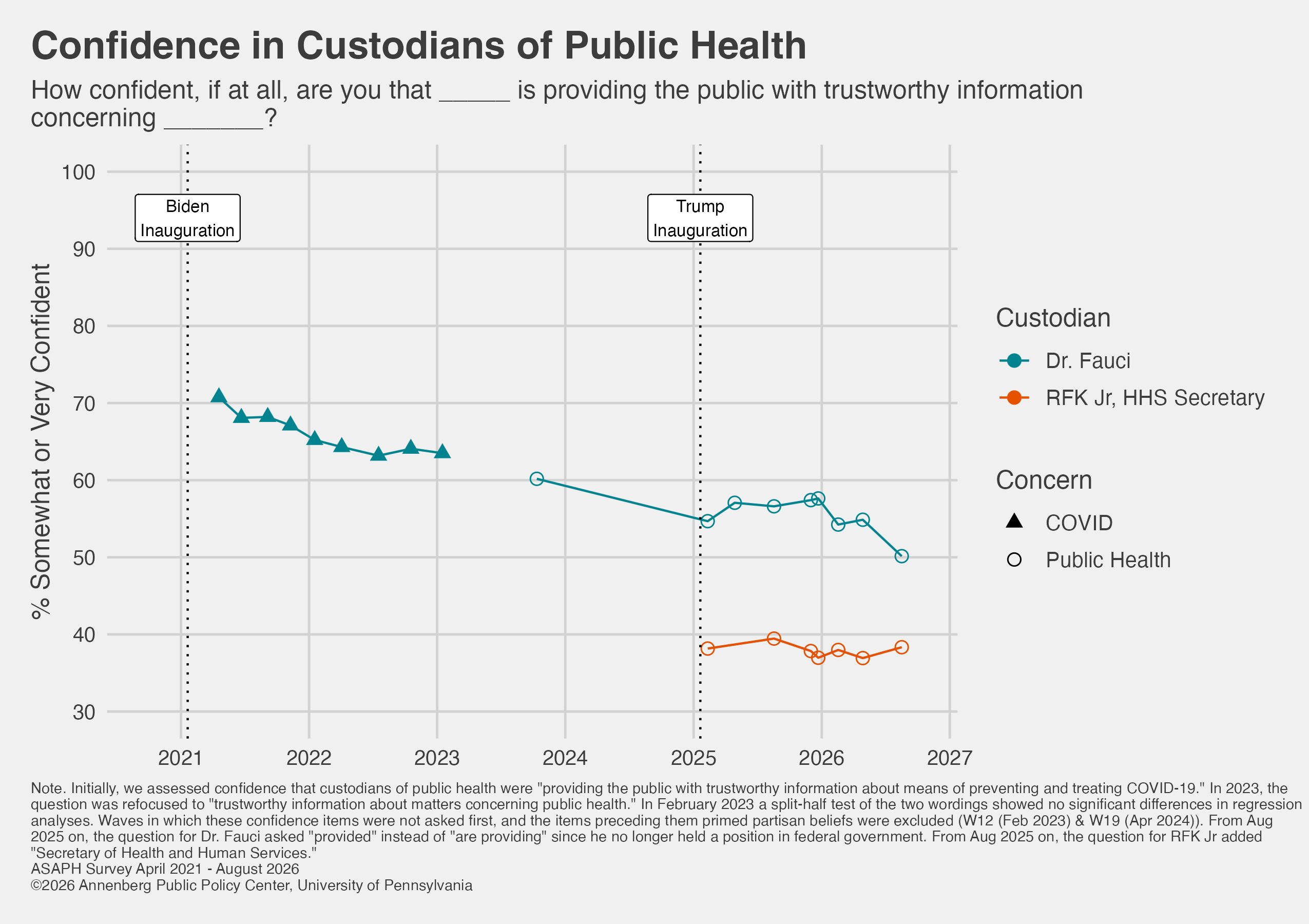
In the August survey of 1,904 empaneled U.S. adults, half (50%) say they are somewhat or very confident that Fauci provided the public with trustworthy information about matters concerning public health, a statistically significant decline of 5 percentage points from 55% in April 2026. Prior to April 2026, there had been no significant change in confidence in Fauci for over a year, with confidence fluctuating between 54% and 58% between February 2025 and April 2026.
By comparison, 38% of Americans in August 2026 say they are confident that Kennedy, the secretary of health and human services, is providing trustworthy information about public health, statistically unchanged from both April 2026 (37%) and February 2025 (38%). This leaves confidence in Fauci currently 12 percentage points higher than confidence in Kennedy, although the gap between them has narrowed since April 2026, when it was 18 points.
Data on confidence in Fauci from as far back as 2021 – when APPC first asked the question, but specifically about his guidance regarding Covid-19 – showed higher confidence levels, ranging from 71% to 63%. Fauci, head of NIAID since 1984, left government office at the end of 2022. By October 2023, 60% of Americans said they were confident that he was providing trustworthy information about matters concerning public health.
Confidence in healthcare providers remains high, but declines for health agencies
APPC survey data released last month shows that Americans’ confidence in their individual healthcare providers remains high, as compared with declining confidence in the major U.S. healthcare agencies, the U.S. Centers for Disease Control and Prevention (CDC), the Food and Drug Administration (FDA), and the National Institutes of Health (NIH).
The data, gathered as part of the same survey cited here, show that 87% of respondents are confident that their doctor, nurse, or other primary healthcare provider is providing trustworthy information about matters of public health, statistically unchanged from 88% in September 2024.
In contrast, in the August 2026 data, 61% express confidence in the CDC, 59% in the FDA, and 61% in the NIH, all of which declined significantly since September 2024. For additional details, see the news release: Public confidence in one’s own healthcare provider remains high.
About the survey
The latest Annenberg Science and Public Health (ASAPH) survey was conducted for the Annenberg Public Policy Center by SSRS, an independent research company. Interviews were conducted by web and telephone among a nationally representative probability sample drawn from the SSRS Opinion Panel. Data were weighted to represent the U.S. adult population.
The August 2026 survey, conducted August 4-17, 2026, among 1,904 U.S. adults, has an estimated margin of sampling error of ±3.2 percentage points at the 95% confidence level. The April 2026 survey was conducted April 14-28, 2026, among 1,639 U.S. adults, with an estimated margin of sampling error ±3.5 percentage points.
For additional information, download the topline and methodology report.
The policy center has been tracking the American public’s knowledge, beliefs, and behaviors regarding vaccination, Covid-19, flu, RSV, and other consequential health issues through its Annenberg Science and Public Health (ASAPH) survey and other national samples since April 2021. The ASAPH and other health surveys are conducted under the auspices of APPC’s Annenberg Health and Risk Communication Institute (AHRCI) by a team that includes Patrick E. Jamieson, director of APPC’s Annenberg Health and Risk Communication Institute, which oversees the health surveys, Ken Winneg, APPC’s managing director of survey research, and APPC research analyst Laura A. Gibson.
See other recent Annenberg health survey news releases:
- Confidence in healthcare providers: Public confidence in one’s own healthcare provider remains high (Aug. 31, 2026)
- Banning glyphosate: Bipartisan majorities in U.S. favor banning glyphosate (Aug. 20, 2026)
- Recommended vaccines during pregnancy: Most Americans are unsure which vaccines the CDC recommends during pregnancy (July 22, 2026)
- Fluoridation of drinking water: Americans split on fluoridation; opposition by MAHA supporters notable (June 11, 2026)
- Maternal health knowledge: Maternal health knowledge is strong, but gaps remain, survey finds (May 29, 2026)
The Annenberg Public Policy Center was established in 1993 to educate the public and policy makers about communication’s role in advancing public understanding of political, science, and health issues at the local, state, and federal levels.