PHILADELPHIA – While data from the Centers for Disease Control and Prevention (CDC) show that the total number of U.S. cases of three sexually transmitted infections (STIs) declined from 2022-24, infection rates remain 13% higher than a decade ago. CDC provisional data show more than 2.2 million U.S. cases of chlamydia, gonorrhea, and syphilis were reported in 2024.
Now, a nationally representative survey of empaneled adults from the Annenberg Public Policy Center (APPC) of the University of Pennsylvania finds that while most Americans understand how STIs spread, there are significant gaps in public knowledge about which infections can be prevented through vaccination.
In the Annenberg survey, conducted April 14-28, 2026, among 1,639 U.S. adults, nearly half of the respondents (47%) say that they or someone they know has ever been diagnosed with an STI. Most of those (72%) who know someone with an STI report knowing two or more people with it. (Download the topline.)
CDC data show how common these infections are. The CDC says the most common STI is human papillomavirus or HPV, and about 85% of people will get an HPV infection in their lifetime. The CDC also has estimated that on any given day in 2018, about 20% of the U.S. population – 1 in 5 people – had an STI.
Gaps in identifying what is sexually transmitted
A sexually transmitted infection, the CDC says, is “a virus, bacteria, fungus or parasite people can get through sexual contact.” There are dozens of STIs. Some are spread mainly by sexual contact (such as genital herpes, gonorrhea, syphilis, chlamydia, and HPV). Some are sometimes spread by sexual transmission (HIV (human immunodeficiency virus), mpox). And some can be spread sexually but are more often spread in other ways (Zika).
The survey finds that a large majority of respondents know that infections which spread mainly by sexual contact are sexually transmitted. In most cases, there has been no significant change in public knowledge from 2024 to 2026. The percentages who know that these diseases are sexually transmitted are:
- 95% Genital herpes
- 94% Gonorrhea
- 91% Syphilis
- 89% Chlamydia
- 75% HPV, a six-point increase from 2024
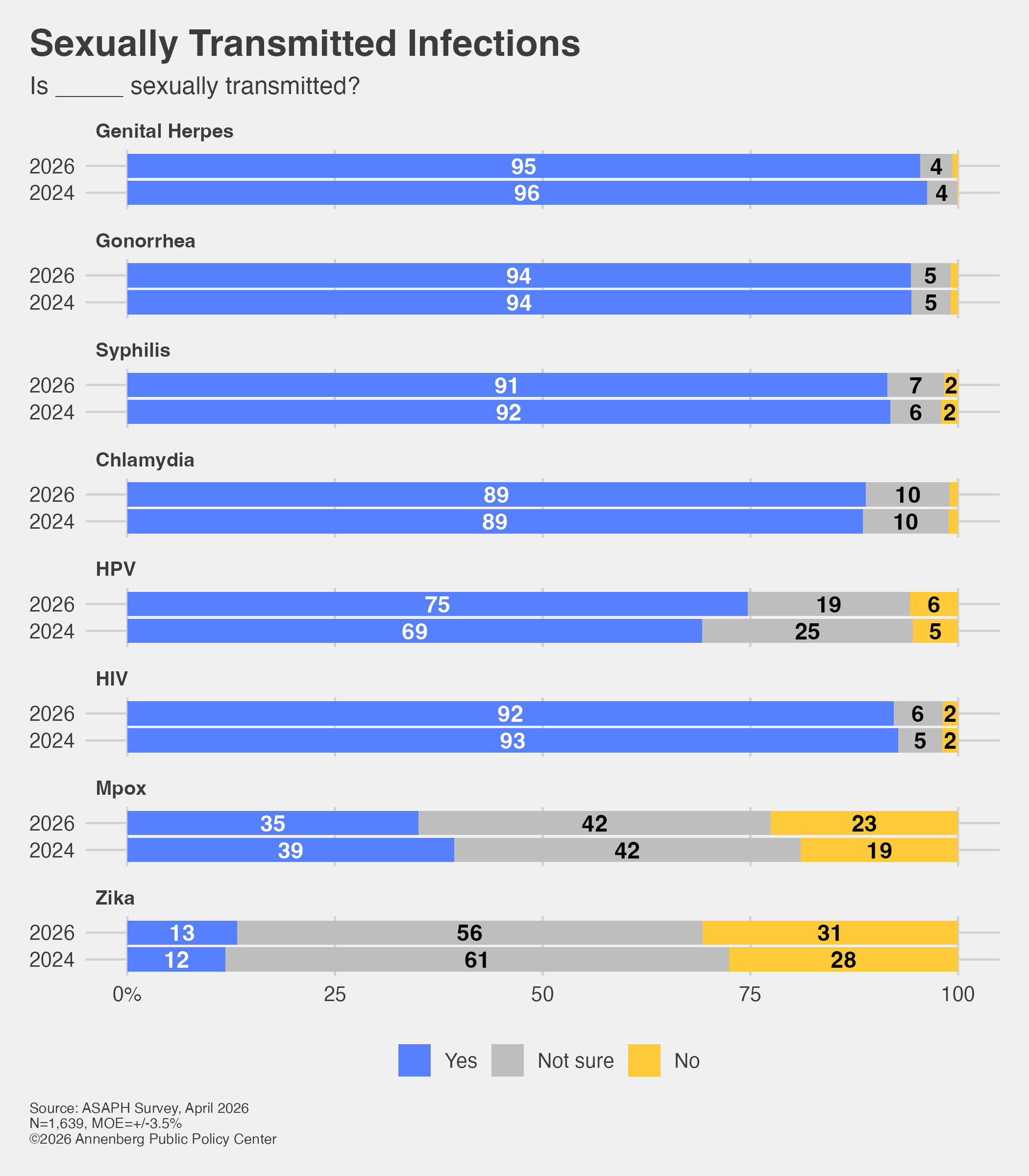
Although sexual transmission is just one of several ways that HIV can be spread, Americans are much more aware that it can be sexually transmitted than they are about mpox or Zika:
- 92% know that HIV can be sexually transmitted.
- 35% know that mpox, also called monkeypox, can be sexually transmitted.
- 13% know that Zika or ZIKV, which is primarily mosquito-borne, can also be sexually transmitted.
“Public understanding improves when accurate health information reaches people clearly and consistently,” said Ken Winneg, APPC’s managing director of survey research. “But these findings show continuing gaps in awareness about diseases which can be sexually transmitted such as HPV, mpox, and Zika.”
Broad awareness of STI transmission but misconceptions persist
The survey shows strong awareness of common ways that STIs are transmitted:
- 97% identify vaginal sex as a transmission route
- 94% anal sex
- 91% genital-to-genital contact
- 89% oral sex
In addition, 49% selected kissing, which is not a common route for STI transmission but may be a form of transmission of syphilis when a sore is present and may be a risk factor for oral gonorrhea. And 1 in 5 (20%) chose sitting on a toilet after someone with an STI sat on it. CDC guidance for a number of STIs (HIV, syphilis, and genital herpes, for instance) says that sitting on a toilet seat is not a form of transmission.
Public understanding is uneven around less common transmission pathways for HIV, in particular. While 92% recognize HIV as sexually transmitted, only 33% know it also can be transmitted by breastfeeding. According to the CDC, HIV can be transmitted during pregnancy, childbirth, or breastfeeding.Limited understanding of which diseases are vaccine-preventable
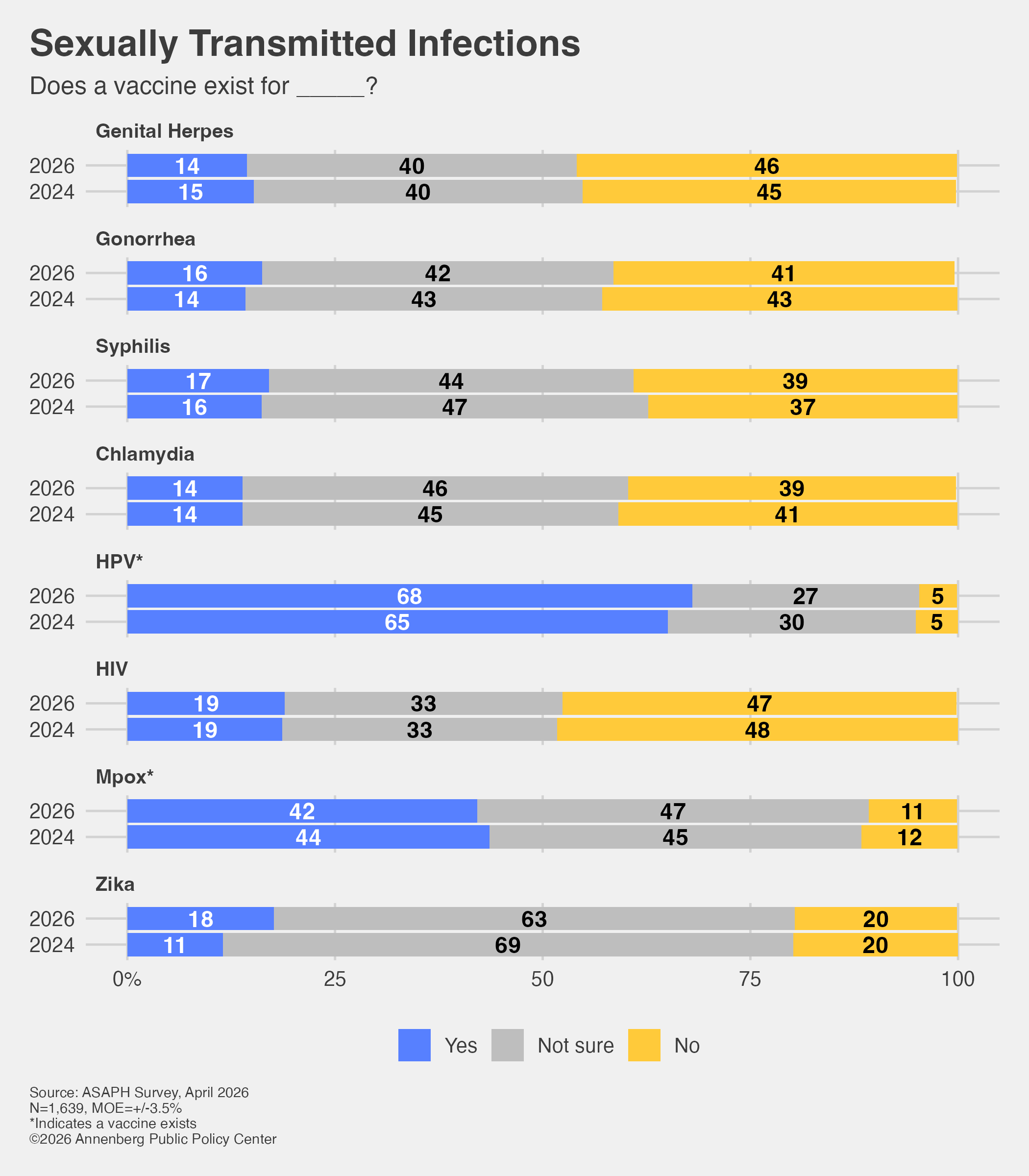
The public’s awareness of which diseases can be prevented with vaccines varies widely. For most of the diseases in our survey, a substantial part of the population says it does not know whether there is a vaccine for them. For the two diseases which may be prevented by vaccines:
- HPV: HPV vaccine awareness is highest, with 68% correctly identifying that a vaccine exists. The CDC reports that HPV vaccination can prevent more than 90% of HPV-related cancers.
- Mpox: Only 42% know a vaccine exists for mpox, despite CDC recommendations that at-risk groups be vaccinated. The vaccine can help prevent an mpox infection if given in advance and can mitigate it if given shortly after exposure.
For some other infections, most Americans are unaware that no vaccine exists:
- Genital herpes: 54% are unsure or incorrectly think a vaccine exists
- Gonorrhea: 58% unsure or incorrect
- Syphilis: 61% unsure or incorrect
- Chlamydia: 60% unsure or incorrect
- HIV: 52% are unsure or incorrect
- Zika: 81% unsure or incorrect
Encouraging areas of public knowledge – and some misconceptions
The survey highlights the public’s strong knowledge of some basic facts about STIs:
- 93% know STIs can spread even without symptoms;
- 87% reject the myth that only people with many sexual partners get STIs;
- 83% know that HIV medications can control disease progression, a decline from 2024, when 87% knew this.
- But only 45% know that most people in the United States who have HIV do not develop AIDS.
- 80% know STIs can be passed from a pregnant person to their baby
- 70% know that HPV can lead to cancer in women
- But 14% also incorrectly think the vaccine leads teens to engage in risky sexual behavior, an increase from 10% who said they believed this in 2024. It does not.
“HPV vaccination is important for preventing cancers caused by HPV,” said Laura A. Gibson, an APPC research analyst. “The increase in awareness that HPV is sexually transmitted is a positive development, but it is concerning to see a similar increase in the incorrect belief that the HPV vaccine leads teens to engage in risky sexual behavior.”
Syphilis: Rising rates underscore importance of public understanding
The survey findings come as syphilis continues to pose a major public health challenge in the United States. According to the CDC’s latest provisional surveillance data, there were more than 190,000 reported syphilis cases in 2024, and the national syphilis rate reached 55.9 cases per 100,000 people. While overall syphilis cases declined about 9% from 2023 levels, congenital syphilis — when the infection is passed from a pregnant person to a baby — increased for the 12th consecutive year, with nearly 4,000 reported cases in 2024. The CDC reports congenital syphilis rates are now nearly 700% higher than a decade ago.
The current survey suggests that many Americans remain uncertain about how syphilis can be prevented and treated. Over 9 out of 10 people (91%) correctly identify syphilis as sexually transmitted but more than half of U.S. adults (61%) are either unsure whether there is a vaccine against syphilis (44%) or say a vaccine exists (17%). It does not, according to the Mayo Clinic.
“Too many Americans remain uncertain about basic facts surrounding syphilis, including how it is prevented and treated,” said Patrick E. Jamieson, director of the policy center’s Annenberg Health and Risk Communication Institute, which oversees the survey. “Those knowledge gaps can have serious public health consequences.”
About 4 in 5 respondents know how to protect against getting syphilis: 80% correctly identify abstinence and 78% correctly identify condom use as ways to protect against syphilis.
The CDC recommends regular STI screening, condom use, prompt antibiotic treatment, and prenatal testing during pregnancy to reduce transmission and prevent congenital syphilis.
Additional context on STI curability
Three bacterial infections – gonorrhea, chlamydia, and syphilis – can be cured with appropriate antibiotics, according to the CDC, but you can be re-infected. Three viral STIs – HPV, genital herpes, and HIV – cannot be cured. Although HPV cannot be cured, in 9 out of 10 cases, “HPV goes away on its own within two years without health problems,” the CDC says. When HPV does not resolve, it can cause cervical and other cancers. Genital herpes is a lifelong infection and has no cure, according to the CDC, but there are medicines that can “prevent or shorten outbreaks.” HIV has no cure but can be managed with medication.
Most patients with mpox who are not severely immunocompromised “will recover with supportive care and pain control only,” the CDC says. Zika has no specific cure but typically resolves on its own, although in rare cases it can cause severe disease affecting the brain.
APPC’s ASAPH survey
The findings come from Wave 29 of the Annenberg Science and Public Health survey (ASAPH), conducted April 14-28, 2026, among 1,639 U.S. adults. It was conducted for the policy center by SSRS, an independent research company. The nationally representative probability-based panel, which was first empaneled in April 2021, has a margin of sampling error of ± 3.5 percentage points at the 95% confidence level. All figures are rounded to the nearest whole number and may not add to 100%. Combined subcategories may not add to totals in the topline and text due to rounding.
Download the topline and methodology report.
The policy center has been tracking the American public’s knowledge, beliefs, and behaviors regarding vaccination, Covid-19, flu, RSV, and other consequential health issues through the Annenberg Science and Public Health (ASAPH) survey and separate national samples since April 2021. The ASAPH survey is conducted under the auspices of APPC’s Annenberg Health and Risk Communication Institute (AHRCI) by a team that includes Ken Winneg, managing director of survey research; research analysts Laura A. Gibson and Shawn Patterson Jr.; and Patrick E. Jamieson, director of the Annenberg Health and Risk Communication Institute.
See other recent Annenberg health survey news releases:
- How the public views scientists: Scientists esteemed by public, with vaccine scientists seen as similar to scientists in general (April 27, 2026)
- Alcohol and cancer: Awareness of alcohol-cancer link holds steady despite omission in new U.S. dietary guidelines (March 19, 2026)
- Trust in health leaders: Stark divide: Americans more confident in career scientists at U.S. health agencies than leaders (March 5, 2026)
- RSV: Most would recommend RSV immunizations for infants, older adults, and during pregnancy (Jan. 21, 2026)
- Shared decision-making: CDC urges “shared decision-making” on some childhood vaccines; many unclear about what that means (Jan. 5, 2026)