Most Americans are unaware or unsure of which vaccines the Centers for Disease Control and Prevention (CDC) recommends during pregnancy, according to a nationally representative survey of U.S. adults by the Annenberg Public Policy Center (APPC) of the University of Pennsylvania.
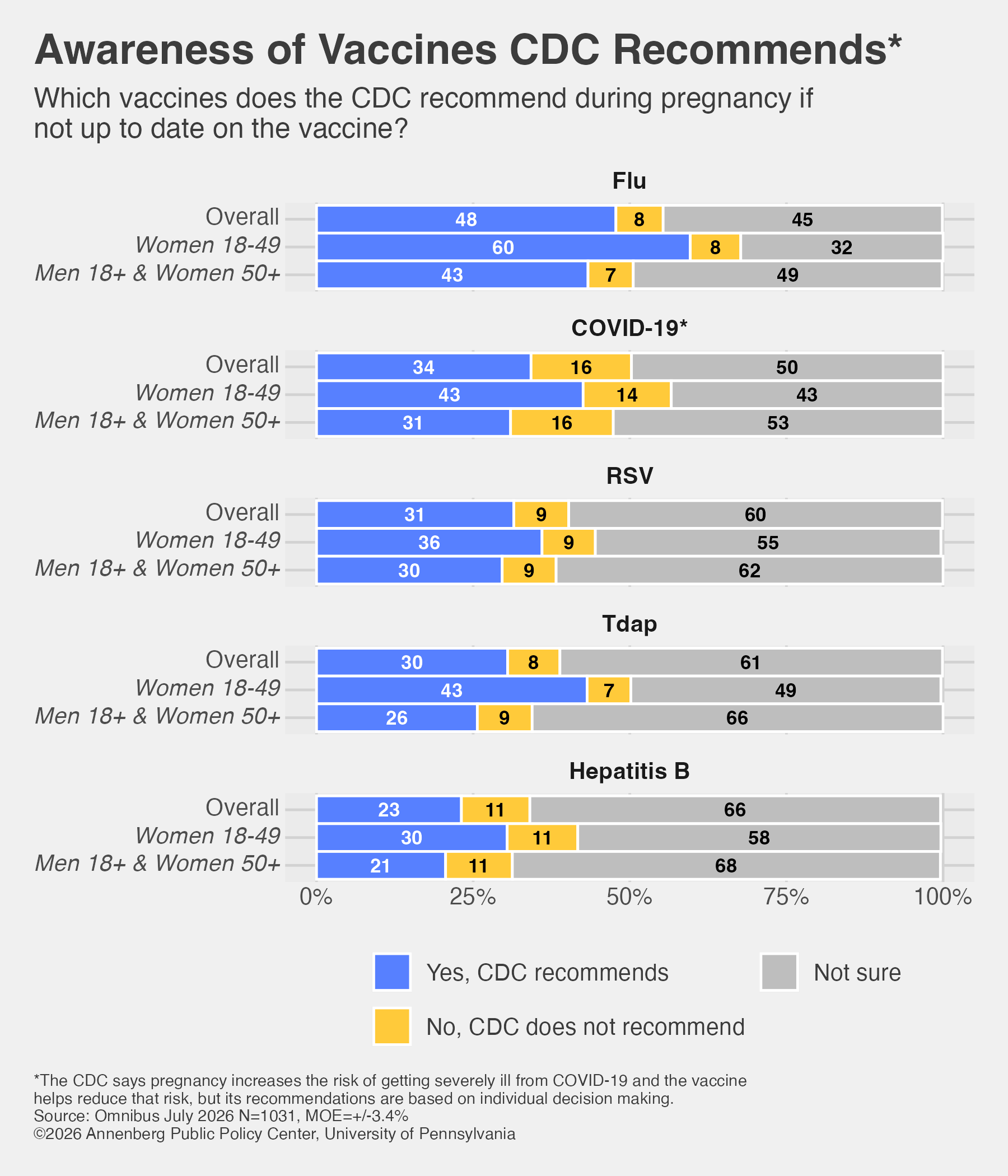
Almost half of those surveyed know that the CDC recommends getting the seasonal flu vaccine during pregnancy, while less than a third know that the CDC recommends the Tdap (tetanus, diphtheria, and pertussis), RSV (respiratory syncytial virus), and hepatitis B vaccines if one is not up to date on these vaccinations.
For the Covid-19 vaccine, over half of those surveyed do not know whether the CDC recommends it during pregnancy. While the CDC says that the vaccine helps reduce the risk for severe illness from Covid-19, it does not explicitly say the vaccine is recommended. Instead, the CDC says its Covid-19 vaccine recommendations are “now based on individual decision making, which emphasizes considering the benefits and risks of vaccination.”
Women of childbearing age (ages 18-49) are significantly more knowledgeable than other adult groups about most of the CDC’s pregnancy vaccine recommendations, although many in this group are also not sure what is recommended.
Uncertainty is a dominant finding in this survey. For each of four vaccines the CDC recommends during pregnancy, at least 45% of respondents are not sure whether the CDC recommends it.
The findings come from an APPC survey conducted on the research company SSRS’s Opinion Panel Omnibus platform among 1,031 U.S. adults from July 1-5, 2026. For further details, download the topline or see the end of this release.
“Our findings suggest that many Americans do not know which vaccines are recommended during pregnancy,” said Ken Winneg, APPC’s managing director of survey research. “The encouraging news is that relatively few people think that the CDC recommends vaccines that are not advised during pregnancy. The challenge is overcoming the widespread uncertainty over what the CDC does recommend.”
CDC recommendations during pregnancy
According to CDC guidance, four vaccines routinely recommended during pregnancy include:
- Seasonal influenza vaccine during flu season.
- Tdap vaccine during every pregnancy, preferably between 27 and 36 weeks’ gestation.
- RSV vaccine during weeks 32-36, administered during RSV season, which is September through January in most of the continental United States. Additional doses are not recommended during subsequent pregnancies.
- Hepatitis B vaccination for individuals who have not already been vaccinated,
The CDC says: “Covid-19 vaccination offers the greatest benefit if you are at higher risk for severe illness, including if you are pregnant. Pregnancy increases your risk of becoming very sick from Covid-19.” It adds that if you get sick with Covid-19 during pregnancy, you are at increased risk of complications that can affect your health and the health of your baby. The CDC recommends that Covid-19 vaccination decisions be made through individual decision making after considering the benefits and risks.
Other medical professionals more clearly back the Covid-19 vaccine during pregnancy. The American College of Obstetricians and Gynecologists (ACOG) strongly recommends that pregnant individuals be vaccinated against Covid-19 and “continues to recommend that all pregnant and lactating individuals receive an updated COVID-19 vaccine or ‘booster.’”
Awareness of recommended vaccines is low
Survey respondents were asked whether the CDC recommends each of eight vaccines during pregnancy. In addition to the five vaccines noted above, respondents were asked about three vaccines the CDC does not recommend during pregnancy: MMR or measles, mumps and rubella; chickenpox or varicella; and human papillomavirus or HPV.
Among U.S. adults overall, about a quarter to less than half of adults correctly identify any of the CDC-recommended vaccines, with the fewest (23%) knowing that the CDC recommends the hepatitis B vaccine during pregnancy and the most (48%) knowing the seasonal flu vaccine.
With the exception of RSV, women age 18 to 49 are significantly more likely than other groups (all adult men and women over 49 years old) to correctly identify all of the CDC-recommended vaccines. Among women 18 to 49, the vaccine least known to be recommended during pregnancy is the hepatitis B vaccine (30%) and the most known is the seasonal flu vaccine (60%).
Uncertainty dominates
For most of the vaccines, the most common response to whether the CDC recommends it during pregnancy is “not sure.” For each of the four recommended vaccines and the Covid-19 vaccine, from 45% to 66% of the overall adult population was not sure whether these were recommended. Among women of childbearing age, from 32% to 58% were not sure for each of the vaccines.
Few incorrectly think non-recommended vaccines should be taken
Current CDC guidance advises against administering the MMR and chickenpox vaccines during pregnancy because they are live-virus vaccines. The MMR and chickenpox vaccines should be given only before or after pregnancy. HPV vaccination is not recommended during pregnancy and should be delayed until after pregnancy if needed.
The survey found that relatively small groups of people incorrectly think that CDC recommends these vaccines:
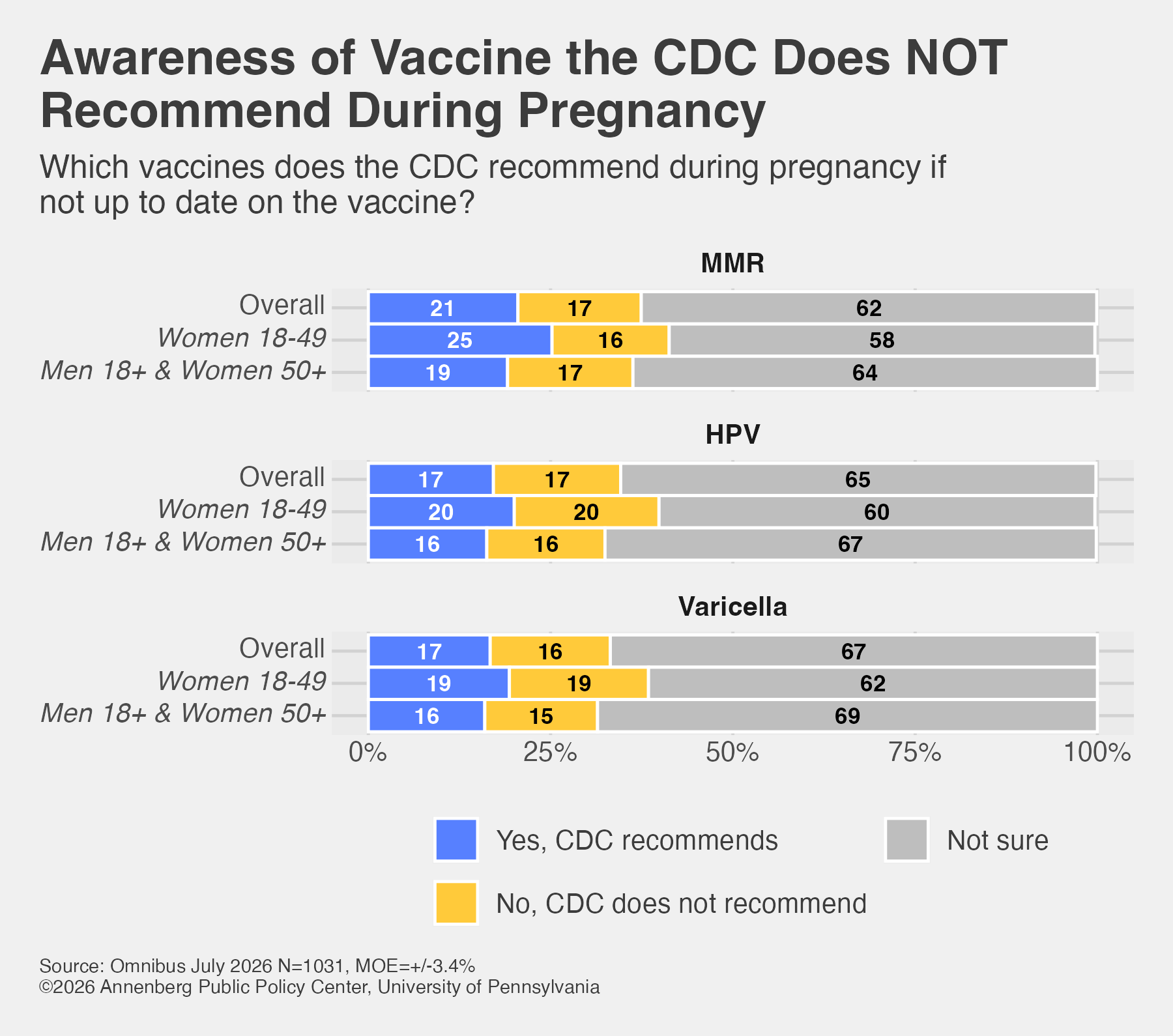
- 21% say the CDC recommends the MMR vaccine during pregnancy.
- 17% say the CDC recommends human papillomavirus (HPV) vaccination.
- 17% say the CDC recommends chickenpox (varicella) vaccination.
Women of childbearing age are no more likely than others to incorrectly identify these vaccines as recommended. For the HPV vaccine, for example, 20% of women 18-49 years old incorrectly say it is recommended during pregnancy, compared with 16% of others, which is not a statistically significant difference.
For all three of these vaccines, the bigger issue is that a majority of respondents are not sure whether the CDC recommends that they should or should not be taken during pregnancy.
“Many Americans routinely get their immunizations from their primary healthcare providers or at local pharmacies,” said Patrick E. Jamieson, director of APPC’s Annenberg Health and Risk Communication Institute, which oversees the health surveys. “It is critical that those professionals pay special attention to vaccine recommendations for recipients who are pregnant.”
Survey methodology
The data reported here come from a survey conducted for the Annenberg Public Policy Center by SSRS, an independent research company. The findings come from a nationally representative probability sample drawn from SSRS’s Opinion Panel, conducted July 1-5, 2026, among 1,031 U.S. adults. It has a margin of sampling error of ± 3.4 percentage points at the 95% confidence level. All figures are rounded to the nearest whole number and may not add to 100%. Combined subcategories may not add to totals in the topline and text due to rounding.
Download the topline and methodology report.
The policy center has been tracking the American public’s knowledge, beliefs, and behaviors regarding vaccination, Covid-19, flu, RSV, and other consequential health issues through its Annenberg Science and Public Health (ASAPH) survey and other national samples such as this one since April 2021. The ASAPH and other health surveys are conducted under the auspices of APPC’s Annenberg Health and Risk Communication Institute (AHRCI) by a team that includes Winneg, Jamieson, and APPC research analysts Laura A. Gibson and Shawn Patterson, Jr.
See other recent Annenberg health survey news releases:
- Fluoridation of drinking water: Americans split on fluoridation; opposition by MAHA supporters notable (June 11, 2026)
- Maternal health knowledge: Maternal health knowledge is strong, but gaps remain, survey finds (May 29, 2026)
- Uncertainty on STI Vaccines: Survey highlights persistent uncertainty on STI vaccines (May 21, 2026)
- How the public views scientists: Scientists esteemed by public, with vaccine scientists seen as similar to scientists in general (April 27, 2026)
- Alcohol and cancer: Awareness of alcohol-cancer link holds steady despite omission in new U.S. dietary guidelines (March 19, 2026)
The Annenberg Public Policy Center was established in 1993 to educate the public and policy makers about communication’s role in advancing public understanding of political, science, and health issues at the local, state, and federal levels.