As the debate over the value of adding fluoride to public drinking water percolates in communities across the nation, a new nationally representative survey from the Annenberg Public Policy Center (APPC) of the University of Pennsylvania finds Americans sharply divided over the use of fluoride in public drinking water.
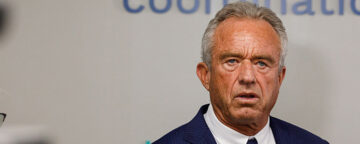
The new findings come amid renewed attention to fluoridation following critical remarks by Health and Human Services Secretary Robert F. Kennedy Jr., legal and regulatory developments, and renewed scientific debate over the health effects of different levels of fluoride exposure.
Fluoride, a mineral that naturally occurs in water and food, is commonly added to dental products such as toothpaste and mouthwash. Most major U.S. cities fluoridate their drinking water. But concerns have arisen that for some pregnant women and children, “the combined total intake of fluoride may exceed safe amounts.”
For decades, the Centers for Disease Control and Prevention (CDC) has promoted community water fluoridation as a safe, cost-effective way to reduce tooth decay, calling it a major contributor to declining cavity rates in the 20th century. The agency has said that fluoridated water saves billions annually in avoided dental treatment costs.
However, on April 6, 2025, the U.S. Environmental Protection Agency (EPA) announced that it will be reviewing “new science on fluoride in drinking water.” That day, RFK Jr. announced that he planned to “tell the Centers for Disease Control and Prevention (CDC) to stop recommending fluoridation in communities nationwide” and “said he’s assembling a task force of health experts to study the issue and make new recommendations.” In a news story, the Associated Press noted that “Kennedy cannot order communities to stop fluoridation, but he can direct the CDC to stop recommending it and work with the EPA to change the allowed amount.”
Highlights
APPC’s Annenberg Science and Public Health Survey (ASAPH) survey, conducted April 14-28, 2026, among 1,639 U.S. adults, finds that:
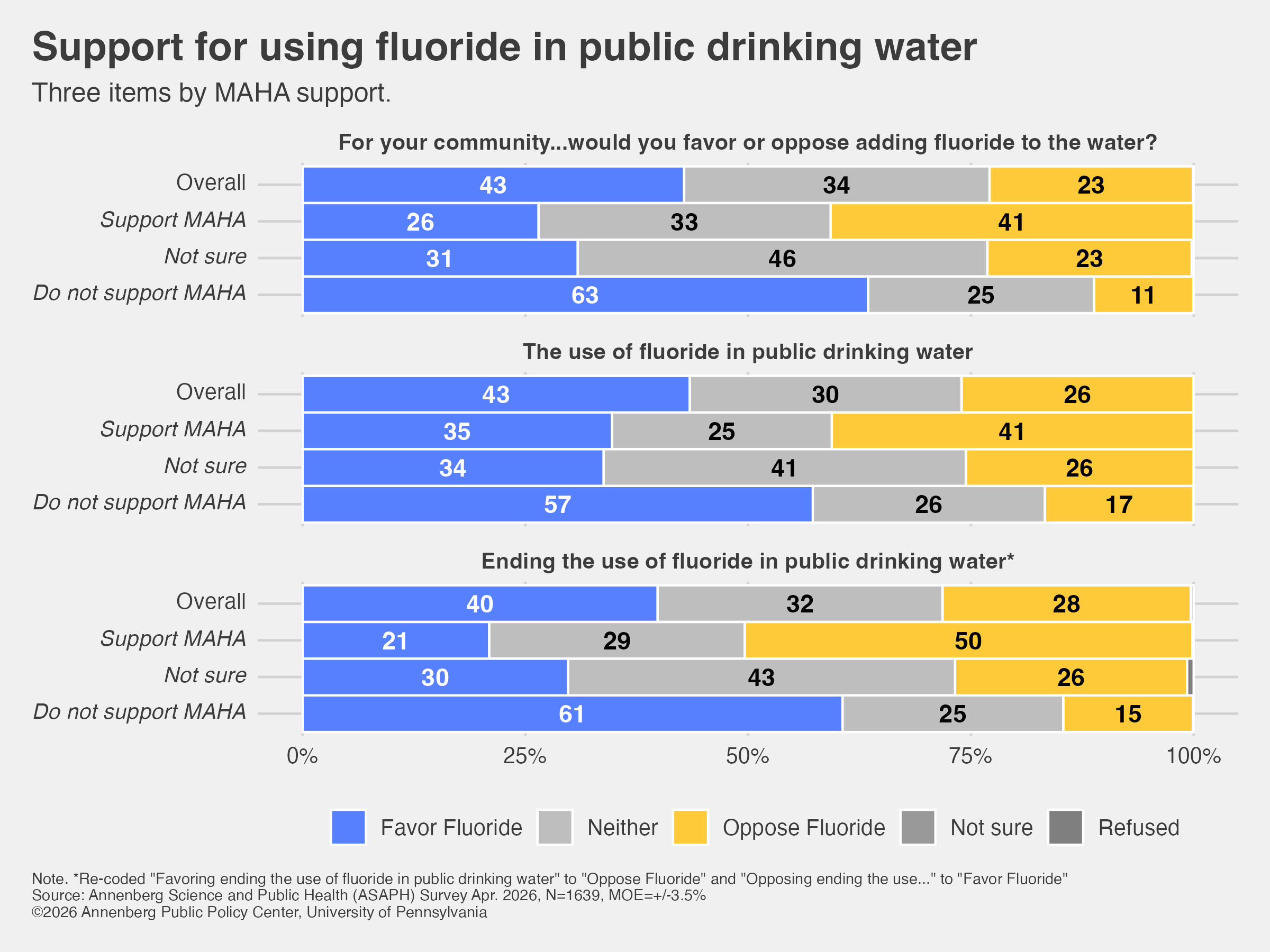
- 43% of U.S. adults favor the use of fluoride in public drinking water while 26% oppose it and 30% neither favor nor oppose it.
- When asked whether they’d favor or oppose fluoridation of the drinking water in their community, if the community was deciding whether to do so, 43% would favor fluoridation and 23% would oppose it, with 34% saying neither favor nor oppose.
- Self-identified supporters of the MAHA movement are more likely to oppose than favor (41% vs. 26%) adding fluoride to their community’s drinking water. Among those who do not support MAHA, most would favor rather than oppose fluoridation (63% vs. 11%).
- Americans are much more confident that the American Dental Association, or ADA, is providing trustworthy information about the health effects of fluoride in drinking water than HHS Secretary Robert F. Kennedy Jr. (74% to 34%). Among MAHA supporters, there is greater confidence in Kennedy (74%) but also confidence in the ADA (68%).
About a quarter (26%) of respondents in our nationally representative survey sample consider themselves supporters of the MAHA movement, or Make America Healthy Again, the political slogan and health initiative first associated with RFK Jr.’s 2024 presidential campaign. Another 40% do not consider themselves MAHA supporters and 33% are not sure. For this analysis we look at responses from the total population, self-identified MAHA supporters, and self-identified non-supporters of MAHA. (Download the topline.)
“Americans are divided on fluoridation, but what stands out is that supporters of the Make America Healthy Again movement are notably more skeptical,” said Patrick E. Jamieson, director of APPC’s Annenberg Health and Risk Communication Institute, which oversees this survey. “Even so, there is widespread trust in the American Dental Association, which reports that 80 years of research shows community water fluoridation to be safe and ‘the single most effective public health measure to prevent tooth decay.’”
Familiarity with use of fluoride in U.S. water supplies
Though fluoride has been part of water supplies across the United States for decades, many Americans say they are not familiar with this. Nearly half of U.S. adults (46%) say they are not familiar with the use of fluoride in U.S. water supplies, while 54% say they are somewhat (45%) or very familiar (9%) with it. Four in 10 (41%) people are not sure whether their community’s public water supply is fluoridated, while about half (48%) say their community’s is.
Perceived effects of water fluoridation on public health
By more than a 2-1 margin, Americans say the use of fluoride in public water supplies has an overall positive (42%) rather than a negative (17%) effect on public health, while 6% say it has no effect. Yet over a third (35%) are not sure, which could reflect a lack of familiarity with the use of fluoride in water supplies.
MAHA supporters are four times more likely than non-supporters to say fluoride in the water supplies has a negative effect on public health (30% vs. 7%). Non-MAHA supporters are twice as likely as MAHA supporters to say water fluoridation has a positive effect on public health (61% vs 30%).
“Although MAHA supporters favor public water fluoridation less than other groups, MAHA supporters are surprisingly equally likely to say fluoride has a positive effect on public health as a negative effect – 30% in both cases – reflecting their uncertainty about its effects,” said Laura A. Gibson, an APPC research analyst.
Views on fluoridating public water supplies
Asked to choose which among a variety of views on fluoridating public water supplies is closest to their own, in the overall population more people support community fluoridation (43%) than oppose it (22%), while a third (34%) don’t have an opinion:
- Among supporters of fluoridation, there is a close divide between those who support fluoridation as a community decision (23%) and those who think communities should be required to fluoridate public water (20%).
- Among opponents of fluoridation, there is an even split between those who think all communities should be banned from fluoridating (11%) and those who oppose fluoridation but think the decision should be left up to each community (11%).
MAHA supporters are more likely to oppose fluoridation, while non-supporters are more clearly in favor of fluoridation:
- Among MAHA supporters, 21% oppose fluoridation and think communities should be banned from doing so, and 18% oppose it but agree the decision should be left up to the community.
- Among non-supporters of MAHA, 33% express support for mandated fluoridation and 28% say they are supportive of fluoridation but think the decision to do so should be left up to each community.
Policy positions on ending the use of fluoride in public water supplies
A plurality of respondents oppose a policy to end the use of fluoride in public drinking water (40% vs. 28% favoring). A third (32%) indicate they neither favor nor oppose. MAHA supporters are over three times as likely to say they favor ending the use of fluoride in drinking water than non-supporters of MAHA (50% vs. 15%).
Who is more trustworthy on fluoridating water: RFK Jr. or the ADA?
Overall, the American public is much more confident that the American Dental Association (ADA) is providing the public with trustworthy information about the health effects of fluoride in drinking water than HHS Secretary Robert F. Kennedy Jr.
The survey finds that two-thirds of U.S. adults (65%) are not confident Kennedy is providing trustworthy information on fluoride in drinking water, with 42% who are “not at all confident” and 23% who are “not too confident.” Only a third of adults (34%) are confident in Kennedy, with 8% who are “very confident” and 27% “somewhat confident.”
By contrast, three-quarters of U.S. adults (74%) say they are confident in the ADA, with 28% who are very confident and 45% who are somewhat confident. A quarter of those surveyed (26%) are not confident in the ADA, with 9% who are not at all confident and 17% who are not too confident.
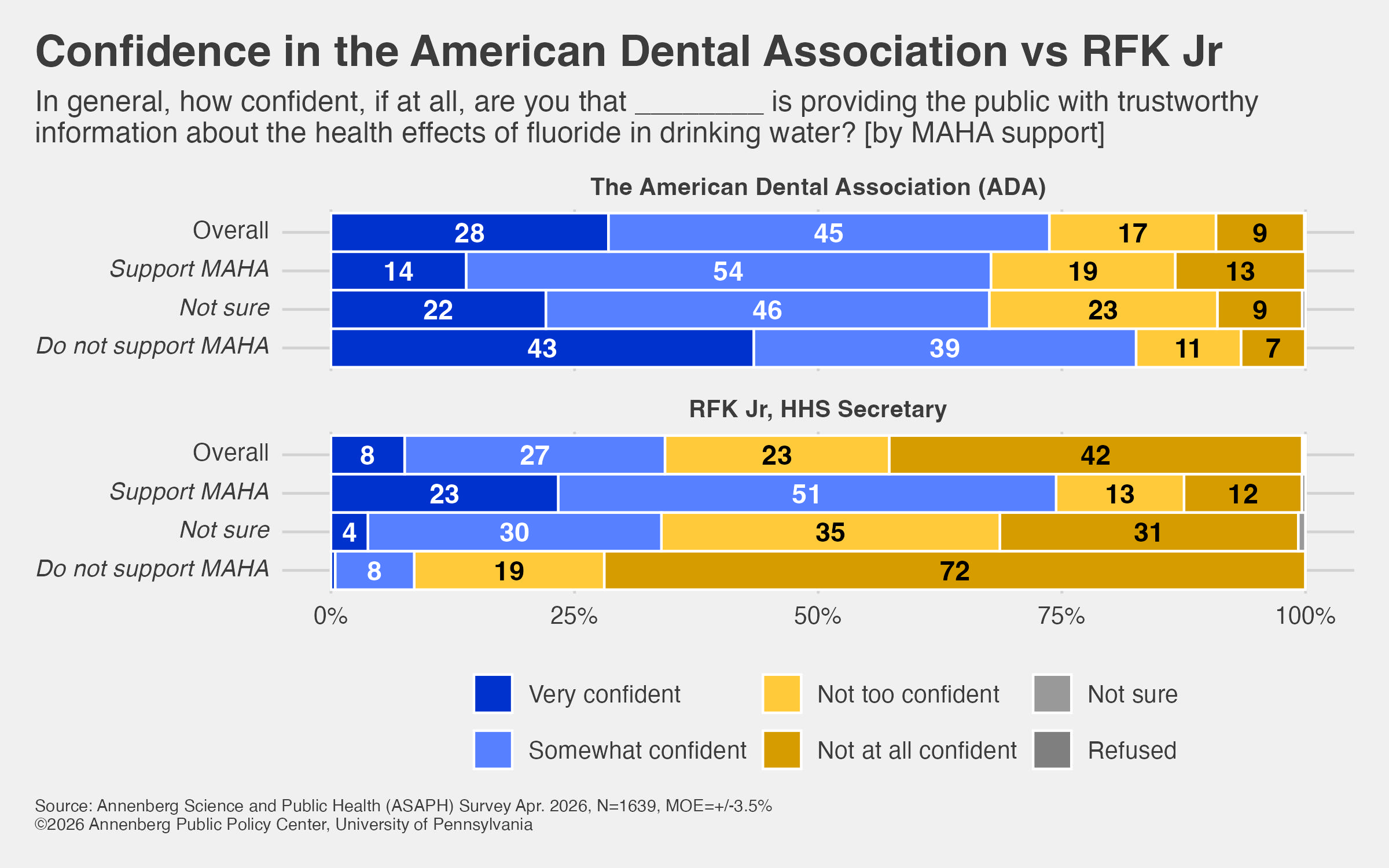
Among the subgroup of MAHA supporters, confidence in Kennedy is much higher. Three in four (74%) MAHA supporters are very (23%) or somewhat (51%) confident in him as a trustworthy source of information about fluoride’s health effects, while only 9% of non-MAHA supporters say they are confident in the health secretary.
The general public and non-supporters of MAHA show greater levels of confidence in the ADA than Kennedy to provide trustworthy information about the health effects of fluoride in drinking water. While most MAHA supporters also express confidence in the ADA (68%), more voice confidence in Kennedy (74%) – and people who are not MAHA supporters have even greater confidence in the ADA (83%).
“When it comes to fluoride, Americans place considerably more trust in the American Dental Association than in Health Secretary Robert F. Kennedy Jr.,” said Ken Winneg, APPC’s managing director of survey research. “These overall numbers obscure the finding that many MAHA supporters express confidence in both sources, reflecting how differently Americans evaluate health information depending on their broader views.”
APPC’s ASAPH survey
The findings come from Wave 29 of the Annenberg Science and Public Health survey (ASAPH), conducted April 14-28, 2026, among 1,639 U.S. adults. It was conducted for the policy center by SSRS, an independent research company. The nationally representative probability-based panel, first empaneled in April 2021, has a margin of sampling error of ± 3.5 percentage points at the 95% confidence level. All figures are rounded to the nearest whole number and may not add to 100%. Combined subcategories may not add to totals in the topline and text due to rounding.
Download the topline and methodology report.
The policy center has been tracking the American public’s knowledge, beliefs, and behaviors regarding vaccination, Covid-19, flu, RSV, and other consequential health issues through the Annenberg Science and Public Health (ASAPH) survey and separate national samples since April 2021. The ASAPH survey is conducted under the auspices of APPC’s Annenberg Health and Risk Communication Institute (AHRCI) by a team that includes Ken Winneg, managing director of survey research; research analysts Laura A. Gibson and Shawn Patterson Jr.; and Patrick E. Jamieson, director of the Annenberg Health and Risk Communication Institute.
See other recent Annenberg health survey news releases:
- Maternal health knowledge: Maternal health knowledge is strong but gaps remain, survey finds (May 29, 2026)
- Uncertainty on STI Vaccines: Survey highlights persistent uncertainty on STI vaccines (May 21, 2026)
- How the public views scientists: Scientists esteemed by public, with vaccine scientists seen as similar to scientists in general (April 27, 2026)
- Alcohol and cancer: Awareness of alcohol-cancer link holds steady despite omission in new U.S. dietary guidelines (March 19, 2026)
- Trust in health leaders: Stark divide: Americans more confident in career scientists at U.S. health agencies than leaders (March 5, 2026)
The Annenberg Public Policy Center was established in 1993 to educate the public and policy makers about communication’s role in advancing public understanding of political, science, and health issues at the local, state, and federal levels. Connect with us on Facebook, X, Instagram, and Bluesky.