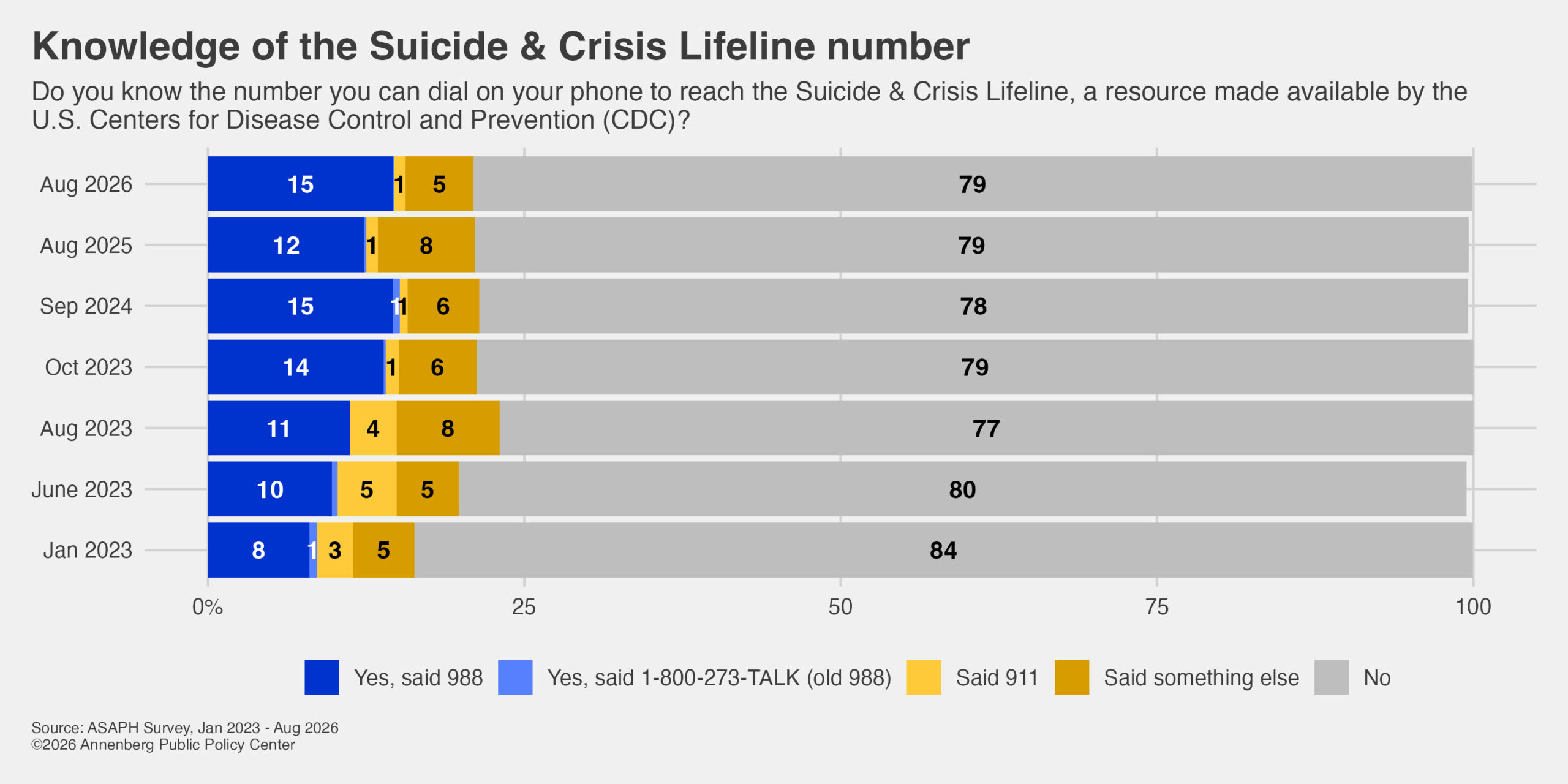
After the 988 Suicide & Crisis Lifeline number was introduced in July 2022, national survey data from the Annenberg Public Policy Center show that public recall of the number grew slowly in 2023. But awareness has stayed steady since October 2023 when it hit 14%. Just 15% of U.S. adults are familiar with it, as of August 2026.
Those 15% of respondents reported both that they knew the number and, when asked in an open-ended format, said the number was 988. The number who inaccurately reported that the number was 911 (the nationwide emergency phone number) stayed at 1% in August 2026.
“The 988 helpline saves lives but only if those in need know the number,” said Patrick E. Jamieson, Director of the Annenberg Health and Risk Communication Inst. at APPC. “When 988 is as readily recalled as 911, the nation will have cause to celebrate.”
Significant differences in awareness of the number were observed across different education levels and race/ethnicities. Only 8% of respondents with a high school education or less schooling could correctly recall the number, less than all of the other education levels (16% of those with some college education and 19% of those with either a college degree or more schooling). Only 9% of Hispanic respondents could correctly recall the number, compared to 16% of White Non-Hispanic respondents. (Other race/ethnicity groups were not different from either of those groups.) There were no significant differences by age or gender.
The survey data come from the 30th wave of the Annenberg Science and Public Health (ASAPH) Knowledge Survey, a nationally representative panel of 1,904 U.S. adults conducted for the Annenberg Public Policy Center by SSRS, an independent market research company. Most have been empaneled since April 2021. To account for attrition, small replenishment samples have been added over time using a random probability sampling design. The most recent replenishment, in June 2026, added 328 respondents to the sample. This wave of the ASAPH survey was fielded Aug. 4-17, 2026. The margin of sampling error (MOE) for the full sample is ± 3.2 percentage points at the 95% confidence level. Data were weighted to represent the U.S. adult population.
Download the topline and the methods report.
The Annenberg Public Policy Center has been tracking the American public’s knowledge, beliefs, and behaviors regarding vaccination, Covid-19, flu, RSV, and other consequential health issues through its Annenberg Science and Public Health (ASAPH) survey and other national samples since April 2021. The ASAPH and other health surveys are conducted under the auspices of APPC’s Annenberg Health and Risk Communication Institute (AHRCI) by a team that includes Patrick E. Jamieson, director of APPC’s Annenberg Health and Risk Communication Institute, which oversees the health surveys; Ken Winneg, APPC’s managing director of survey research; research analyst Shawn Patterson Jr; and APPC research analyst Laura A. Gibson.
See other recent Annenberg health survey news releases:
- Climate change and illness: In hottest summer on record, 2 in 3 Americans say climate change is increasing heat-related illnesses (Sept. 17, 2026)
- Controlling mosquitoes: Most Americans know how to control mosquitoes; Many unsure how to use insect repellent. (Sept. 10, 2026)
- Confidence in public health officials: Public confidence in Fauci declines since spring, but still exceeds RFK Jr. (Sept. 9, 2026)
- Confidence in healthcare providers: Public confidence in one’s own healthcare provider remains high (Aug. 31, 2026)
- Banning glyphosate: Bipartisan majorities in U.S. favor banning glyphosate (Aug. 20, 2026)
The Annenberg Public Policy Center was established in 1993 to educate the public and policy makers about communication’s role in advancing public understanding of political, science, and health issues at the local, state, and federal levels.