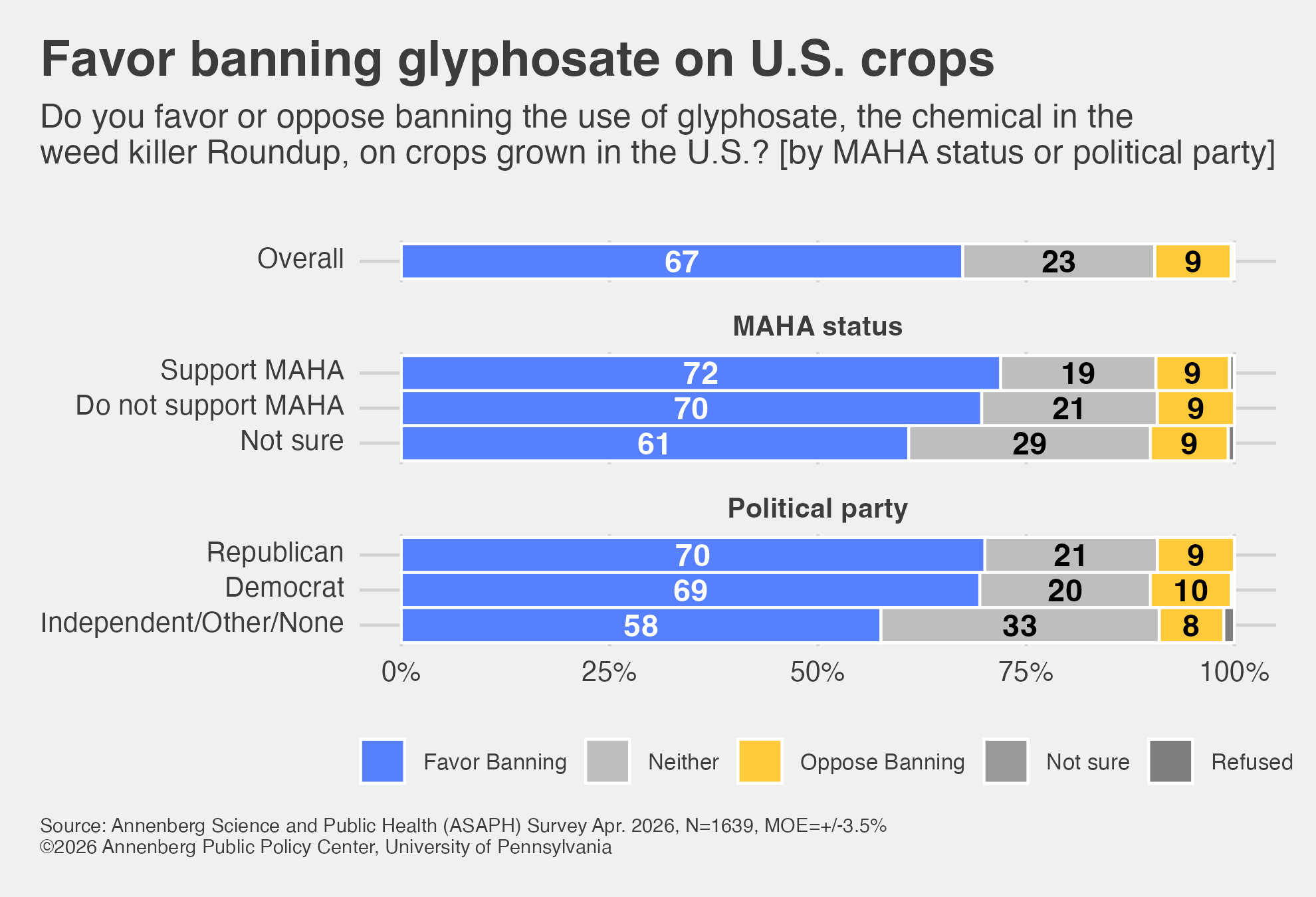
Two-thirds of Americans favor banning the use of the herbicide glyphosate, the active ingredient in the popular weed killer Roundup, on crops grown in the United States, according to a nationally representative survey conducted by the Annenberg Public Policy Center (APPC) of the University of Pennsylvania.
Yet the spring survey also finds that most Americans have read, seen, or heard little about glyphosate in the few months preceding the survey and many are uncertain about its health effects.
Support for banning glyphosate cuts across political and ideological groups, the survey finds. Seventy-two percent of people who identify as supporters of the MAHA movement, or Make America Healthy Again, favor banning glyphosate, as do 70% of those who do not support MAHA. Support for banning the herbicide is also strong among both major parties: 70% of self-identified Republicans and 69% of self-identified Democrats favor a ban. Fewer self-identified independents favor a ban.
“Americans express strong support for banning glyphosate even though most acknowledge hearing relatively little about the herbicide in recent months,” said Ken Winneg, APPC’s managing director of survey research.
The findings come from Wave 29 of the Annenberg Science and Public Health (ASAPH) survey, which was conducted April 14-28, 2026, among 1,639 empaneled U.S. adults. MAHA support was assessed by asking whether survey respondents consider themselves supporters of the Make America Healthy Again (MAHA) movement. Those who report being MAHA supporters comprise 26% of the survey respondents. Those who do not support MAHA make up 40% of the survey respondents, while those who are not sure comprise 33% of respondents. See the end of this release or the topline for further details.
The controversy over glyphosate
The weed killer Roundup, which contains glyphosate, has been used in the United States since the 1970s. MAHA activists and influencers have called for banning or permanently phasing out the use of glyphosate on crops in the United States. Zen Honeycutt, the founder and executive director of Moms Across America, which supports MAHA, said at a People vs. Poison rally in April 2026, “For 14 years, I have dedicated my life to getting glyphosate banned and transforming our food supply.” MAHA health activist Kelly Ryerson, who goes by the online moniker Glyphosate Girl, argued in comments to the EPA for “a permanent phase-out of glyphosate and glyphosate-based herbicides, including on our agricultural land.”
Health and Human Services Secretary, Robert F. Kennedy Jr., has long said that glyphosate causes cancer but has not advocated for an outright ban. Speaking on the Joe Rogan Experience podcast in 2023, prior to being nominated as Health and Human Services Secretary, Kennedy referred to his experience as a lawyer involved in cases against Monsanto’s glyphosate products. “When we sued Monsanto… there’s many, many diseases that are linked to glyphosate exposure, including non-alcoholic fatty liver cancers [that] are very, very closely linked, a lot of kidney diseases, and severe damage to the microbiome.”
In February 2026, President Donald J. Trump signed an executive order invoking his powers under the Defense Production Act “to protect domestic production of elemental phosphorus and glyphosate-based herbicides – two critical inputs essential to military readiness and America’s agricultural strength, respectively.” His action sparked an outcry among MAHA activists, whose support played a role in re-electing him. “MAHA unleashes on White House after Trump backs pesticide,” the website Politico noted.
Appearing on the Joe Rogan Experience later that month, Kennedy Jr. defended Trump’s executive order but again indicated that glyphosate was dangerous. “It’s not a good thing to have in your food so … it’s not something that I was particularly happy with.” But, he added, “I also understand the president’s point of view… If you banned glyphosate overnight … it would destroy the American food system.”
In a 7-2 ruling in June 2026, the Supreme Court overturned a Missouri jury award for a man who claimed that two decades of exposure to the herbicide glyphosate, found in Roundup, caused his non-Hodgkin’s lymphoma and that Monsanto, which manufactures and distributes Roundup, should have included a cancer warning on its label.
The evidence on effects of glyphosate exposure is inconsistent, according to an overview by FactCheck.org, a project of the Annenberg Public Policy Center. The International Agency for Research on Cancer (IARC), part of the World Health Organization, classified glyphosate as “probably carcinogenic to humans” in 2015, based primarily on “limited” evidence in humans and “sufficient” evidence in experimental animals. However, in a 2017 review, the U.S. Environmental Protection Agency (EPA) concluded that glyphosate is “not likely to be carcinogenic to humans” when used according to label directions.
Most have heard little about glyphosate in recent months
Despite the controversy over Trump’s February order, more than 8 in 10 Americans (83%) in APPC’s April survey say they have read, seen, or heard either “nothing at all” (54%) or “a little” (29%) about glyphosate in recent months. Just 16% report hearing “a moderate amount” or more about it. Even among MAHA supporters, recent awareness of glyphosate is low, with 76% saying they have heard either nothing at all (42%) or only a little (34%). Only a quarter (24%) say they have heard a moderate amount or more.
Half in U.S. say glyphosate poses cancer risk – and nearly as many are unsure
Half of U.S. adults (50%) believe exposure to glyphosate causes cancer, while nearly as many (46%) are not sure. Only 4% say it has no effect on cancer risk. A majority of both MAHA supporters (57%) and non-supporters of MAHA (52%) say they believe exposure to glyphosate causes cancer, more than those who are unsure about their MAHA support (42%). Those unsure about supporting MAHA are also more unsure that glyphosate causes cancer (54%) compared to 39% among MAHA supporters and 43% among non-MAHA supporters.
Just over half of Republicans (51%) and Democrats (53%) alike believe that glyphosate causes cancer, while most other respondents in those parties say they are not sure (45% Republicans and 43% of Democrats). Fewer self-described independents (42%) say it causes cancer, and more (55%) say they are not sure.
“Public concern about possible cancer risk as a result of glyphosate exposure and support for banning its use on crops in the U.S. cross the political divide,” noted Patrick E. Jamieson, director of APPC’s Annenberg Health and Risk Communication Institute, which oversees the survey.
![Annenberg Science and Public Health (ASAPH) Survey findings for the question "Which comes closer to your view? Glyphosate [the chemical in the weed killer Roundup] causes cancer or has no effect on getting cancer"](https://www.annenbergpublicpolicycenter.org/wp-content/uploads/pr-glyphosate-fig-mahapid2-1400x955.png)
Many people are unsure how glyphosate affects U.S. food supply
When asked which of three statements is most accurate about the use of glyphosate, only a third of Americans (33%) say it is most accurate that glyphosate increases the U.S. food supply by helping farmers control weeds. Nearly half (48%) say they are unsure. Twelve percent say it is most accurate to state that glyphosate has no effect on food production, and 6% think it is most accurate to say the use of glyphosate decreases the food supply.
APPC’s ASAPH survey
The survey was conducted April 14-28, 2026, among 1,639 U.S. adults in the Annenberg Science and Public Health (ASAPH) panel, a nationally representative probability-based panel conducted by SSRS, an independent research company. The survey has a margin of sampling error of ±3.5 percentage points, adjusted for design effect. See the topline for question wording and additional data.
The policy center has been tracking the American public’s knowledge, beliefs, and behaviors regarding vaccination, Covid-19, flu, RSV, and other consequential health issues through the Annenberg Science and Public Health survey and separate national samples since April 2021. The ASAPH survey is conducted under the auspices of APPC’s Annenberg Health and Risk Communication Institute (AHRCI) by a team that includes Ken Winneg, managing director of survey research; research analyst Laura A. Gibson; and Patrick E. Jamieson, director of the Annenberg Health and Risk Communication Institute.
See other recent Annenberg health survey news releases:
- CDC-recommended vaccines during pregnancy: Most Americans are unsure which vaccines the CDC recommends during pregnancy (July 22, 2026)
- Fluoridation of drinking water: Americans split on fluoridation; opposition by MAHA supporters notable (June 11, 2026)
- Maternal health knowledge: Maternal health knowledge is strong, but gaps remain, survey finds (May 29, 2026)
- Uncertainty on STI vaccines: Survey highlights persistent uncertainty on STI vaccines (May 21, 2026)
- How the public views scientists: Scientists esteemed by public, with vaccine scientists seen as similar to scientists in general (April 27, 2026)
The Annenberg Public Policy Center of the University of Pennsylvania was established in 1993 to educate the public and policy makers about communication’s role in advancing public understanding of political, science, and health issues at the local, state, and federal levels.