A nationally representative survey conducted by the Annenberg Public Policy Center (APPC) of the University of Pennsylvania finds that a majority of Americans value U.S. membership in the North Atlantic Treaty Organization (NATO) and consider it a meaningful security asset, but views are sharply divided along partisan lines.
In addition, Republican attitudes diverge by whether respondents identify mainly as supporters of President Donald Trump or of the Republican Party more generally, a pattern that points to a broader fracturing of party consensus on U.S. foreign policy commitments.
The Annenberg survey, released following Trump’s April 8th meeting with NATO Secretary-General Mark Rutte at the White House, comes amid an ongoing debate among Republican leaders over U.S. participation in NATO. In early April, Senators Mitch McConnell (R., Ky.) and Thom Tillis (R., N.C.) broke with Trump after he said he was considering U.S. withdrawal from the alliance, warning that an exit would undermine U.S. security. Sen. Rand Paul (R., Ky.), however, has been supportive of Trump’s declared desire to leave NATO and of his constitutional authority to withdraw without requiring Senate approval.
Findings
The survey, by the Annenberg Public Policy Center’s Institutions of Democracy division, was conducted among a nationally representative sample of 1,330 U.S. citizens age 18 and older from Feb. 17-March 20, 2026. (Download the topline here.) The survey finds that:
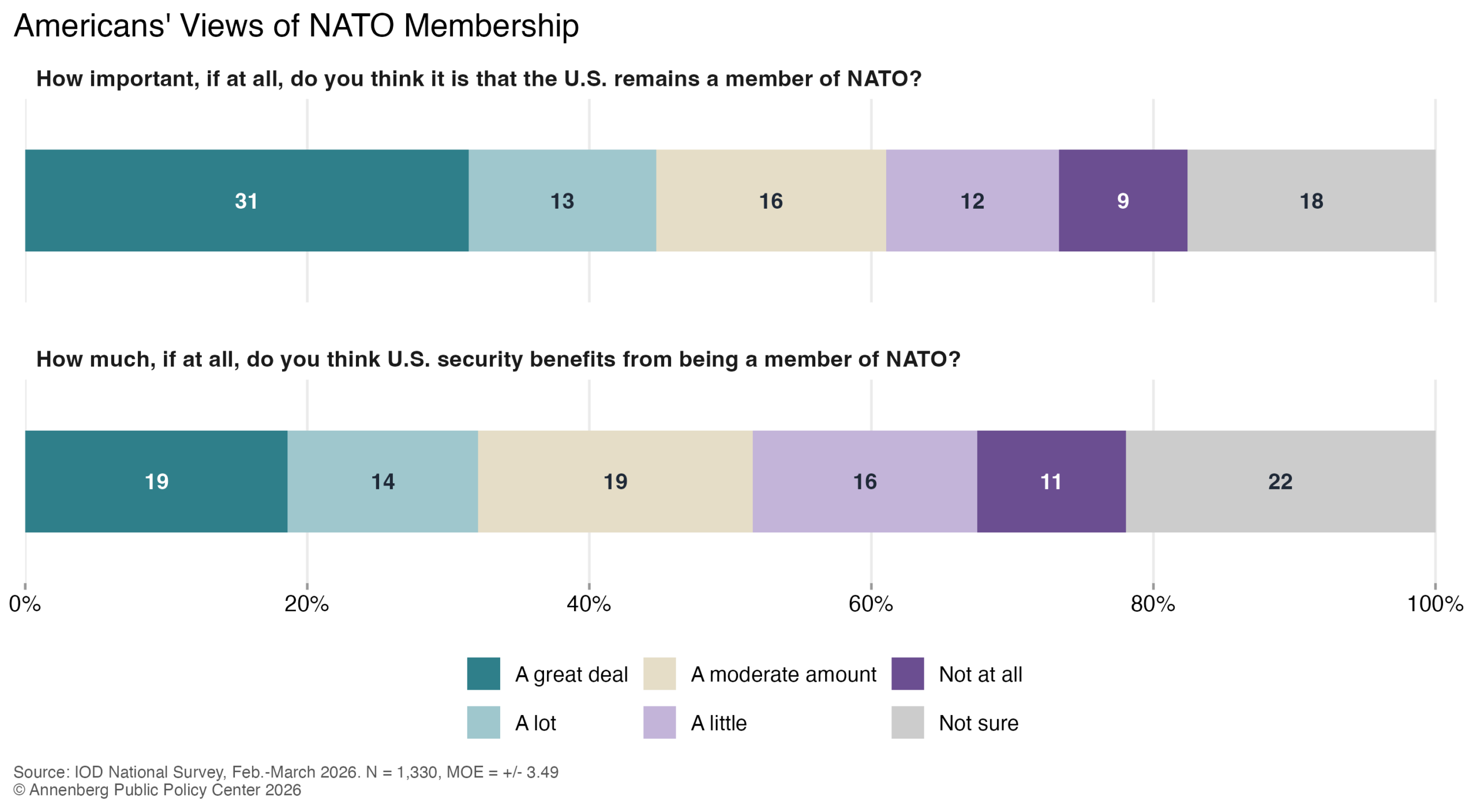
- A majority of U.S. adults (61%) say that the United States remaining a member of NATO is at least moderately important;
- Just over half of Americans (52%) say U.S. security benefits a moderate amount or more from NATO membership;
- Nearly 4 in 10 Americans (38%) have a somewhat or very favorable opinion of NATO – more than twice as many as those who hold an unfavorable opinion (18%);
- There is a deep divide among Republicans: fewer than 1 in 4 (22%) who identify primarily as Trump supporters say NATO provides at least a moderate amount of benefit to U.S. security, while nearly half (47%) who identify primarily with the Republican party do.
“Although President Trump has repeatedly condemned NATO and said he’s considering withdrawing the U.S. from it, a majority of Americans say that the United States should remain a NATO member and that U.S. security benefits from NATO membership,” said Matthew Levendusky, director of APPC’s Institutions of Democracy division and a professor of political science and communication at the University of Pennsylvania.
NATO membership and U.S. security benefits
The survey finds broad but not universal U.S. support for NATO. Overall, 61% of Americans say remaining in NATO is at least moderately important, compared with 21% who say it is only a little or not at all important and 18% who are not sure. Just over half of Americans (52%) say U.S. security benefits at least a moderate amount from NATO membership – including 19% who say it benefits a great deal and 14% who say it benefits a lot – compared with 26% who say U.S. security benefits a little or not at all, and 22% who say they are not sure.
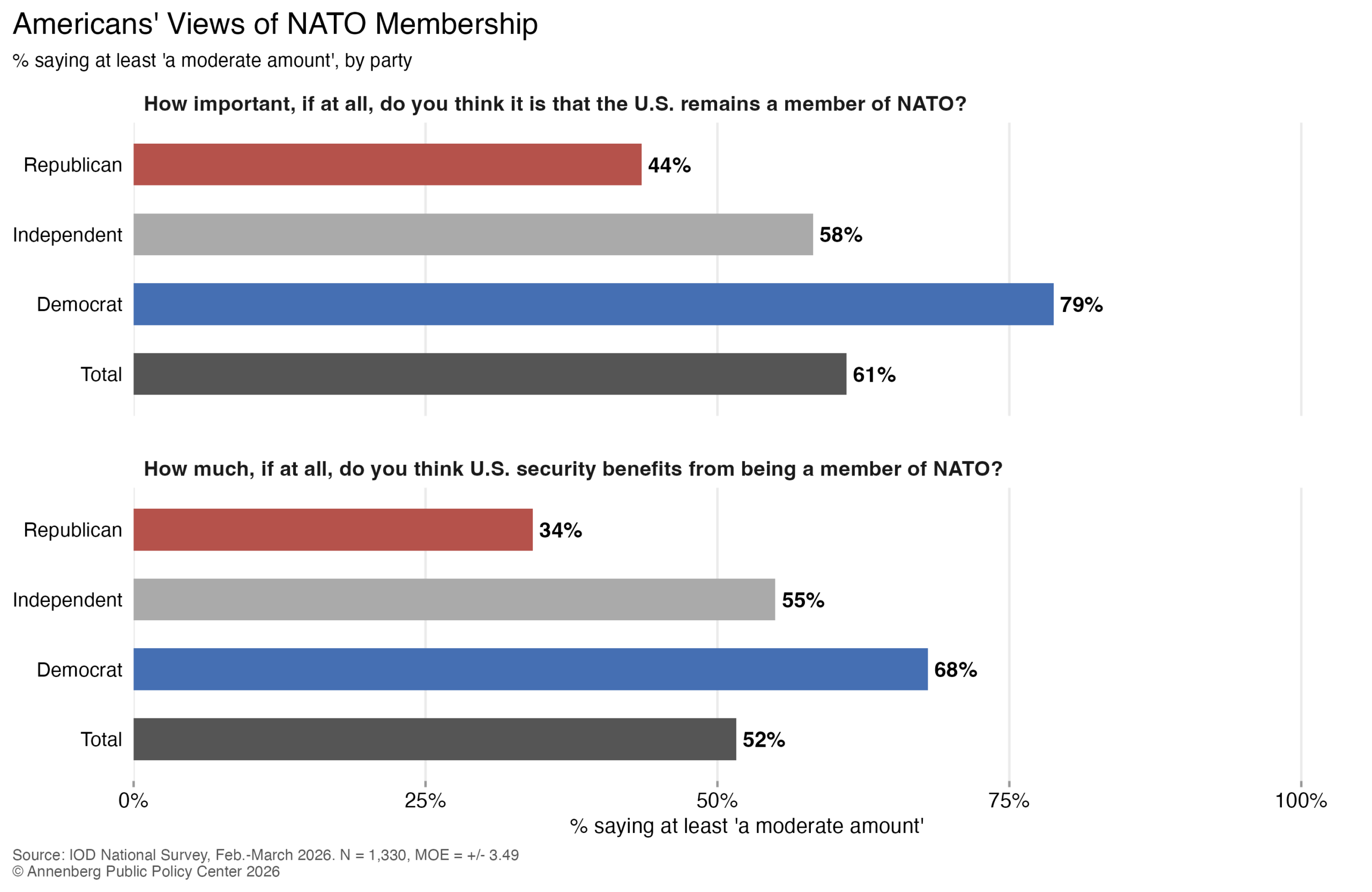
Party differences: The survey respondents were asked in a prior wave of this survey whether they identify with or lean toward the Republican party or the Democratic party, or are independent/some other party.
Democrats are the most supportive of NATO: 79% say it is moderately or more important the U.S. remain a NATO member and 68% say NATO provides at least a moderate security benefit.
Republicans are notably less likely to hold those views: 44% say NATO membership is at least moderately important, while 34% report moderate or greater security benefits – a Republican-Democrat gap of 35 and 34 points, respectively, on NATO membership and U.S. security.
Respondents who are self-described independents or members of other parties fall between the two partisan poles, with 58% seeing NATO membership as important and 55% seeing security benefits to the United States.
NATO favorability
Beyond security-benefit and membership-importance questions, the survey also measures overall favorability toward NATO. About 4 in 10 Americans (38%) hold a somewhat or very favorable view of NATO, more than twice as many as those (18%) with a somewhat or very unfavorable view of it. But 28% say their view of NATO is neither favorable nor unfavorable and 17% report that they don’t know enough to say. Partisan differences are significant: 55% of Democrats express favorable views, compared with 21% of Republicans and 35% of independents.
Foreign policy
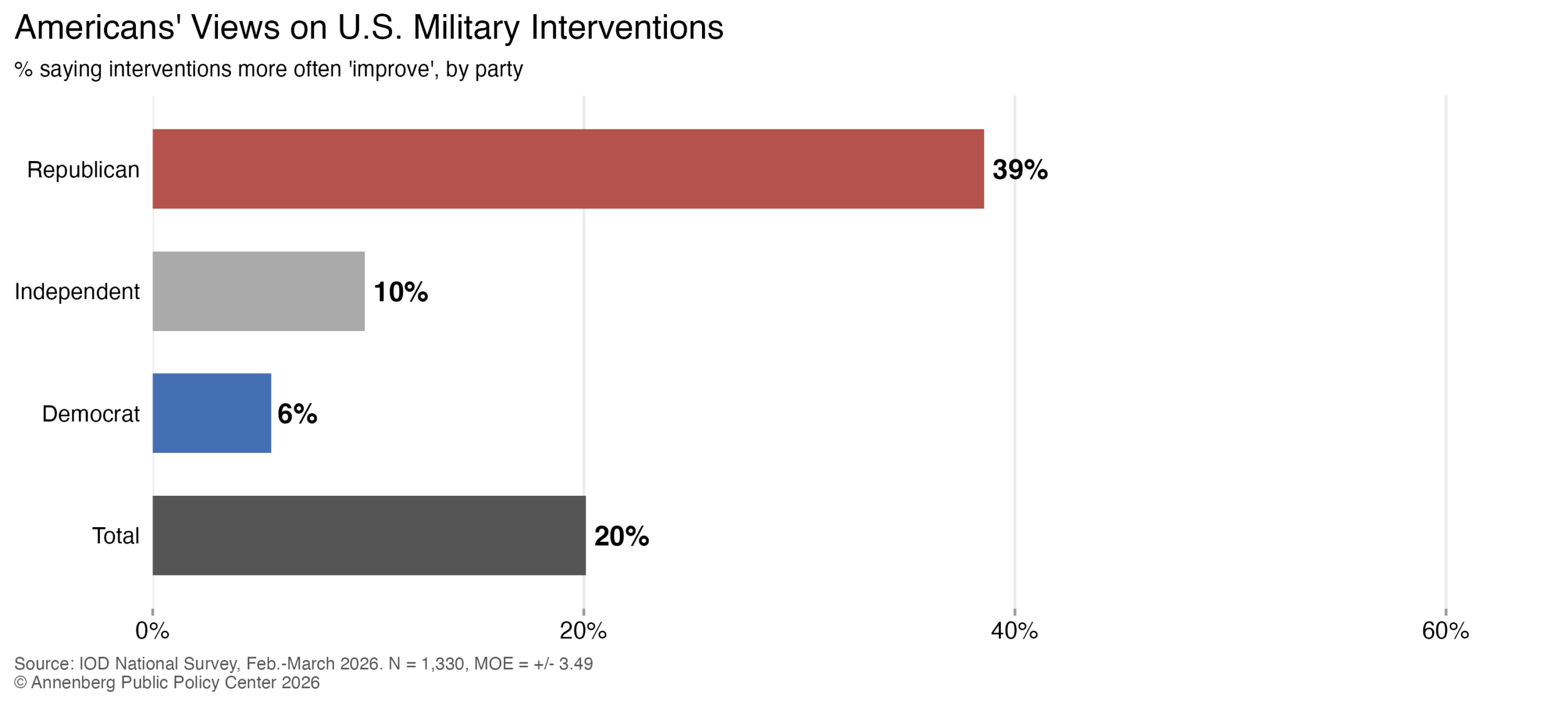
The survey also asks whether U.S. foreign military interventions more often improve or worsen situations in the countries where they occur. Overall, 42% say such interventions worsen the situations, while 20% say such interventions improve them. About 4 in 10 Republicans (39%) say they think that U.S. foreign military interventions improve conditions where they occur, while 6% of Democrats do, a 33-point gap. Only 10% of independents say U.S. interventions improve situations.
The Republican divide: Trump loyalists vs. party identifiers
One striking finding concerns divisions solely within the ranks of Republicans. A prior wave of this survey had asked Republicans whether they consider themselves more of a supporter of Donald Trump, more of a supporter of the Republican Party, both equally, or neither.
On NATO membership, 28% of Trump supporters vs. 59% of Republican party supporters say continued membership is at least moderately important. On the benefits to U.S. security, the difference is similarly pronounced: 22% of Republicans who identify primarily as Trump supporters say NATO provides at least a moderate amount of benefit to U.S. security – compared with 47% among those who identify primarily with the GOP, a 25-point difference.
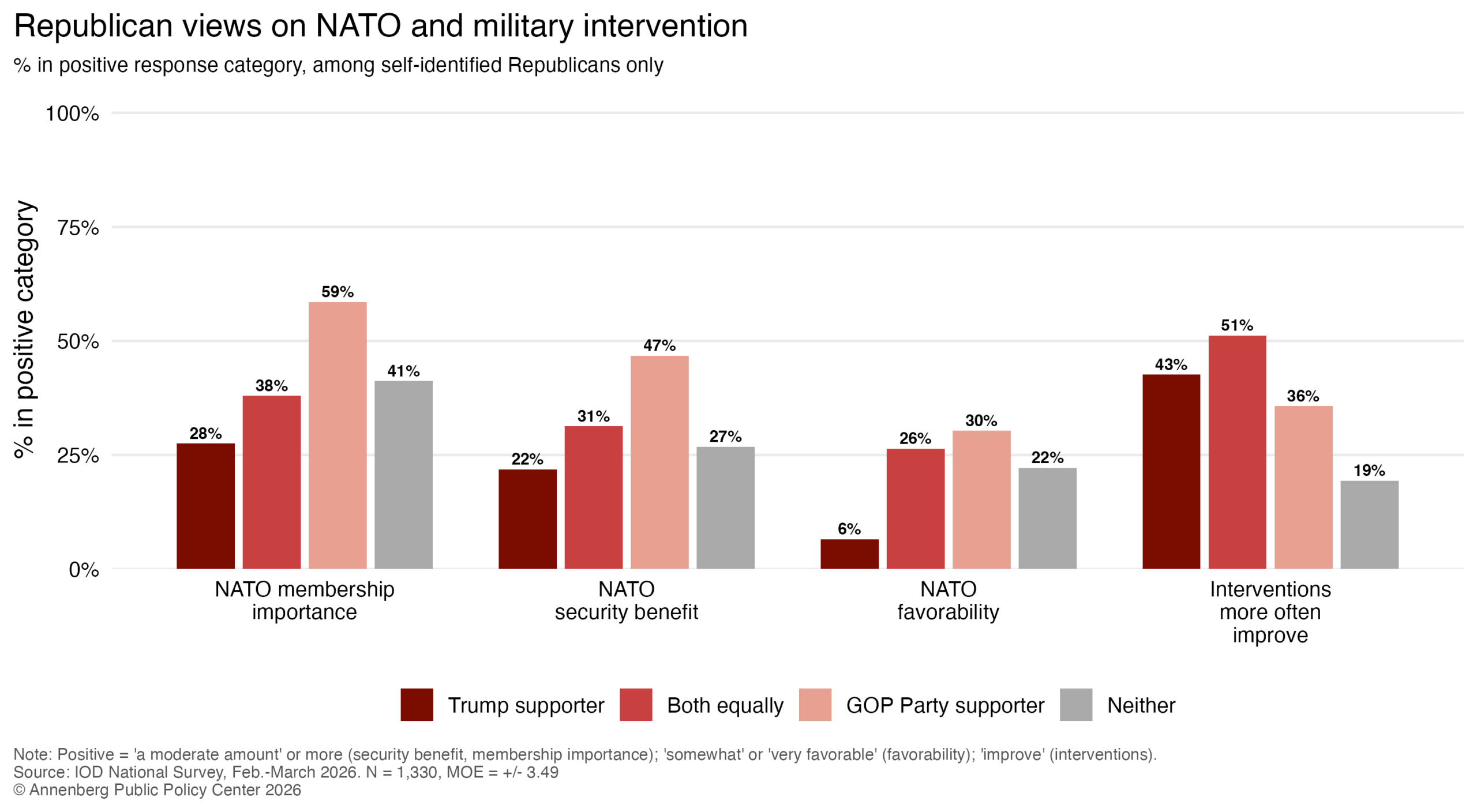
Republicans who say they are supporters of both Trump and the party fall between the two groups, with 38% seeing the benefits of U.S. membership in NATO and 31% seeing the benefits of NATO to U.S. security.
“What we’re seeing is not simply a partisan divide on foreign policy — the data may also suggest a fracturing within the Republican coalition itself. Although these subgroup patterns are based on smaller sample sizes, the different views on NATO between Trump supporters and party supporters are significant,” said Shawn Patterson Jr., a research analyst at APPC. “This has real implications for American foreign policy.”
APPC’s Institutions of Democracy survey
The Annenberg Public Policy Center’s Institutions of Democracy survey was fielded with a nationally representative sample of 1,330 U.S. citizens ages 18 and older from Feb. 17-March 20, 2026. The survey was conducted for APPC by SSRS, an independent research company, primarily online, with a small sample of phone respondents. Respondents were weighted to align with population benchmarks. The margin of error for the full sample is ±3.5 percentage points, and it is larger for subgroups.
Download the topline and the survey methodology. See the topline for question wording.
APPC’s Institutions of Democracy division studies democratic institutions, public opinion, political behavior, and information environments. IOD conducts original survey research and related empirical work to provide rigorous, nonpartisan evidence on contemporary political and public-affairs questions.
The Annenberg Public Policy Center of the University of Pennsylvania was established in 1993 to educate the public and policy makers about communication’s role in advancing public understanding of political, science, and health issues at the local, state, and federal levels. Connect with us on Facebook, X, Instagram, and Bluesky.