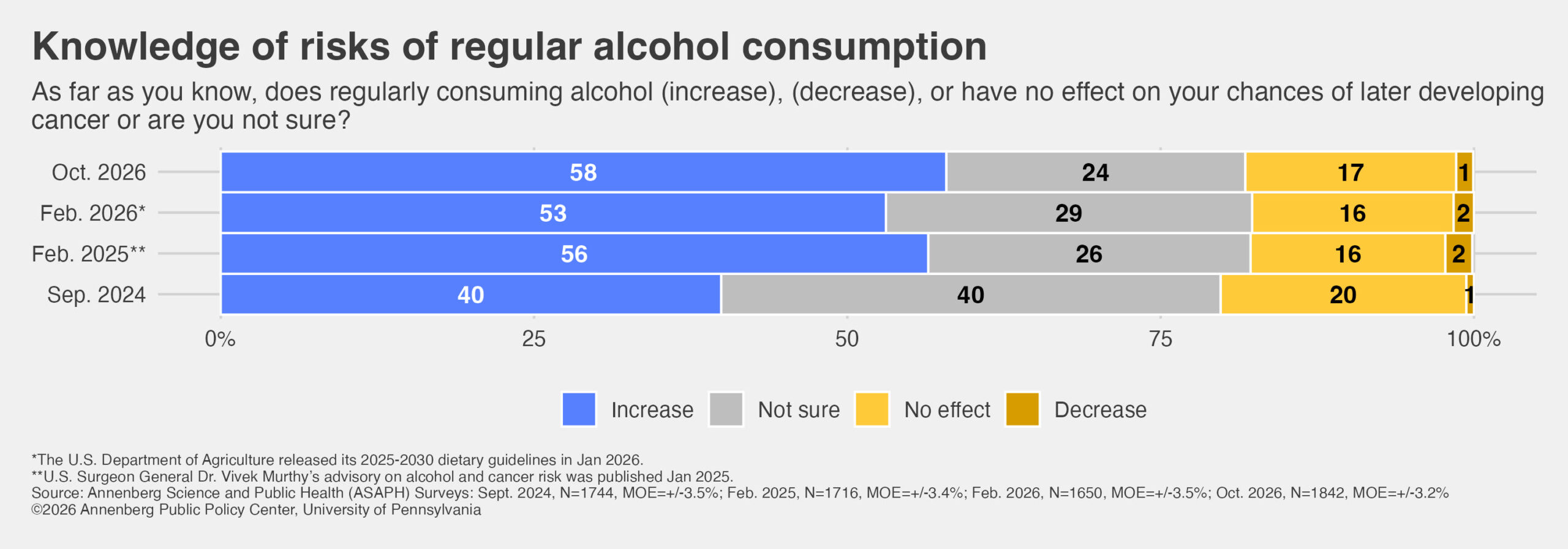
Nearly 6 in 10 Americans (58%) know that regularly consuming alcohol increases the chances of later developing cancer, according to a nationally representative survey in October by the Annenberg Public Policy Center (APPC), a statistically significant increase of five percentage points since February 2026.
The modest rebound raises the level of public knowledge roughly to where it was in February 2025 (56%), a month after the Biden administration’s surgeon general, Dr. Vivek Murthy, issued an advisory on the causal link between alcohol consumption and at least seven types of cancer.
Overall, the current level of knowledge (58%) about the connection between alcohol consumption and an increased risk of cancer stands 18 percentage points higher than in September 2024, when we first asked the question.
The new finding comes from the policy center’s latest Annenberg Science and Public Health (ASAPH) survey, conducted Sept. 22-Oct. 5, 2026, among 1,842 empaneled U.S. adults.
Shortly before this survey was fielded, in September 2026, researchers at the University of Miami’s Miller School of Medicine published data showing that even moderate and small amounts of alcohol increased the risk of cancer. Drawing on those data, headlines informed the public that “Alcohol-related cancer deaths in US have more than doubled over three decades.”
Laura A. Gibson, an APPC research analyst, noted that it is not possible to draw a direct link between news coverage of the Miami study or the surgeon general’s warning and the growth in knowledge about alcohol and cancer. Even so, she said, “We know that ongoing media coverage plays an important role in amplifying the general public’s awareness of health risks.”
Despite the improvement, the survey finds that more than 4 in 10 Americans (42%) do not recognize that regularly consuming alcohol increases cancer risk: Nearly a quarter (24%) say they are not sure whether drinking alcohol affects their chances of developing cancer and 17% incorrectly believe that alcohol consumption has no effect on cancer risk.
In January 2026, the U.S. Department of Agriculture released its 2025-2030 Dietary Guidelines for Americans. Unlike the prior guidelines, which explicitly warned about the relationship between alcohol consumption and cancer, the revised guidelines did not mention cancer risk, although they advised limiting alcoholic beverages for better health.
For additional background, see our March 2026 release: Awareness of alcohol-cancer link holds steady despite omission in new U.S. dietary guidelines.
About the survey
The latest wave of the Annenberg Science and Public Health (ASAPH) survey, Wave 31, was conducted for APPC from Sept. 22-Oct. 5, 2026, among 1,842 U.S. adults by SSRS, an independent research company. Interviews were conducted by web and telephone among a nationally representative probability sample drawn from the SSRS Opinion Panel, with the data weighted to represent the U.S. adult population. The margin of error is ±3.2 percentage points.
The Annenberg Public Policy Center has been tracking Americans’ knowledge, beliefs, and behaviors regarding vaccination, Covid-19, flu, RSV, and other consequential health issues through its ASAPH survey and other national samples since April 2021. Besides Gibson, the survey team includes Ken Winneg, managing director of survey research; Patrick E. Jamieson, director of the Annenberg Health and Risk Communication Institute, which oversees the survey; research analyst Shawn Patterson Jr.; and Kathleen Hall Jamieson, APPC’s director emerita.
For additional information, download the topline and methodology report.
See other recent Annenberg health survey news releases:
- MAHA and its policy concerns: One in 4 Americans supports MAHA, but three times as many share food-related concerns (Oct. 22, 2026)
- 988 Lifeline: Knowledge of the 988 Suicide Lifeline remains low (Oct. 9, 2026)
- RFK Jr. and the measles vaccine: About 1 in 3 Americans say RFK Jr. recommends measles vaccine (Sept. 29, 2026)
- Climate change and illness: In hottest summer on record, 2 in 3 Americans say climate change is increasing heat-related illnesses (Sept. 17, 2026)
- Controlling mosquitoes: Most Americans know how to control mosquitoes; Many unsure how to use insect repellent. (Sept. 10, 2026)
The Annenberg Public Policy Center was established in 1993 to educate the public and policy makers about communication’s role in advancing public understanding of political, science, and health issues at the local, state, and federal levels.