As protesters rally against data center construction in dozens of states and New York and Texas pause the issuance of permits for large data centers, a new nationally representative survey finds that Americans’ opposition to data centers in their communities has risen sharply since last spring.
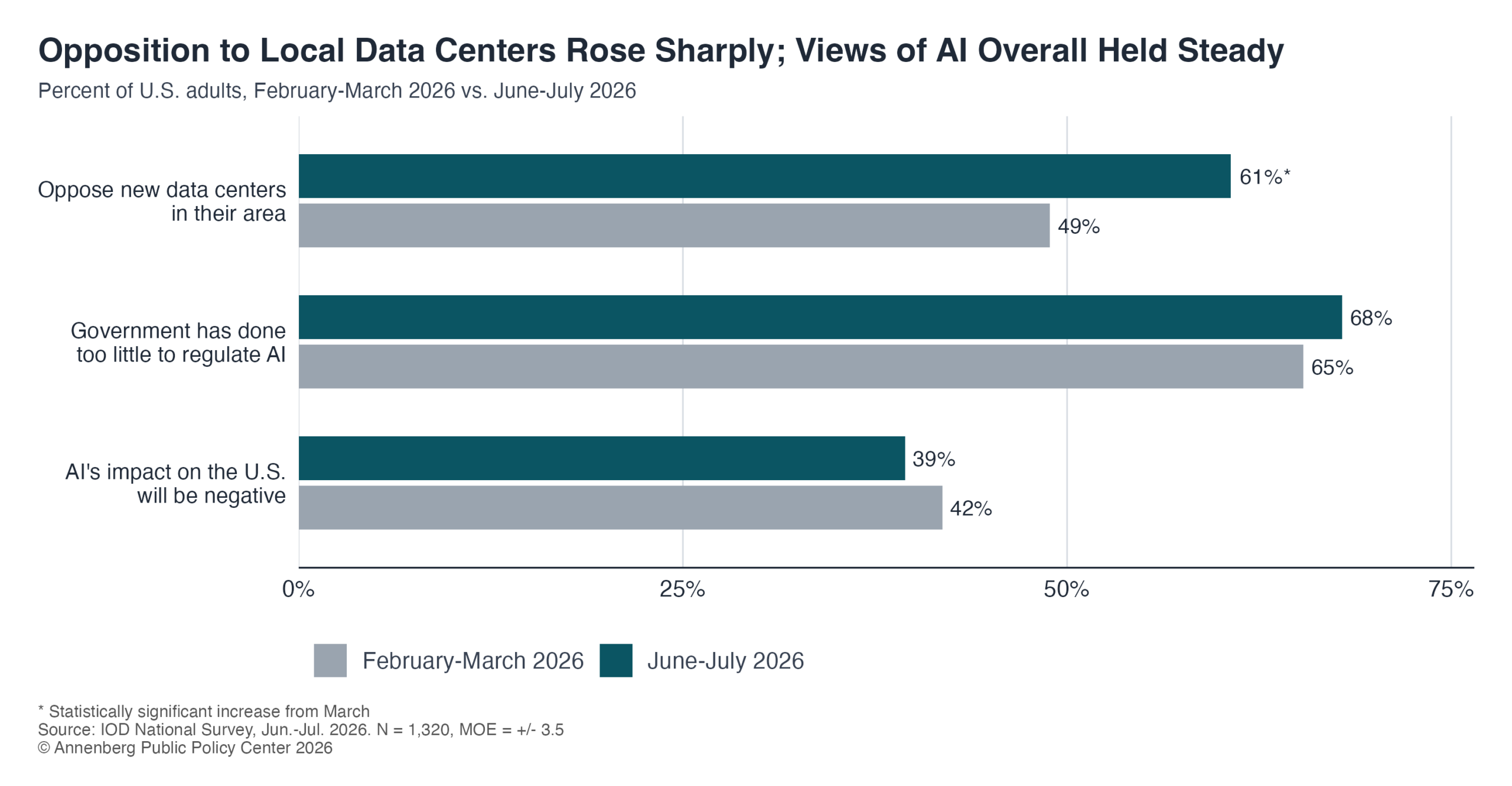
The survey, conducted by the Annenberg Public Policy Center (APPC) of the University of Pennsylvania, finds that about 3 in 5 U.S. adults (61%) oppose the construction of new data centers in their area, up 12 percentage points from a survey fielded in February and March.
Americans’ broader views of artificial intelligence (AI), however, have remained stable. The share saying that AI’s impact on the United States over the next 10 years will be somewhat or very negative was 39%, statistically unchanged from the spring. Two-thirds (68%) continue to say the government has done “too little” to regulate AI, unchanged from the spring.
The movement over these four months was concentrated in one place: what Americans think about the physical infrastructure of a data center being built near their home.
Key findings
The survey, by the Annenberg Public Policy Center’s Institutions of Democracy division, was conducted among a nationally representative sample of 1,320 U.S. adult citizens from June 16-July 19, 2026. (Download the topline here.) The survey finds that:
- Opposition to local data centers rose 12 points over four months: Three in five Americans (61%) now somewhat or strongly oppose the construction of new data centers in their area, up from 49% in the survey ending in March.
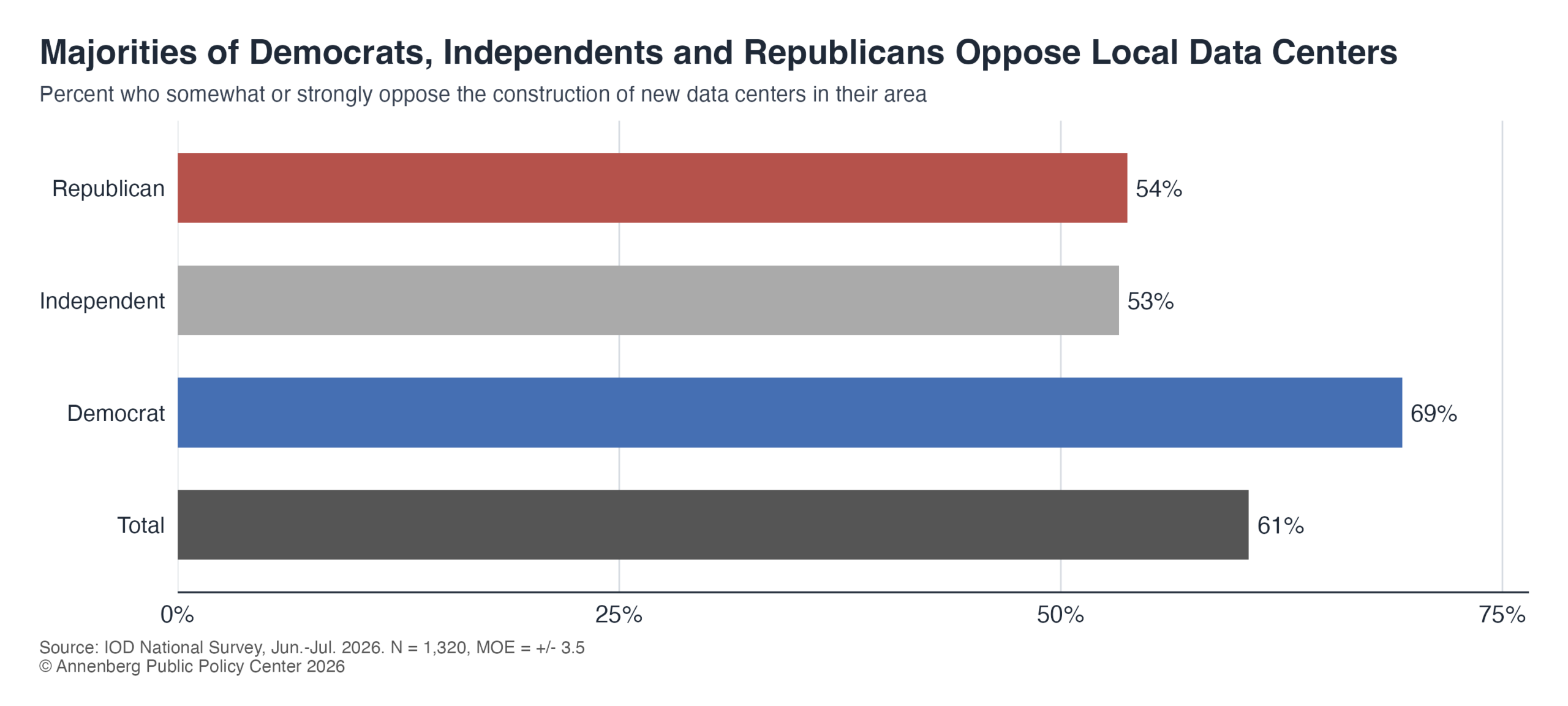
- Opposition crosses party lines and is highest among younger adults: Majorities of Democrats (69%), Republicans (54%) and independents (53%) oppose new local data centers. Opposition is highest among young adults under 30 (70%) and declines to 57% among those 65 and older, the inverse of what one might expect for a new technology.
- Views of AI overall, and demand for regulation, have held steady: 39% expect AI’s impact on the United States to be negative over the next decade, against 18% who expect it to be positive, unchanged from the spring. Two-thirds (68%) say the government has done “too little” to regulate AI.
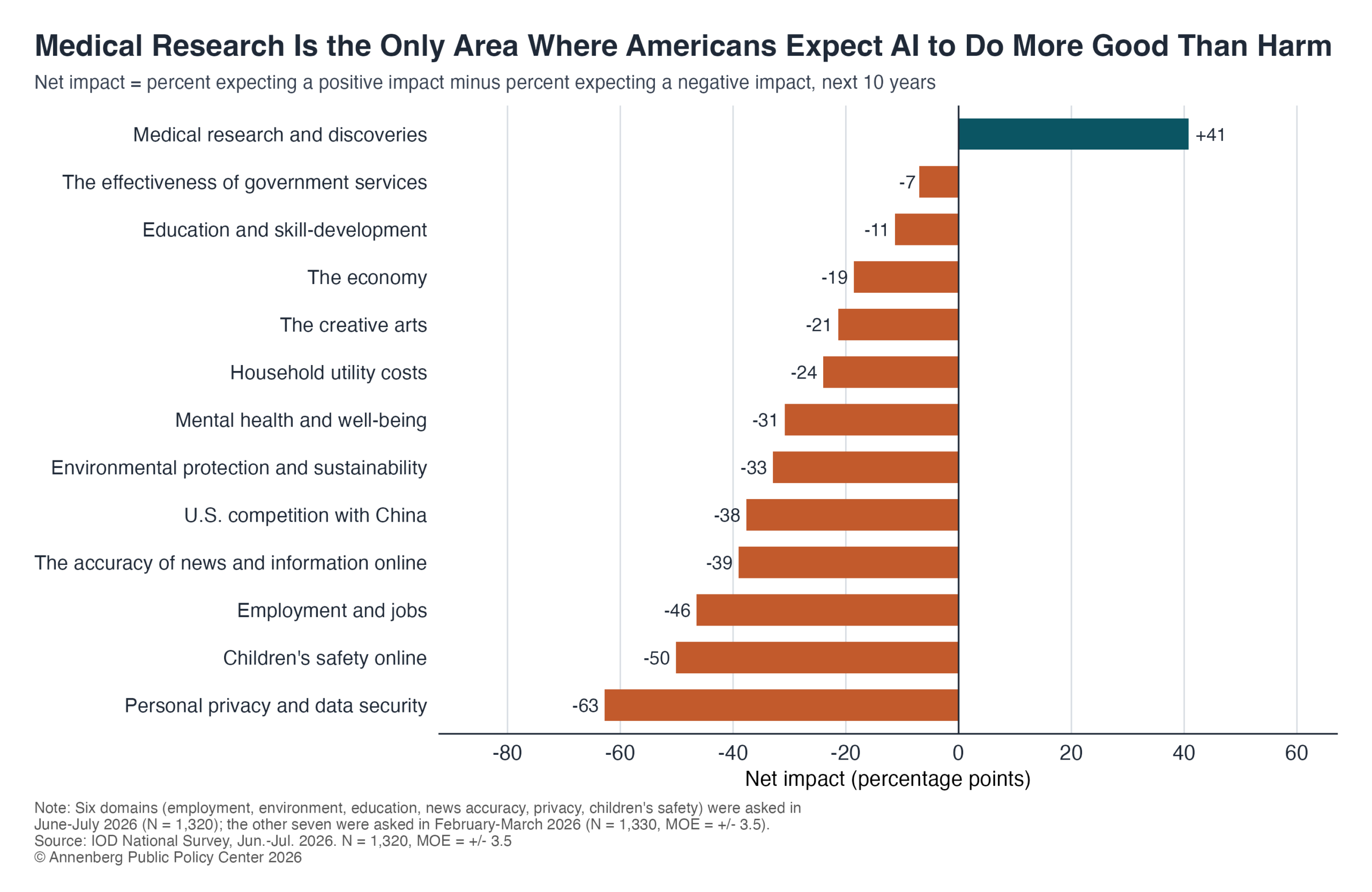
- Medical research remains the one area where Americans expect AI to help: Across 13 areas, only medical research and discoveries draws a net-positive assessment (+41 points) in which the anticipated benefits of AI outweigh the expected negatives. The most negative areas are personal privacy and data security (-63 points), children’s safety online (-50 points), and employment and jobs (-46 points).
“What stands out is the contrast,” said Shawn Patterson Jr., an APPC research analyst. “Americans’ expectations for how AI will affect the country, and their views toward regulation, are essentially unchanged since March. Over the same period, however, opposition to a data center in their area rose 12 points. That’s a dramatic move over a relatively short period of time.”
Opposition to local data centers rose sharply
Asked whether they would oppose or support the construction of new data centers in their area, 61% of Americans are opposed – 44% strongly and 16% somewhat. Only 14% are supportive (down from 21% in the spring), and 25% say they neither support nor oppose this. That is a marked increase in opposition since the spring, when 49% were opposed. The 12-point increase is statistically significant and is the largest shift on any AI question measured in these surveys.
Opposition is not confined to a partisan subgroup. Majorities of Democrats (69%), Republicans (54%) and independents (53%) alike oppose new data centers in their area. Opposition is highest among adults under 30 (70%) and declines with age, to 57% among those 65 and older – a reversal of the usual pattern in which younger Americans are more receptive to new technology.
Views of AI overall and demand for regulation did not shift
While opposition to data centers climbed, Americans’ broader assessment of AI remained unchanged. Asked about AI’s impact on the United States over the next 10 years, 39% say it would be somewhat or very negative, 18% say somewhat or very positive, and 35% say the impact would be equally positive and negative. In the spring, 42% expected a negative impact – a difference that is statistically unchanged.
Demand for regulation is similarly stable and similarly high. Over two-thirds of Americans (68%) say the government has done “too little” to regulate AI (statistically unchanged from the spring), compared with 8% who say it has done “too much” and 22% who say about the right amount. The demand for regulation remains bipartisan: 80% of Democrats, 61% of independents and 58% of Republicans say the government has done too little.
Awareness and use of AI remain widespread. About three-quarters of Americans (76%) say they have heard, read, or seen at least a moderate amount about AI, and 59% report using or interacting with AI at least a few times in the past month, including 34% who used it many times or almost every day. About 1 in 5 (21%) say they never used AI in the past month.
Where Americans think AI will help or hurt
The survey asked about AI’s expected impact across six new areas, which together with seven areas measured in the spring produce a 13-item map of public expectations. Only one area is net positive: medical research and discoveries, where 57% expect a positive impact and 16% a negative one, for a net of +41 percentage points.
Every other area is net negative, and the areas closest to people’s own lives are the most negative. Personal privacy and data security is the worst-rated of the 13 (6% positive, 69% negative, net -63 points), followed by children’s safety online (net -50) and employment and jobs (net -46). Also strongly negative are the expected impacts on the accuracy of news and information online (net -39) and U.S. competition with China (net -38). Education and skill-development (net -11) and the effectiveness of government services (net -7) are the least negative of the non-medical areas.
People who use AI are less negative about it – but not about data centers
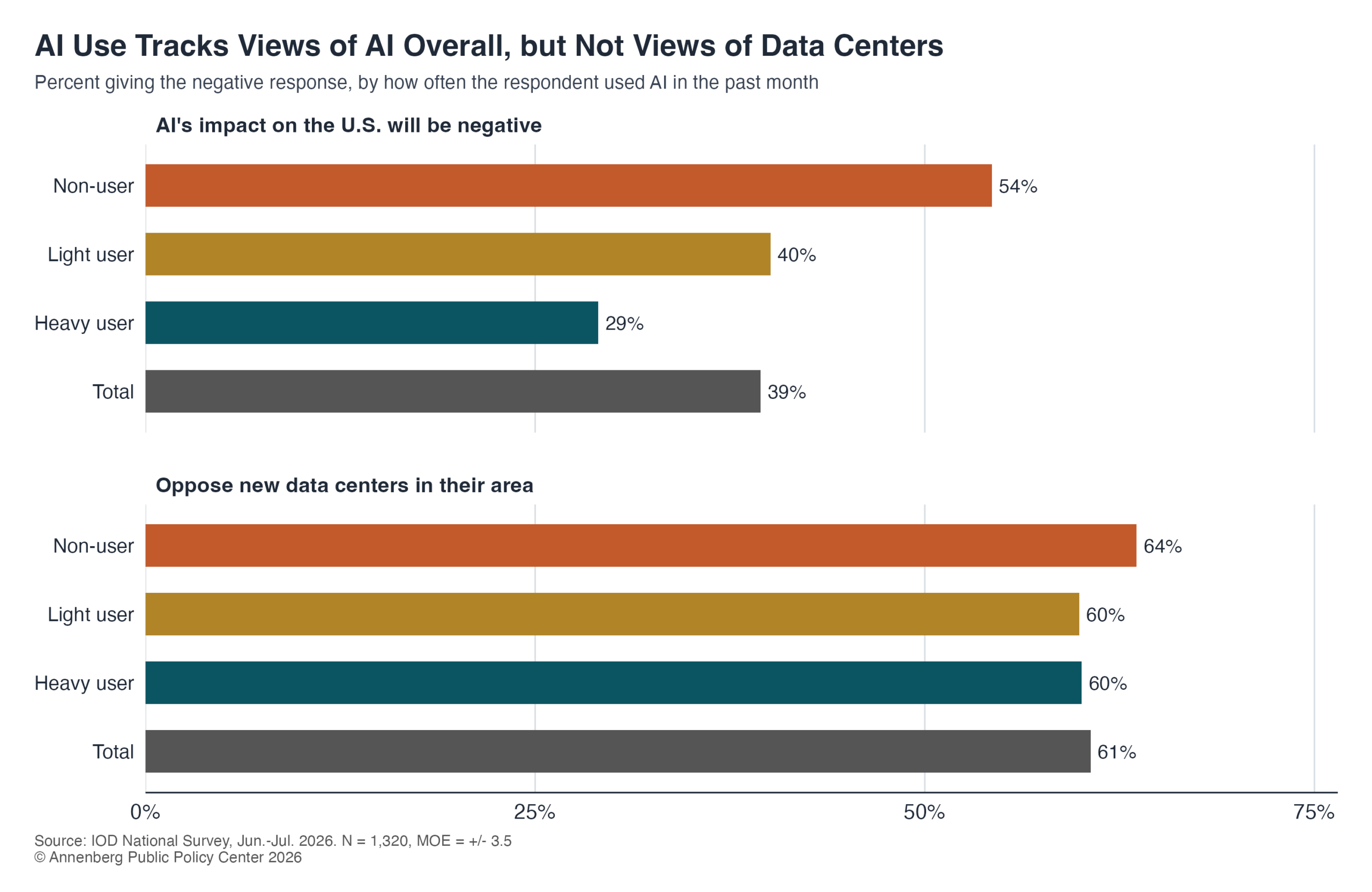
Americans who use AI regularly take a markedly less negative view of what it will do to the country. Among those who report never using AI in the past month, 54% expect AI’s impact on the United States to be negative. That falls to 40% among light users and 29% among those who used AI many times or almost every day. The gap holds after accounting for party, age, gender, education, income, race and religion.
It is hands-on use, rather than exposure, that tracks this view. When how much a person has heard about AI and how much they have used it are considered together, only use predicts a less negative outlook.
Where this pattern stops is instructive. Opposition to local data centers is essentially flat across different usage groups: 64% among nonusers, 60% among light users and 60% among heavy users. Baseline AI use did not predict later data-center opposition. Familiarity with AI tracks a more favorable view of what the technology will do to the country in the abstract. It does not extend to what it might do to the respondent’s own neighborhood, own data or own job.
“The people who use AI the most are the most optimistic about what it will do for the country, and that has been consistent across our surveys,” said University of Pennsylvania political science professor Matt Levendusky, the Stephen and Mary Baran Chair in the Institutions of Democracy at APPC. “That optimism, however, has clear limits, and it disappears when we ask about privacy, about jobs, and about whether a data center should go up nearby. Even heavy AI users seem to be concerned about these very concrete worries.”
APPC’s Institutions of Democracy survey
The Annenberg Public Policy Center’s Institutions of Democracy survey was fielded with a nationally representative sample of 1,320 U.S. citizens ages 18 and older from June 16-July 19, 2026. The survey was conducted for APPC by SSRS, an independent research company, primarily online, with a small sample of phone respondents. Respondents were weighted to align with population benchmarks. The margin of error for the full sample is ±3.5 percentage points, and it is larger for subgroups.
Download the topline and the survey methodology.
The Annenberg Public Policy Center of the University of Pennsylvania was established in 1993 to educate the public and policy makers about communication’s role in advancing public understanding of political, science, and health issues at the local, state, and federal levels.