As public trust in the U.S. Supreme Court continues to fall, new research from the Annenberg Public Policy Center (APPC) of the University of Pennsylvania finds that jury service is associated with more positive attitudes toward courts and judges – but that Americans’ opportunities to serve are shrinking as jury trials become increasingly rare.
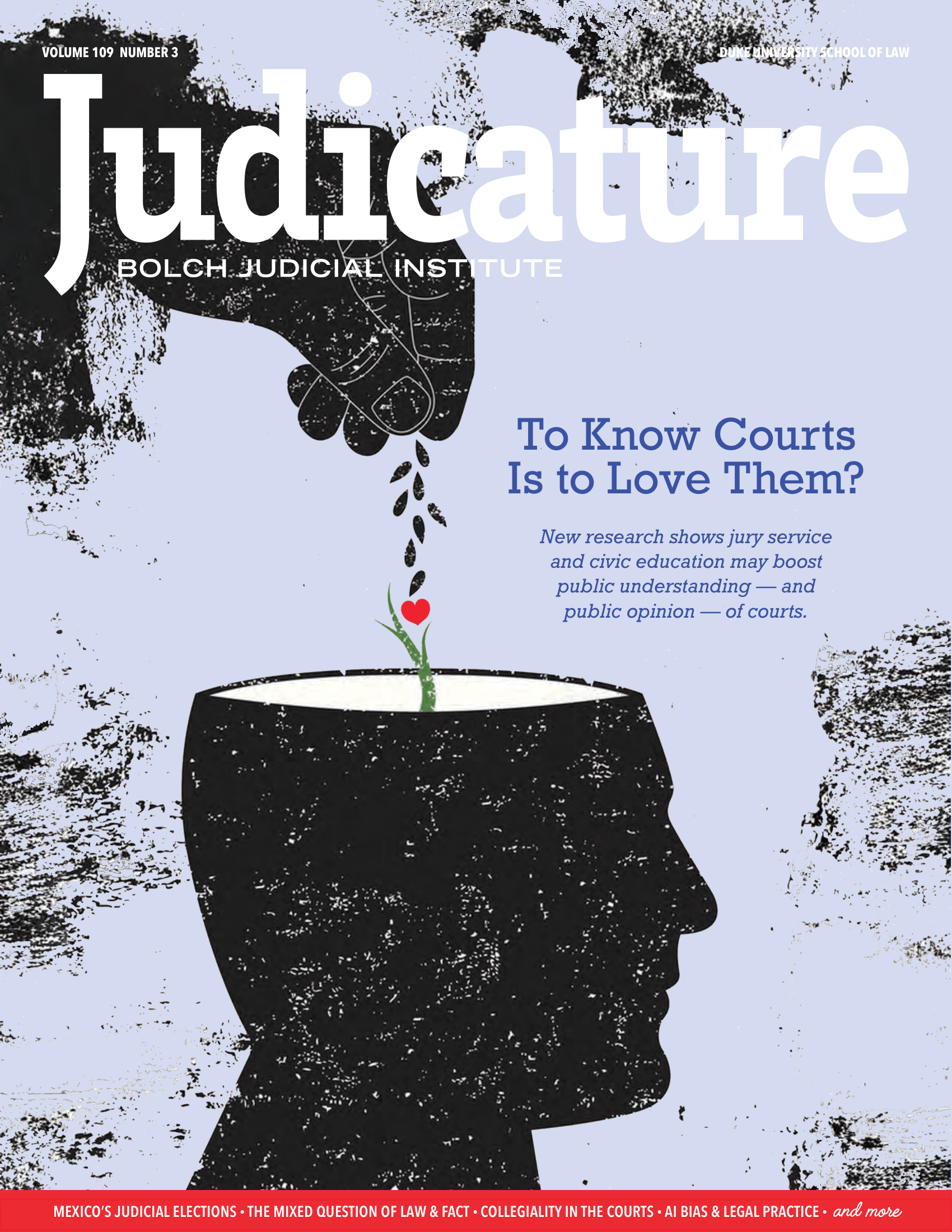 The findings, published in Judicature, the scholarly journal of the Duke University School of Law, draw on nationally representative surveys conducted by APPC’s Institutions of Democracy (IOD) division. The authors – Shawn Patterson Jr., Abby Murray, Matthew Levendusky, R. Lance Holbert, and Kathleen Hall Jamieson – find that respondents who served on a jury in the past five years viewed courts as more legitimate, trusted them more, and attributed more positive traits to judges, compared with those who had not served.
Key findings
- Trust in the U.S. Supreme Court has declined sharply. In a March 2025 survey of U.S. adults, 41% of those surveyed expressed high or moderate trust in the Supreme Court, down from 68% in 2019 – a 27-point drop. Meanwhile, the share reporting low or no trust in the Court grew to 59%.
- Jury service is linked to better attitudes toward the courts. Survey respondents who reported jury service in the past five years viewed courts as more legitimate, trusted courts more overall, and were more likely to attribute positive traits to judges, even after controlling for age, education, gender, income, party identification, and race.
- Jury trials are vanishing. At the federal level, civil cases going to trial dropped from 5.5% in 1962 to 0.8% by 2013, while federal criminal jury trials shrank from 8.2% to 3.6% in the same period. The number of people called for federal jury duty fell 37% between 2006 and 2016. In APPC surveys, the share of adults reporting jury service in the past five years dropped from an average of 9% before 2020 to just 4% in 2025.
- Civic knowledge: Higher levels of civic knowledge were associated with an even larger boost in perceived court legitimacy than jury service – roughly 14 percentage points compared with 9 points for jury duty.
“These findings suggest that the decline in the numbers of jury trials, both in civil and criminal cases, is somewhat problematic,” said Shawn Patterson Jr., an APPC research analyst. “Fewer jury trials mean fewer jurors, and fewer jurors mean fewer people experiencing our courts firsthand.”
Matthew Levendusky, the Stephen and Mary Baran Chair in the Institutions of Democracy at APPC and director of the IOD division, added: “When you experience the courts firsthand, you see up close how they work, and that seems to translate into greater trust.”
The case for civic education
With jury service declining, the authors argue that expanding civic education offers an alternative path to rebuilding public trust in the courts, as civic knowledge had the strongest association with court legitimacy of any factor tested. The authors urge a more integrated approach to civic learning, connecting K-12 instruction with adult education through workplaces, community organizations, and court-based learning centers such as the Stephen G. Breyer Community Learning Center on Courts and the Constitution in Boston and the Justice & Democracy Centers of Minnesota.
“Whatever the route, the ultimate goal should be to raise baseline civic literacy and empower all individuals to participate meaningfully in democratic life,” said Lance Holbert, director of the policy center’s Leonore Annenberg Institute for Civics. “In a time of polarization and misinformation, this is not merely an educational priority – it is a democratic necessity.”
“To Know Courts Is to Love Them?” was published by the Bosch Judicial Institute at Duke Law, Vol. 109 No. 3, in June 2026. In addition to Patterson, Levendusky, and Holbert, the authors include Abby Murray, a third-year Duke Law student and student editor for Judicature, and Kathleen Hall Jamieson, director of the policy center.
Read and download the article here.
The Annenberg Public Policy Center of the University of Pennsylvania was established in 1993 to educate the public and policy makers about communication’s role in advancing public understanding of political, science, and health issues at the local, state, and federal levels.