Vaccines and scientists who work on them have been embroiled in controversy and subject to unfounded attacks over the past half-dozen years. The litany of attacks has included both debunked claims and claims that lack evidence – for instance, that vaccines using mRNA technology such as Covid-19 vaccines alter people’s DNA (no evidence), that some vaccines contain tracking microchips (false), that vaccines cause autism (no evidence), and that scientists working on childhood vaccines are motivated by profit (no evidence).
Despite these repeated attacks, a nationally representative survey by the Annenberg Public Policy Center (APPC) of the University of Pennsylvania finds that the American public continues to see scientists working on vaccines in fundamentally similar ways to medical scientists and scientists in general.
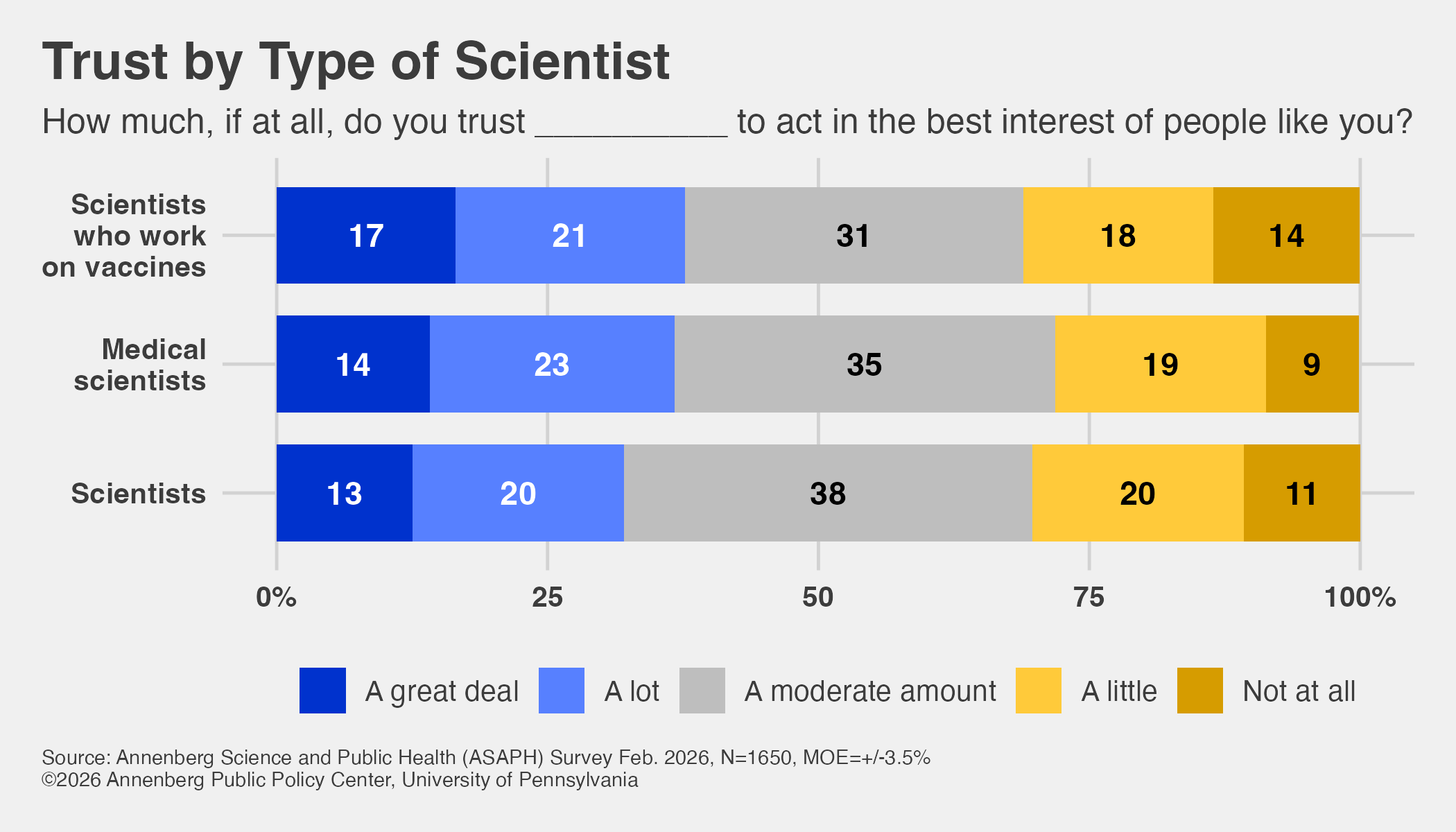
The Annenberg survey, conducted Feb. 3-17, 2026, among 1,650 U.S. adults, finds that nearly 7 in 10 people (69%) say they trust vaccine scientists a moderate or greater amount to act in the best interests of “people like you.” This finding is statistically no different than the percentage who have moderate or more trust in medical scientists (72%) and scientists in general (70%).
The level of trust (moderate or higher) in scientists is comparable to the levels found in earlier Annenberg surveys for trust in police officers (70%) and the military (70%) and is considerably higher than trust in journalists (49%), religious leaders (47%), elected officials (36%) and business leaders (30%).
See the topline for question wording.
Evaluating scientists through FASS
In addition to fielding overall questions on trust, Annenberg Public Policy Center research has developed a five-factor tool to measure the public’s perception of science and scientists: whether scientists are perceived to be credible and prudent; whether they are perceived to correct errors (self-correcting) and overcome individual bias; and whether the scientific findings produced by these scientists have benefited “people like me” and “the country as a whole” (beneficial). The study “Factors Assessing Science’s Self-Presentation model and their effect on conservatives’ and liberals’ support for funding science,” published in 2023 in the Proceedings of the National Academy of Sciences, first explored the five factors, or FASS.
Public perceptions of different kinds of scientists vary – indeed, past APPC research has shown that the public perceives climate scientists and scientists working on artificial intelligence less favorably than scientists in general on some of these factors.
Despite the sustained, unwarranted attacks on vaccines and the scientists working on them, the current survey shows that the U.S. public continues to perceive vaccine scientists as either comparable to or more favorable than scientists in general. The current survey finds that vaccine scientists are regarded as being just as credible, self-correcting, and unbiased, and their work as beneficial, as scientists in general. The one statistically significant difference favors vaccine scientists as being even more prudent than scientists in general.
“It is reassuring to see that the public trusts vaccine scientists to act in their best interests just as much as scientists in general, despite the unfounded attacks on vaccine research,” said APPC research analyst Laura A. Gibson.
Equal levels of trust in different types of scientists
The Annenberg survey asks respondents how much they trust a) scientists working on vaccines, b) medical scientists, and c) scientists to act “in the best interest of people like you” on a scale from (1) “not at all” to (5) “a great deal.” On average, people report having “a moderate amount” of trust (3) in all three groups of scientists. A statistical regression comparing the mean or average scores shows that the mean for vaccine scientists is 3.1, which is statistically no different than for medical scientists (3.1) or scientists in general (3.0).
- Scientists working on vaccines: Nearly 7 in 10 (69%) say they trust vaccine scientists a moderate amount or more to act in their best interest, including 38% who say they trust vaccine scientists a great deal or a lot to act in their best interest and 31% who say they trust this group of scientists a moderate amount. About 1 in 3 (31%) say they trust them a little or not at all.
- Medical scientists: 72% say they trust medical scientists a moderate amount or more to act in their best interest, including 37% who say they trust medical scientists a great deal or a lot and 35% who say they trust this group of scientists a moderate amount. Less than 1 in 3 (28%) say they trust them a little or not at all.
- Scientists in general: 70% say they trust scientists a moderate amount or more to act in their best interest, including 32% who say they trust scientists in general a great deal or a lot to act in their best interest and 38% who say they trust this group of scientists a moderate amount. About 1 in 3 (30%) say they trust them a little or not at all.
Trusting scientists to report funding sources honestly
In addition, when asking about vaccine scientists and medical scientists, the public trusts them equally to be honest about their funding sources. Over half say they trust vaccine scientists (55%) and medical scientists (57%) “some” or “a lot” to be open and honest about who is paying for their work. (The survey did not ask about scientists in general.)
How often scientists’ biases affect their work
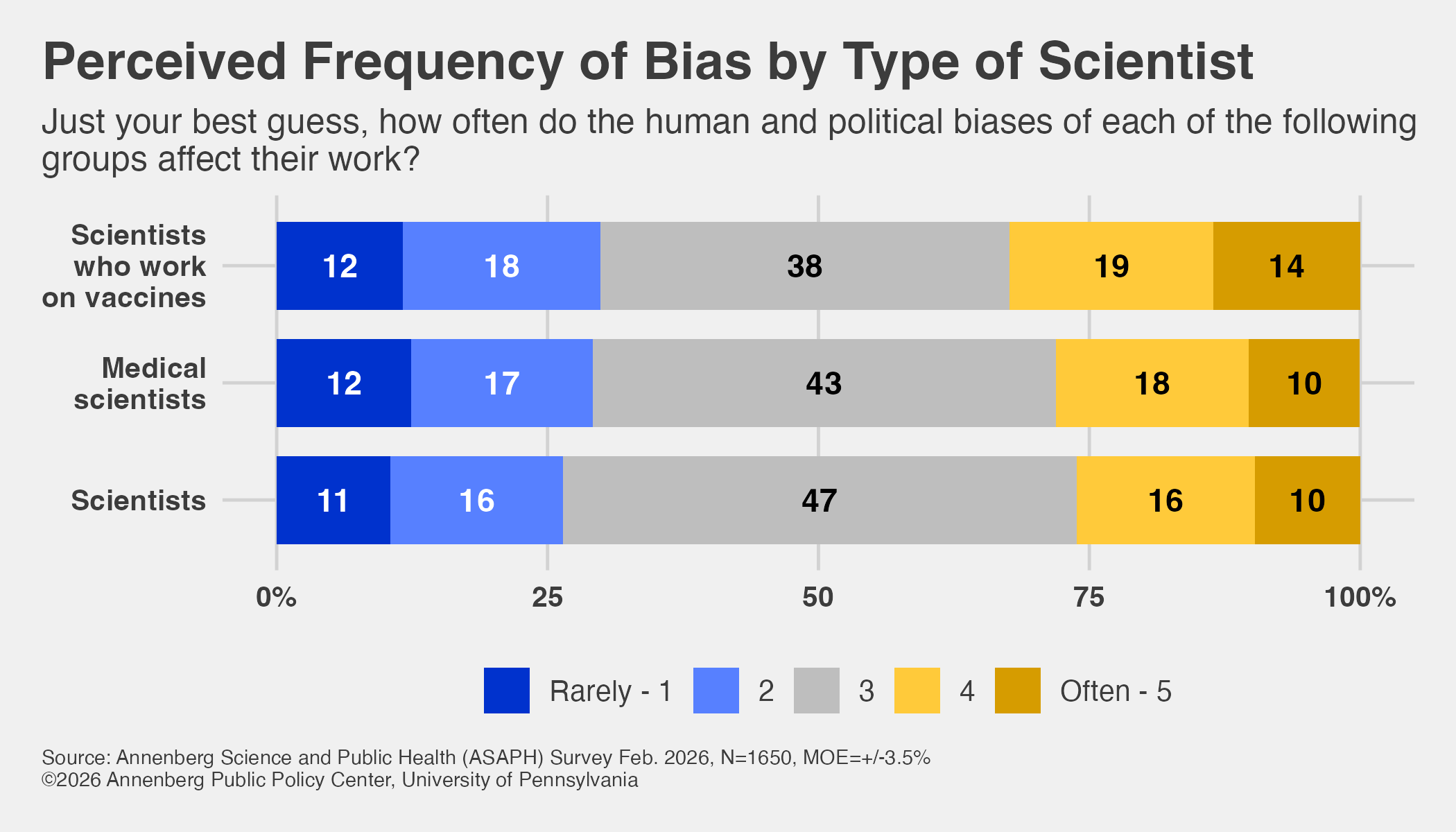
The U.S. public perceives that the biases of scientists who work on vaccines, medical scientists, and scientists in general affect their work equally often. APPC researchers measured perceptions of bias with the question, “How often do the human and political biases of each of the following groups affect their work?” This question also uses a five-point scale, in which (1) is “rarely” and (5) is “often.” Again, a regression analysis shows that the mean score for vaccine scientists is not statistically different from the mean score for medical scientists or scientists in general – it is in the middle, 3.0, for all three groups.
Being prudent & other factors assessing scientists
A series of 13 questions were used to determine the five factors in how people assess scientists – whether the public views them as credible and prudent, and whether they correct their errors (self-correcting) and work to overcome their biases. Survey respondents were also asked to consider whether the science produced by scientists benefits people like them and society in general (beneficial). Half of the survey sample was asked to assess vaccine scientists, and the other half was asked to assess scientists in general. (See the topline for the questions and data.)
As mentioned above, on four of the five factors vaccine scientists and their work are seen as being just as beneficial, credible, self-correcting, and unbiased as scientists in general. Public perceptions of both groups are the most favorable on the beneficial and credible factors and slightly less so for the self-correcting and unbiased factors, though perceptions of favorability on all four of these factors stand above the midpoint of the scale.
Perceptions of being prudent are the least favorable of the five factors. Also, only perceptions of being prudent show a significant difference favoring vaccine scientists over scientists in general. Perceptions of vaccine scientists’ prudence are no different from the midpoint of the scale, while perceptions of the prudence of scientists in general are in the unfavorable direction.
The prudent factor includes three survey questions: whether respondents agree or disagree that [vaccine scientists/scientists] 1) feel superior to others; 2) create unintended consequences and replace older problems with new ones; and 3) do whatever it takes to get grants and publish, even if that means cutting corners. Unlike with the other scales, lower scores (i.e., disagreement) on these items indicate that respondents think these scientists show a higher level of prudence.
Vaccine scientists are seen as slightly more prudent than scientists in general, with the public disagreeing more with several assertions about vaccine scientists. A quarter of respondents (24%) disagree that vaccine scientists feel superior to others, compared with 16% for scientists in general. Nearly a third of respondents (30%) disagree that science by vaccine scientists creates unintended consequences and replaces older problems with new ones, compared with 23% for scientists in general. A third (33%) disagree that vaccine scientists do whatever it takes to get grants and publish, even if it means cutting corners, compared with 26% for scientists, in general. All differences are statistically significant.
“Scientists need to ask why they are perceived as lower on prudence relative to the other factors of trust in science and scientists,” said Patrick E. Jamieson, director of APPC’s Annenberg Health and Risk Communication Institute and a coauthor of the original article on FASS.
APPC’s ASAPH survey
Wave 28 of the Annenberg Science and Public Health (ASAPH) panel survey was conducted Feb. 3-17, 2026, among 1,650 U.S. adults. Data were collected by SSRS, an independent research company, via web and telephone using a nationally representative probability sample from SSRS’s Opinion Panel. The margin of error is ± 3.5 percentage points. The panelists are quarantined from other survey panel membership to avoid response bias from other surveys. The ASAPH panel has been fielded continuously since April 2021 across 28 waves.
Download the topline and methodology report.
The policy center has been tracking the American public’s knowledge, beliefs, and behaviors regarding vaccination, Covid-19, flu, RSV, and other consequential health issues through the Annenberg Science and Public Health (ASAPH) survey and separate national samples since April 2021. The ASAPH survey is conducted under the auspices of APPC’s Annenberg Health and Risk Communication Institute (AHRCI) by a team that includes Ken Winneg, managing director of survey research, research analyst Laura A. Gibson, and Patrick E. Jamieson, director of AHRCI.
See other recent Annenberg health survey news releases:
- Alcohol and cancer: Awareness of alcohol-cancer link holds steady despite omission in new U.S. dietary guidelines (March 19, 2026)
- Trust in health leaders: Stark divide: Americans more confident in career scientists at U.S. health agencies than leaders (March 5, 2026)
- RSV: Most would recommend RSV immunizations for infants, older adults, and during pregnancy (Jan. 21, 2026)
- Shared decision-making: CDC urges “shared decision-making” on some childhood vaccines; many unclear about what that means (Jan. 5, 2026)
- MMR vaccine: As measles cases rise, views of MMR vaccine safety and effectiveness and willingness to recommend it drop (Dec. 22, 2025)
The Annenberg Public Policy Center was established in 1993 to educate the public and policy makers about communication’s role in advancing public understanding of political, science, and health issues at the local, state, and federal levels. Connect with us on Facebook, X, Instagram, and Bluesky.