Public confidence that career scientists at federal health agencies such as the Centers for Disease Control and Prevention (CDC), the National Institutes of Health (NIH), and the Food and Drug Administration (FDA) are providing the public with trustworthy information about matters concerning public health is significantly higher than confidence in the leaders of those agencies, according to a new survey from the Annenberg Public Policy Center (APPC) of the University of Pennsylvania.
The survey, conducted Feb. 3-17, 2026, among a nationally representative sample of 1,650 U.S. adults, also finds that confidence in federal health and environmental agencies on specific topics is lower than in major professional health and science associations in those areas. See the topline for the data and precise question wording.
Highlights
The survey finds:
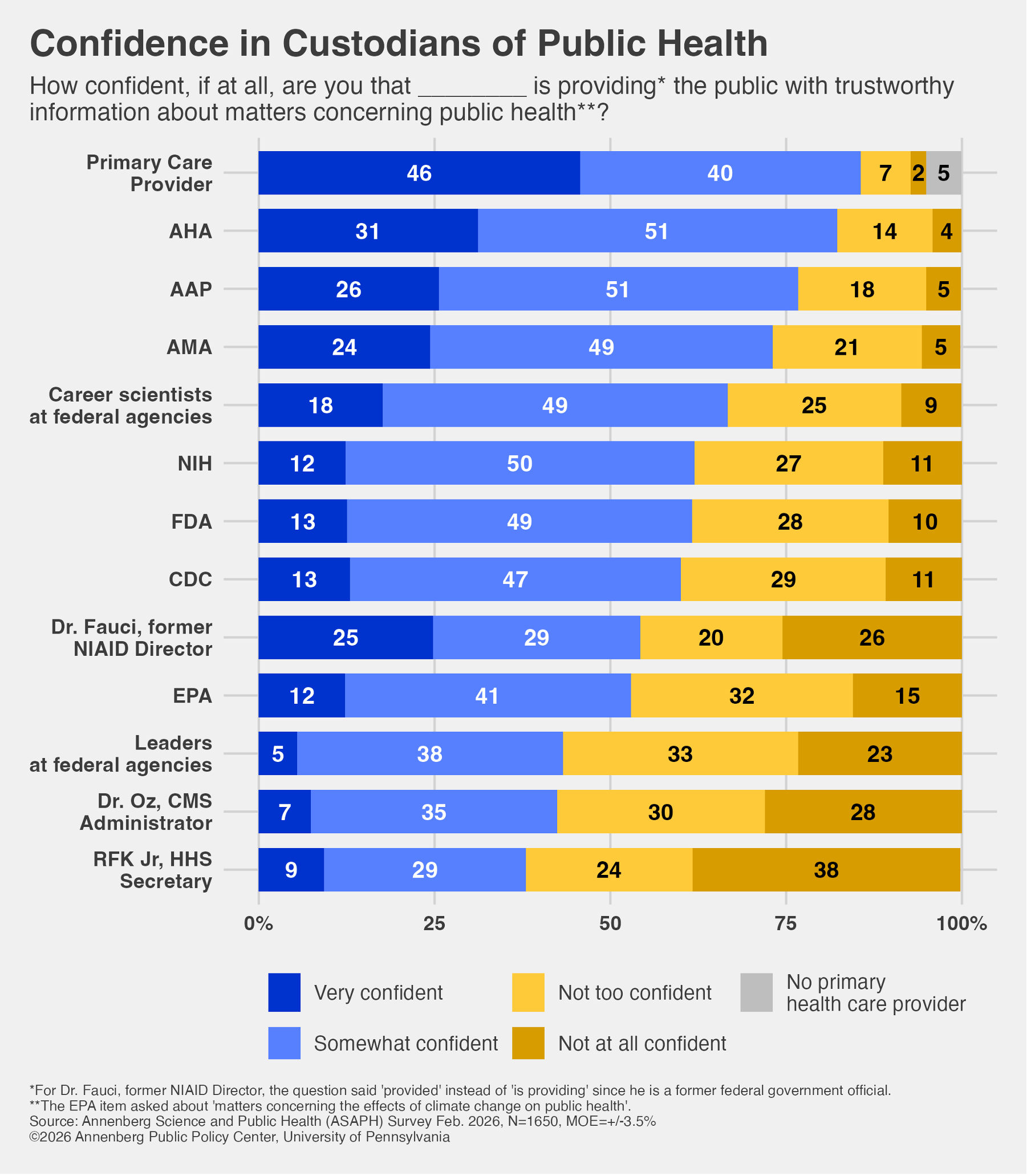
- Career scientists vs. health agency leaders: Two-thirds of Americans (67%) have confidence in career scientists working at U.S. federal health agencies, compared with just 43% confidence in agency leaders overall.
- RFK Jr. and Dr. Oz: About 4 in 10 U.S. adults are confident Health and Human Services Secretary Robert F. Kennedy Jr. (38%) and Dr. Mehmet Oz (42%), administrator of the Centers for Medicare and Medicaid Services, are providing trustworthy information on public health – lower than the confidence people say they had in Dr. Anthony Fauci (54%), former head of the National Institute of Allergy and Infectious Diseases, when he was in office.
- Confidence in experts outside government: People have greater trust in major health and science associations outside government – such as the American Heart Association, American Academy of Pediatrics, American Medical Association, and National Academy of Sciences – than in U.S. health agencies.
- AAP vs. CDC: On vaccinating newborns for hepatitis B, Americans say they are more likely to accept the advice of the American Academy of Pediatrics than the CDC by nearly a 4-1 margin.
- Trust in CDC, FDA, NIH sinking: Year over year in February surveys, public trust in the CDC, FDA, and NIH dropped significantly from 2024 (74%-76%), the final year of the Biden administration, to 2025 (67%), the first year of this Trump administration – and fell again, now, in 2026 (60-62%).
Confidence in career scientists at U.S. health agencies vs. leaders of the agencies
The survey reveals a striking gap between how Americans view career scientists at federal health agencies such as the CDC, NIH, and FDA, vs. the leaders of those agencies, all of which are overseen by Health and Human Services (HHS) Secretary Robert F. Kennedy, Jr., a longtime vaccine critic. Two-thirds of respondents (67%) express confidence in career scientists at the CDC, NIH, and FDA, with only 33% saying they were not confident. By contrast, confidence in the leaders of those same agencies was much lower – just 43% of Americans are confident in the agency leaders, vs. 57% who say they are not confident in them.
Only 5% of Americans say they are “very confident” that the leaders at federal health agencies such as the CDC, NIH, and FDA are providing the public with trustworthy information about matters concerning public health, compared with 18% who are very confident in the career scientists at those agencies.
Levels of confidence in the specific leaders of health agencies are roughly equivalent to the more generic confidence noted above. About 4 in 10 Americans express confidence in HHS Secretary Kennedy (38%) and in Dr. Mehmet Oz (42%), administrator of the Centers for Medicare and Medicaid Services, to provide the public with trustworthy public health information.
Confidence in Oz is significantly higher than it was in April 2025 when he assumed office (33%) and February 2025 (32%), at the beginning of the second Trump administration. There has been no change in confidence for Kennedy, who assumed office in February 2025, over the same period. By comparison, Americans voice greater confidence that Dr. Anthony Fauci, former director of the National Institute of Allergy and Infectious Diseases, provided the public with trustworthy information on matters concerning public health (54%) than either Kennedy (38%) or Oz (42%) do now.
“The public is differentiating the trustworthiness of career scientists in the CDC, NIH, and FDA from that of the leaders of those agencies,” said Ken Winneg, APPC’s managing director of survey research, “and recalling substantially higher confidence in the guidance that former director Fauci provided than that offered by Secretary Kennedy or Dr. Oz.”
Major professional health associations more trusted than U.S. health agencies
Americans voice greater confidence in major professional health associations to provide trustworthy information in matters related to public health than they do in federal health agencies.
Eight in 10 (82%) U.S. adults say they are confident in the American Heart Association (AHA), 77% are confident in the American Academy of Pediatrics (AAP), and 73% are confident in the American Medical Association (AMA) to provide trustworthy information in matters related to public health.
Significantly fewer people say they are confident in the CDC (60%), NIH (62%), and the FDA (62%) in this regard. The confidence in agency numbers are notably lower than confidence in career scientists at those agencies (67%).
In the areas of vaccine safety and safe alcohol consumption, Americans are more likely to accept the recommendations of major professional health associations than the recommendations of the federal health agencies charged with protecting Americans’ health.
Vaccine safety
The CDC provides the American public with information about vaccine safety and effectiveness. Six in 10 Americans (59%) say they are confident that the CDC is providing the public with trustworthy information about the safety and effectiveness of vaccines. However, if the American Medical Association and the CDC disagree on the safety of a vaccine, Americans are twice as likely to accept the recommendation of the AMA (34%) than the CDC (15%). A third say they are not sure (34%) and 17% say they would take neither group’s recommendation. This finding matches results from an APPC survey conducted in November 2025, with a different national probability sample, when 35% said they would accept the AMA recommendation on vaccine safety and 16% said they would accept the CDC’s recommendation.
The CDC also recommends the schedule for childhood vaccines. In December 2025, the CDC changed the childhood immunization schedule for the hepatitis B vaccine, which had been universally recommended to all newborns, limiting its recommendation to “infants born to women who tested positive for the hepatitis B virus or whose status is unknown.” The CDC advised other parents to use a process of “shared clinical decision-making” with a health care provider when deciding whether to vaccinate their infant against hepatitis B. The American Academy of Pediatrics (AAP) responded in January 2026 by recommending the previous CDC guidance: “universal hepatitis B vaccination for all infants, beginning with the first dose within 24 hours of birth.”
The Annenberg survey shows that the CDC’s current recommendations are less likely to be accepted than the recommendations of the AAP. When asked which recommendation they would accept if there were a disagreement between the AAP and the CDC on whether newborns should be given a hepatitis B vaccine, Americans are nearly four times more likely to accept the recommendation of the AAP (42%) than the CDC (11%). Again, about a third of those surveyed (32%) say they are unsure, and 16% would take neither.
Safe Alcohol Use
Americans also trust a major professional health association, the AMA, over federal health agencies for guidance concerning safe alcohol use. When asked which of five organizations they trust the most when it comes to information about safe alcohol use, more choose the AMA (32%) than the National Institute on Alcohol Abuse and Alcoholism (14%) or the CDC (9%). A plurality (40%) is not sure which to trust the most, while small numbers choose the National Alcohol Beverage Control Association (4%) and Distilled Spirits Council of the United States (1%).
“These findings reflect a clear divergence in how Americans view federal health agencies versus major professional health associations,” said Laura A. Gibson, a senior data analyst at the Annenberg Public Policy Center.
On climate, public trusts National Academy of Sciences 2-1 over EPA
When asked to choose between the National Academy of Sciences (NAS) and the Environmental Protection Agency (EPA) if those groups disagree on the causes of climate change, 30% say they would be more likely to accept the conclusion of the NAS vs. 14% for the EPA, with 20% choosing neither and 36% saying they are unsure. Overall confidence in the EPA as a source of trustworthy information concerning the effects of climate change on public health has declined 20 percentage points in a little more than two years. In the current survey, 53% of Americans express confidence in the EPA on this issue, down from 73% in November 2023, while the proportion who lack confidence in the EPA on this issue has risen to nearly half the population (47%) from 27% in November 2023.
Confidence in health agencies drops in first year of Trump administration
Americans’ confidence that the CDC, FDA, and NIH are providing the public with trustworthy information about matters concerning public health declined significantly from February 2024, the final year of the Biden administration, to February 2025, the beginning of the second Trump administration, and again to February 2026, the current survey.
Confidence levels were higher in February 2024 (74% to 76%) and remained stable in April, July, and September of Biden’s final year in office. Confidence began to significantly decline under Trump, beginning in February 2025 (67% for all three) and dropped further in the latter part of 2025 to levels where they currently stand.
CDC: While a majority of people continue to say they are confident the CDC is providing trustworthy information on public health, the proportion is lower today than at the start of this Trump term or the final year of Biden’s term. Six in 10 (60%) in the current, February 2026, survey are confident the CDC provides trustworthy information about matters concerning public health, down from 67% in February 2025 and 76% in February 2024. (The numbers took a significant drop to their current level in December 2025.) The percentage of those who are “very confident” in the CDC is significantly lower (13%) than in February 2025 (23%) and February 2024 (31%).
FDA: As with the CDC, confidence that the FDA is providing the public with trustworthy information about matters concerning public health has declined year over year. In the current survey, 62% express confidence in the FDA, a significant drop from 67% in February 2025 and 74% in February 2024. (The numbers took a significant drop to their current level in December 2025, to 62%, the current level.)
NIH: The survey shows similar levels of decline in Americans’ confidence in the NIH to provide the public with trustworthy public health information. In the current survey, 62% say they are confident in the NIH, significantly lower than 67% in February 2025 and 75% in February 2024. (These numbers took a significant drop in August 2025 to 62%, the current level.)
Confidence in one’s own health provider remains highest
A strong majority of Americans have confidence that their own primary health care provider is providing trustworthy information about matters concerning public health. The survey shows that 86% are confident that their doctor, nurse, or other primary health care provider is providing trustworthy information. Confidence in one’s own health care provider remains the highest of all measured items, including U.S. agencies, their leaders, and career scientists, and is significantly higher than confidence in the major professional health organizations (AMA, AHA, and AAP).
APPC’s ASAPH survey
Wave 28 of the Annenberg Science and Public Health (ASAPH) panel survey was conducted Feb. 3-17, 2026, among 1,650 U.S. adults. Data were collected by SSRS, an independent research company, via web and telephone using a nationally representative probability sample from SSRS’s Opinion Panel. The margin of error is ±3.5 percentage points. The panelists are quarantined from other survey panel membership to avoid response bias from other surveys. The ASAPH panel has been fielded continuously since April 2021 across 28 waves.
Download the topline and methodology report.
The policy center has been tracking the American public’s knowledge, beliefs, and behaviors regarding vaccination, Covid-19, flu, RSV, and other consequential health issues through the Annenberg Science and Public Health (ASAPH) and separate national samples since April 2021. APPC’s health survey team includes Ken Winneg, managing director of survey research, research analyst Laura A. Gibson, and Patrick E. Jamieson, director of the Annenberg Health and Risk Communication Institute.
See other recent Annenberg health survey news releases:
- Vaccine safety: Study finds declining perceptions of safety of Covid-19, flu, and MMR vaccines (Feb. 10, 2026)
- RSV: Most would recommend RSV immunizations for infants, older adults, and during pregnancy (Jan. 21, 2026)
- Shared decision-making: CDC urges “shared decision-making” on some childhood vaccines; many unclear about what that means (Jan. 5, 2026)
- MMR vaccine: As measles cases rise, views of MMR vaccine safety and effectiveness and willingness to recommend it drop (Dec. 22, 2025)
- Whooping cough: Cases of whooping cough remain high, but knowledge about the disease still low (Dec. 18, 2025)
The Annenberg Public Policy Center was established in 1993 to educate the public and policy makers about communication’s role in advancing public understanding of political, science, and health issues at the local, state, and federal levels.