PHILADELPHIA – The United States is experiencing the worst year for measles cases in more than three decades, with nearly 2,000 cases confirmed by the Centers of Disease Control and Prevention (CDC). There have been 49 outbreaks spanning 44 states, with major outbreaks in Texas, along the Utah-Arizona border, and most recently, in South Carolina, where hundreds of people who were exposed to the virus have been quarantined.
A vaccine-preventable illness, measles is highly contagious and potentially deadly, especially for young children. This year’s outbreaks have led to three deaths, including two children. Although measles was declared “eliminated” from the United States in 2000, thanks largely to what the CDC calls “a highly effective vaccination program,” if the current outbreaks cannot be stopped, the nation may lose its elimination status, which is determined by the World Health Organization.
According to the CDC, 93% of the confirmed measles cases in the United States are among those who are unvaccinated or whose vaccination status is unknown.
As U.S. cases rise, a new nationally representative panel survey by the Annenberg Public Policy Center (APPC) of the University of Pennsylvania finds a small but significant drop in the proportion of the public that would recommend that someone in their household get the MMR vaccine, which protects against measles, mumps, and rubella. The survey of 1,637 U.S. adults, which was conducted Nov. 17-Dec. 1, 2025, finds drops in both the perceived safety and effectiveness of the MMR vaccine, as well as for two other vaccines, for seasonal flu and Covid-19. The public does, however, continue to see vaccination as the best defense against diseases like the measles. See the end of this news release or the topline for additional details.
“Vaccination dispatched measles to the history books for most children in the United States,” said Patrick E. Jamieson, the director of APPC’s Annenberg Health and Risk Communication Institute. “Tragically, fears driven by misinformation have revived the threat.”
Decline in likelihood to recommend MMR vaccine
According to the CDC, “The best way to protect against measles is to get the measles, mumps, and rubella (MMR) vaccine.”
The survey finds that most people (86%) say they would be likely to recommend that someone in their household who is eligible for the measles, mumps, and rubella (MMR) vaccine get the vaccine. This represents a small but significant decline from November 2024, when 90% said they would recommend the MMR vaccine to eligible members of their household. Respondents also report significant declines in the likelihood they would recommend vaccines against HPV, or human papillomavirus (75%, down from 79% in November 2024) and polio (85% down from 88% in November 2024) to eligible people in their household over the same time period.
A regression analysis shows that the average decline in recommending the MMR vaccine is not significantly different from those other declines.
“The small but significant decreases in the likelihood to recommend the MMR, HPV, and polio vaccines should be a cause for concern,” said Ken Winneg, APPC’s managing director of survey research.
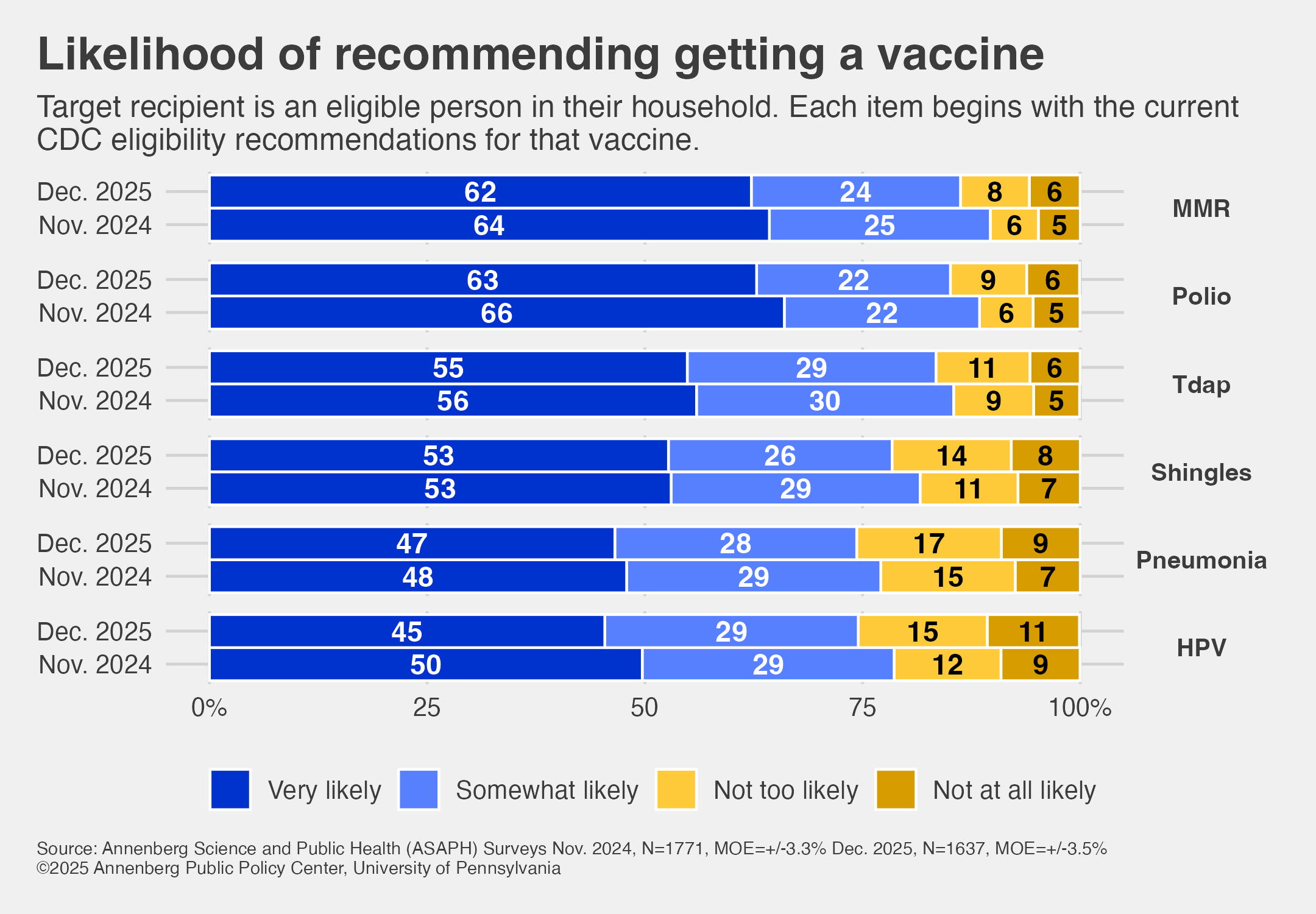
The likelihood of people recommending three other vaccines to people in their household — the shingles, Tdap (tetanus, diphtheria, and pertussis) and pneumonia vaccines — did not change significantly from 2024 to 2025.
Views of safety and effectiveness of MMR vaccine down from 2022
Safety: More than 8 in 10 people (83%) rate the MMR vaccine as safe. While that proportion has remained about the same since APPC surveys conducted in 2024 and 2023, it is significantly lower than how people perceived its safety in August 2022, when 88% considered the MMR vaccine safe – a drop of five percentage points from the current survey. Survey respondents also show significant declines in the perceived safety of the seasonal flu vaccine (80%, down from 85% in August 2022) and Covid-19 vaccine (65%, down from 73% in August 2022) over the same time period.
Effectiveness: Since August 2022, results from APPC surveys have shown a significant decline in the perceived effectiveness of the MMR vaccine in preventing symptomatic disease as well.* In the current survey, 83% say that the MMR vaccine is effective, down from 87% in 2022. Respondents similarly report significant declines in the perceived effectiveness of the vaccines against the flu (72%, down from 81% in August 2022) and Covid-19 (61%, down from 69% in August 2022) over the same time period.
Here, regression analyses show that the average decline in the perceived safety, and separately the perceived effectiveness, of the MMR vaccine is significantly smaller than the declines in perceived safety or effectiveness of the other vaccines assessed, including flu and Covid-19.
MMR vaccine still considered safer than diseases it prevents
The survey finds no change in the relative perception of the safety of getting the MMR vaccine compared with getting the diseases it protects against. Three in 4 people (76%) say it is true that it is safer to get the MMR vaccine than to get the diseases it protects against: measles, mumps, or rubella. This is unchanged since February 2024, when we last asked this question.
Worry about contracting measles declines since April 2025
People’s worry that they or a family member will get measles in the next three months has decreased slightly but significantly since April 2025. In the current survey, 13% say they are worried that they or someone in their family would contract measles over the “next three months,” a four-point decline from April 2025 (17%). By contrast, among illnesses that people are susceptible to year-round, respondents are more worried about Covid-19 in the current survey (25%) than they were in April 2025 (20%). “Since measles cases are surging, this is a surprising finding,” Jamieson said.
Though worry is low, many say it would be ‘bad’ to have measles
More than two-thirds (68%) say that it would be “bad” for them to have the measles, including 31% who say it would be “extremely bad.” In August 2022, a smaller majority (58%) said getting measles would be “bad.” More respondents think it would be bad to have polio (87%) or skin cancer (80%, up from 76% in 2022), and fewer respondents think it would be bad to have the seasonal flu (25%) or Covid-19 (42%). Regression analyses show that the average increase in people reporting that it would be “bad” to have measles is significantly larger than any other illness assessed.
Vaccines still seen as the best defense against diseases like measles
Nearly 8 in 10 people (76%) correctly say it is true that vaccines are the best defense we have against measles, chickenpox, polio, and Covid-19, which represents no change since 2024. “Individuals deciding not to vaccinate against measles, chickenpox, polio, or Covid-19 put both their families and communities at risk because these diseases are so infectious,” said Laura A. Gibson, an APPC research analyst.
APPC’s ASAPH survey
The survey data come from the 26th wave of a nationally representative panel of 1,637 U.S. adults conducted for the Annenberg Public Policy Center by SSRS, an independent market research company. This wave of the Annenberg Science and Public Health Knowledge (ASAPH) survey was fielded Nov. 17-Dec. 1, 2025. The margin of sampling error (MOE) is ± 3.5 percentage points at the 95% confidence level. All figures are rounded to the nearest whole number and may not add to 100%. Combined subcategories may not add to totals in the topline and text due to rounding.
Download the topline and the methods report.
The policy center has been tracking the American public’s knowledge, beliefs, and behaviors regarding vaccination, Covid-19, flu, RSV, and other consequential health issues through this survey panel since April 2021. APPC’s survey team includes Patrick E. Jamieson, director of the Annenberg Health and Risk Communication Institute; research analyst Laura A. Gibson; and Ken Winneg, managing director of survey research.
See other recent Annenberg health survey news releases:
- Whooping cough: Cases of whooping cough remain high, but knowledge of the disease still low (Dec. 18, 2025)
- Support for hepatitis B vaccine: Although public overwhelmingly supports hepatitis B vaccine for a newborn, partisan differences exist (Dec. 5, 2025)
- CDC vs. AMA on vaccine safety: Americans more likely to trust American Medical Association than CDC on vaccination safety (Dec. 3, 2025)
- Measles and the MMR vaccine: Public not highly knowledgeable about safety of MMR vaccine or risks of getting measles (Oct. 30, 2025)
- Vaccination during pregnancy: Under half in U.S. would recommend some routine vaccinations during pregnancy (Sept. 30, 2025)
The Annenberg Public Policy Center was established in 1993 to educate the public and policy makers about communication’s role in advancing public understanding of political, science, and health issues at the local, state, and federal levels.
* Updated Feb. 11, 2026, to indicate that the question asked about the effectiveness in preventing symptomatic disease.