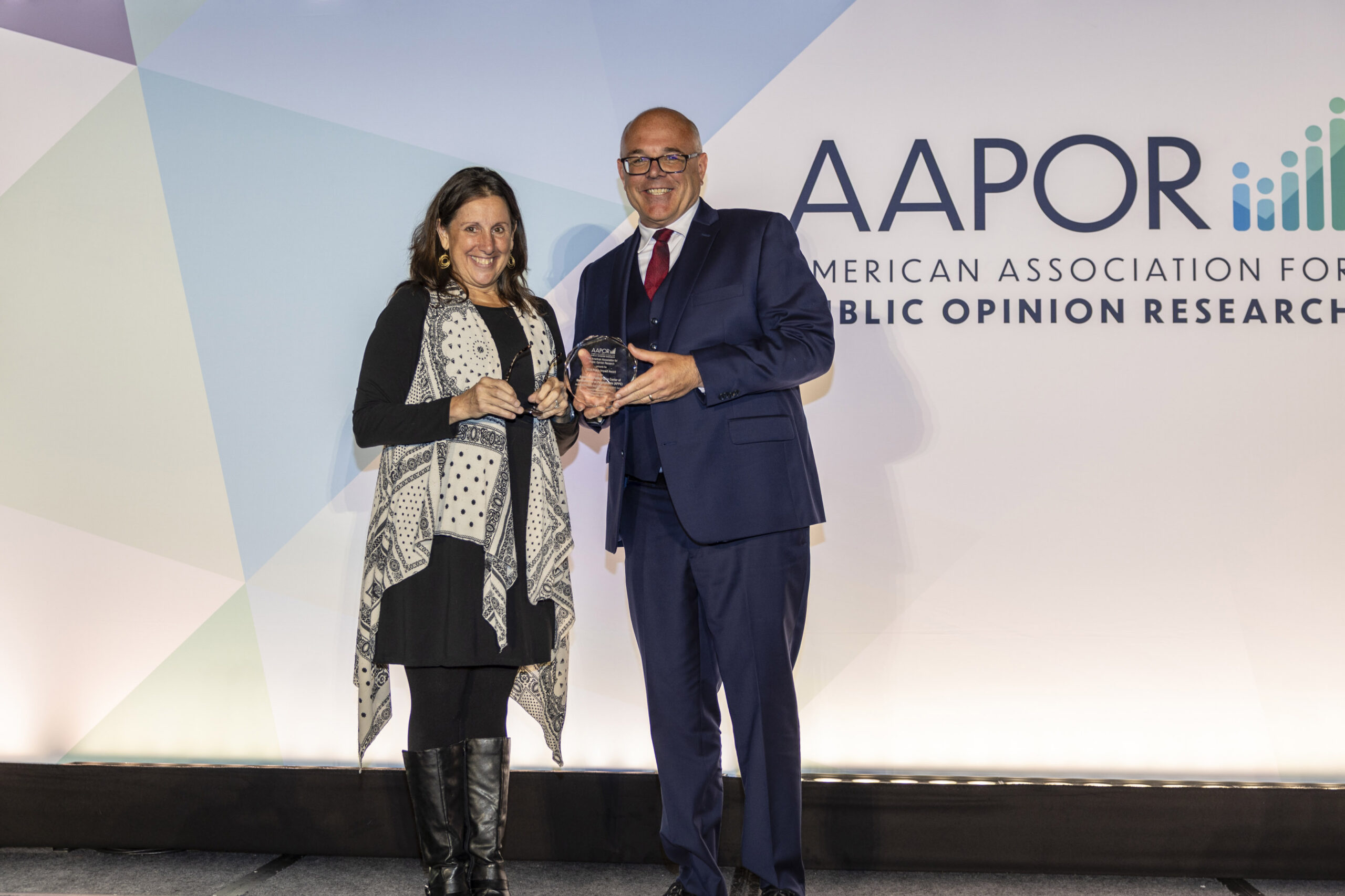
A signature survey of the Annenberg Public Policy Center (APPC) has won the American Association for Public Opinion Research’s (AAPOR) 2026 Policy Impact Award.
The award recognizes the policy center’s Annenberg Science and Public Health survey (ASAPH), a nationally representative, probability-based panel study that was launched by APPC’s Annenberg Health and Risk Communication Institute (AHRCI) in April 2021 and is now in its 29th wave. The award was presented in Los Angeles on May 14, 2026, at AAPOR’s 81st annual conference.*
In its award citation, AAPOR cited the survey’s sustained contribution to understanding public attitudes toward science and health:
The ASAPH survey provides an ongoing, methodologically rigorous barometer of what the public knows, believes, and trusts about science and health, with particular emphasis on vaccination, emerging infectious diseases, and the credibility of public health institutions. These repeated ASAPH measures have informed vaccine policy debates, federal advisory processes, and federal responses to emerging health threats while illuminating critical trust gaps in governmental and professional health agencies. For its exemplary use of survey data to inform health policy, strengthen public discourse, and enhance the nation’s capacity to respond to continuing and emerging health challenges, AAPOR is pleased to recognize the Annenberg Science and Public Health (ASAPH) survey with the 2026 Policy Impact Award.

“For more than three-quarters of a century, AAPOR has set high standards for those employing survey research. The ASAPH team is particularly proud to receive the AAPOR’s Policy Impact Award,” said Patrick E. Jamieson, director of AHRCI. “We are grateful for the recognition that APPC’s signature science and public health survey has proven helpful to individuals and policy makers confronting continuing and emerging health challenges.”
Since 2021, the ASAPH survey has tracked shifts in Americans’ knowledge, beliefs, and behaviors on major public health issues, including vaccine policy and safety, prevention of infectious disease transmission, and trust in public health institutions.
Survey questions have focused on knowledge and behaviors related to topics ranging from maternal health to sexually transmitted infections; vaccination recommendations; the Centers for Disease Control and Prevention’s (CDC) move to “shared clinical decision-making” for some vaccines; the risks associated with bird flu in raw milk; the relationship between alcohol consumption and cancer risk; awareness of the 988 Suicide and Crisis Lifeline; and guidance to prevent sudden infant death syndrome (SIDS). The survey also tracks public confidence in individuals’ primary healthcare providers, U.S. health officials, key federal agencies, and nongovernmental organization such as the American Medical Association and the American Academy of Pediatrics.
The ASAPH team and its collaborators share results in regular press releases and in scholarly publications on, for example, public perceptions of scientists, how “mental models” can be used to undercut misinformation, and how science-consistent climate beliefs predict climate-related behavior and support for public policies.
Since 2023, ASAPH findings have been viewed millions of times through coverage in digital, print, broadcast, and wire service outlets. The data have been cited by leaders at the National Institutes of Health and other federal agencies in a Nature Medicine commentary; referenced in an Advisory Committee on Immunization Practices (ACIP) report on the polio vaccine; cited in a congressional hearing on the pandemic; included in CDC reports on vaccine confidence, and served as a basis for an article in the Proceedings of the National Academy of Sciences (PNAS) on confidence in science.

“This award reflects the hard work of a dedicated team committed to careful, transparent research,” said Ken Winneg, APPC’s managing director of survey research. “We value AAPOR’s role in reminding both researchers and the public that high-quality survey data help strengthen public health policy and trust.”
Founded in 1947, AAPOR describes itself as “the leading association of public opinion and survey research professionals.” Past winners of the Policy Impact Award include International Health Policy Surveys (2025), American National Election Studies (2024), the U.S. Census Bureau for the American Community Survey (2019), the Urban Institute’s Health Reform Monitoring Survey (2016), the Henry J. Kaiser Family Foundation’s Kaiser Health Tracking Polls (2015), and the RAND Corporation’s HIV cost and services utilization study (2005).
In addition to Jamieson and Winneg, the ASAPH team includes research analysts Laura A. Gibson and Shawn Patterson Jr. The survey is funded by the AHRCI endowment established for APPC by the Annenberg Foundation and conducted for the policy center by SSRS, an independent market research company.
The Annenberg Public Policy Center of the University of Pennsylvania was established in 1993 to educate the public and policy makers about communication’s role in advancing public understanding of political, science, and health issues at the local, state, and federal levels.
* Updated on June 4, 2026.