Over a third of U.S. adults (35%) cannot name all three branches of the government and under half can name four of the five rights protected by the First Amendment, according to the 2026 Annenberg Constitution Day Civics Survey from the Annenberg Public Policy Center (APPC) of the University of Pennsylvania. Of the five First Amendment rights, only freedom of speech is identified by more than half of survey respondents.
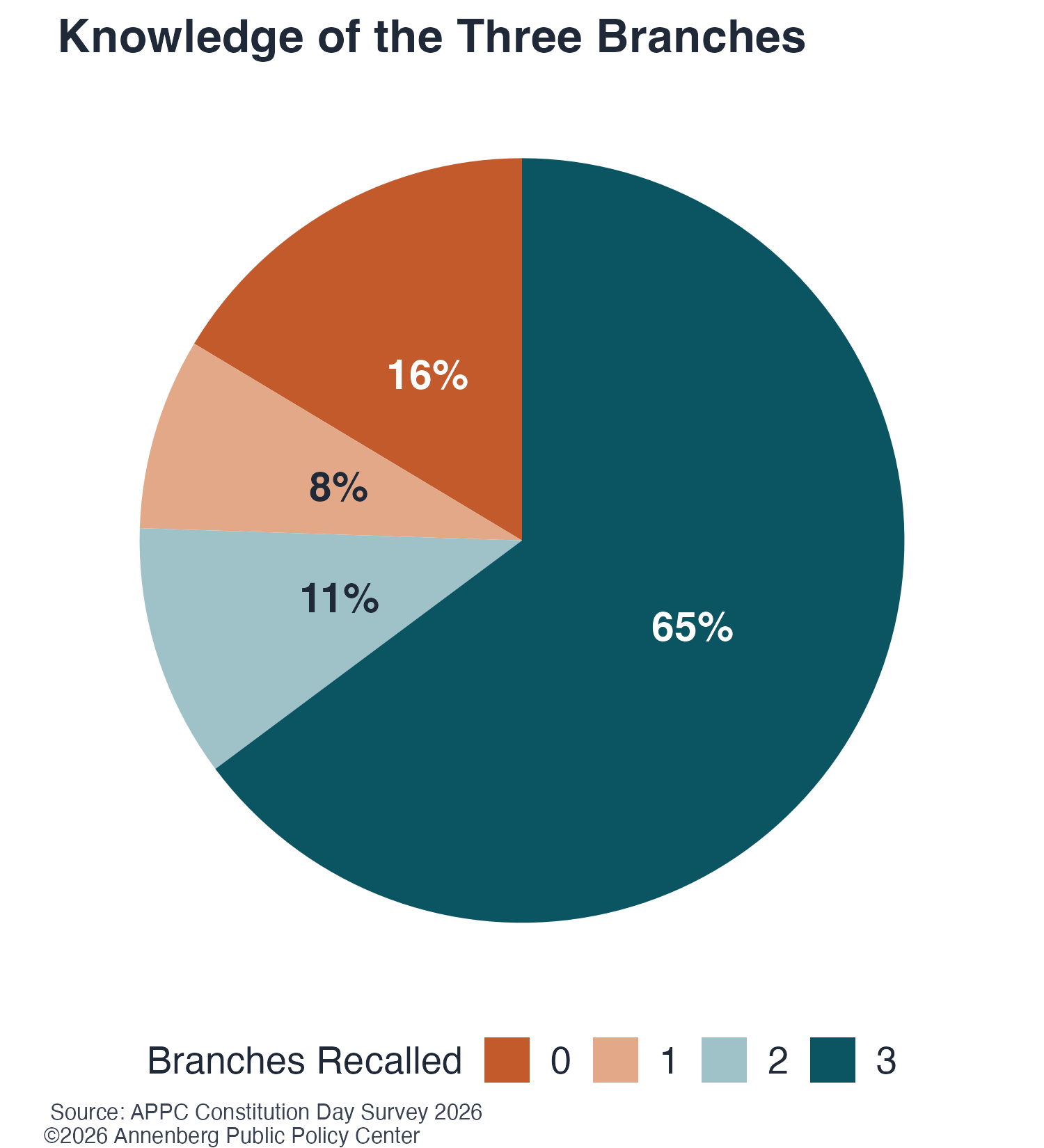 Conducted Aug. 6-9, 2026, among a nationally representative sample of 1,034 U.S. adults, the survey finds that 65% can name the executive, legislative, and judicial branches, which is not a statistically significant change from 70% in 2025 and 65% in 2024.
Knowledge of the rights guaranteed by the First Amendment shows one significant change from the prior year’s survey. When asked in an open-ended question if they can name the specific rights guaranteed by the First Amendment, 73% cite freedom of speech, significantly fewer than the 79% who named that in 2025, but statistically the same as 2024 (74%).
Responses for the other four rights do not differ significantly from the past two years. Fewer than half (43%) name freedom of religion and fewer than one-third name freedom of assembly (31%) or freedom of the press (29%). Just over 1 in 10 (12%) name the right to petition the government. In all, 9% of respondents correctly name all five First Amendment protections, while 24% name none of them. A quarter (25%) incorrectly cite the right to bear arms, which is protected by the Second Amendment, not the First.
“Ignorance is costly,” said Kathleen Hall Jamieson, director emerita of the Annenberg Public Policy Center. “You can’t protect and cherish rights that you don’t know you have.”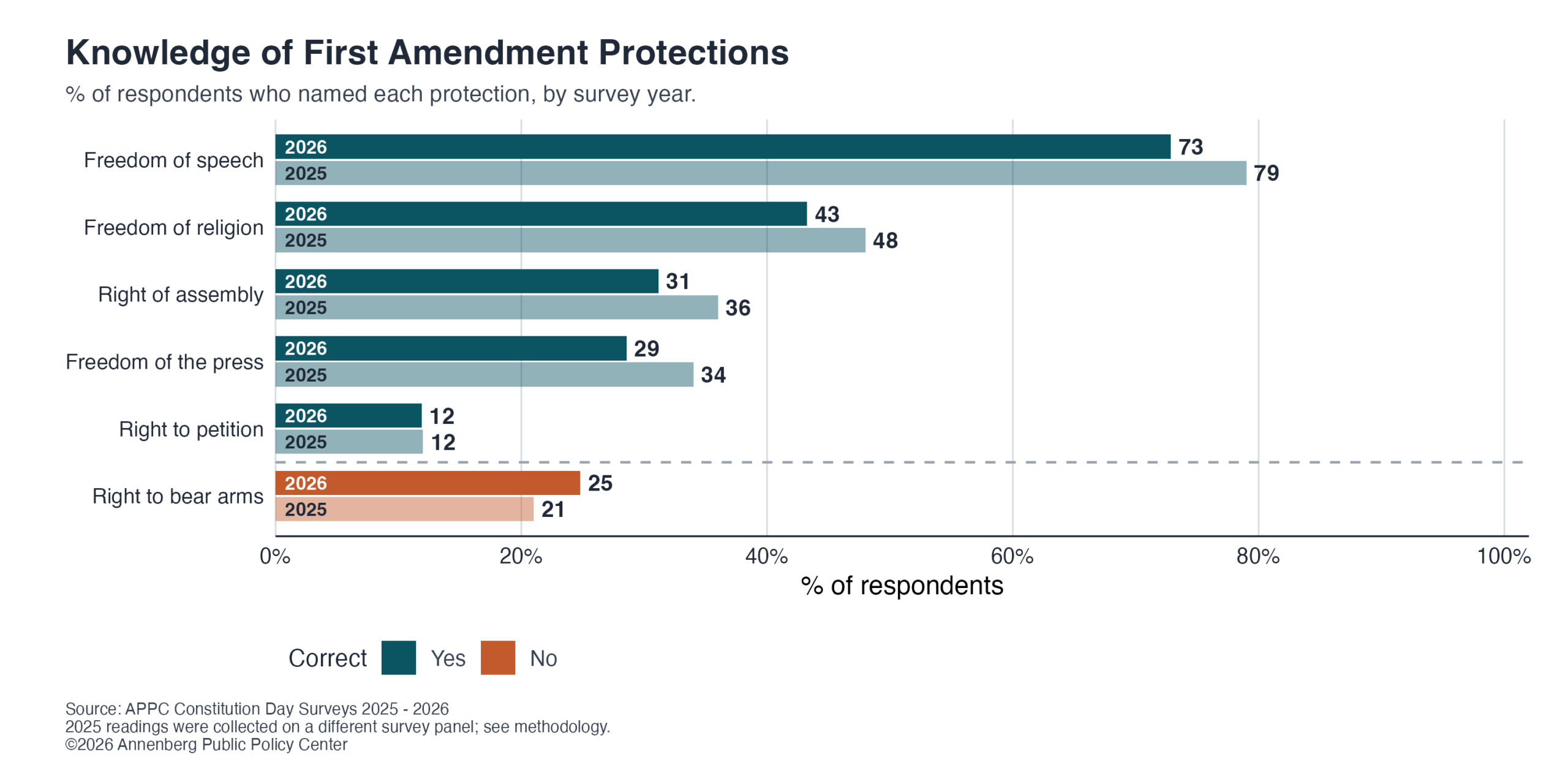
Majority knows immigrants in the U.S. illegally have rights under the Constitution
As U.S. courts weigh the meaning of birthright citizenship, the survey finds that most Americans know the U.S. Constitution protects the rights of people who are in the country illegally. Over half (56%) of U.S. adults say it is “very” or “somewhat” inaccurate to say that people who are in the country illegally do not have any rights under the Constitution, while 44% say it is accurate. The Supreme Court has long held that the Constitution’s core protections are written in terms of “persons,” not citizens, and apply to people in the United States regardless of immigration status.
Similarly, three-quarters (76%) correctly say that children born in the United States and subject to its jurisdiction are U.S. citizens if neither of their parents is a citizen (birthright citizenship).
Veto power, the Supreme Court, states’ rights
This year’s survey also asked about knowledge of constitutional provisions related to veto power, the role of the Supreme Court, and states’ rights:
- Veto overrides: 83% know that when a president vetoes legislation, the bill becomes law if two-thirds of the members in each house of Congress vote to override the veto.
- A 5-4 Supreme Court ruling: 69% know a 5-4 Supreme Court decision is the law and needs to be followed. Almost 1 in 5 (18%) say the decision is sent back to Congress for reconsideration and 12% say it is sent back to the federal court of appeals to be decided there.
- Who determines what is constitutional: 60% know that the Supreme Court has the final responsibility for determining whether an action by the president is constitutional if the president and the Supreme Court disagree. However, 17% say the final responsibility lies with Congress, 4% say it is with the president, and 19% are not sure.
- States’ rights: Asked what the 10th Amendment to the U.S. Constitution says about the relationship between the states and the federal government, half of U.S. adults (50%) correctly say that powers not granted to the federal government are reserved to the states or the people. About 1 in 8 people (13%) say it’s the other way around – that states only have powers granted to them by the Constitution – and over a third (37%) are not sure which is correct. The 10th Amendment, ratified in 1791 as part of the Bill of Rights, says: “The powers not delegated to the United States by the Constitution, nor prohibited by it to the States, are reserved to the States respectively, or to the people.”
Constitution Day
APPC releases its annual Annenberg Constitution Day Civics Survey in advance of Constitution Day, which celebrates the signing of the Constitution on Sept. 17, 1787. APPC’s initiatives to enhance civics education include Annenberg Classroom, which offers free resources for teaching the Constitution, and the Civics Renewal Network (CRN), a coalition of 50 nonpartisan, nonprofit organizations dedicated to improving civics education by providing free, high-quality resources for teachers. Recently added resources for teachers include the collaborative Constitution Day Hub website and a short film on freedom of the press, “Holding the Line: Journalism & Democracy,” part of Annenberg Classroom’s series of award-winning videos.
“This year’s findings indicate there is still work to be done in strengthening the citizenry’s knowledge of the U.S. Constitution. An understanding of our nation’s founding documents remains paramount for the long-term health of the nation’s democracy,” said R. Lance Holbert, director of APPC’s Leonore Annenberg Institute for Civics (LAIC), the home of Annenberg Classroom and the facilitator of the Civics Renewal Network.
The Annenberg Constitution Day Civics Survey
The Annenberg Constitution Day Civics Survey is a nationally representative survey conducted in advance of Constitution Day by the Annenberg Public Policy Center. The 2026 survey was fielded for APPC by independent research company SSRS on the SSRS Opinion Panel Omnibus from August 6-9, 2026, among 1,034 U.S. adults ages 18 and older. The margin of sampling error is ±3.5 percentage points at the 95% confidence level. Data in 2024 and 2025 were collected on APPC’s Institutions of Democracy and Annenberg Science and Public Health (ASAPH) panel, respectively. See the topline for details.
The Constitution Day Civics survey team comprises Matt Levendusky, director of APPC’s Institutions of Democracy division; research analyst Shawn Patterson Jr.; APPC’s managing director of survey research, Ken Winneg; R. Lance Holbert, director of the Leonore Annenberg Institute for Civics; and APPC director emerita Kathleen Hall Jamieson.
The Annenberg Public Policy Center was established in 1993 to educate the public and policy makers about communication’s role in advancing public understanding of political, science, and health issues at the local, state, and federal levels.