Fifty years ago, George Gerbner and Larry Gross published the first cultivation article, “Living with Television: The Violence Profile,” a foundational article that asked how sustained exposure to television shapes the way people understand the world around them.
This fall, scholars from across the United States, Europe, and Australia returned to the School where the work began to ask a question for the future: can a theory born in the television era explain a world of podcasts, social feeds, algorithms, and artificial intelligence?
Cultivation theory holds that the stories people encounter through media gradually shape how they see the world. Gerbner and Gross developed the theory through the Cultural Indicators project, which tracked the content of television over decades and surveyed viewers about their beliefs. Their research found that people who watch more television are more likely than lighter viewers to hold views of the world that match what they saw on screen. In the decades since, that theory has generated an immense body of research and ranks among the most frequently cited theories of communication. In her opening remarks, Dean Sarah Banet-Weiser called it “one of the most significant and enduring frameworks in communication research.”
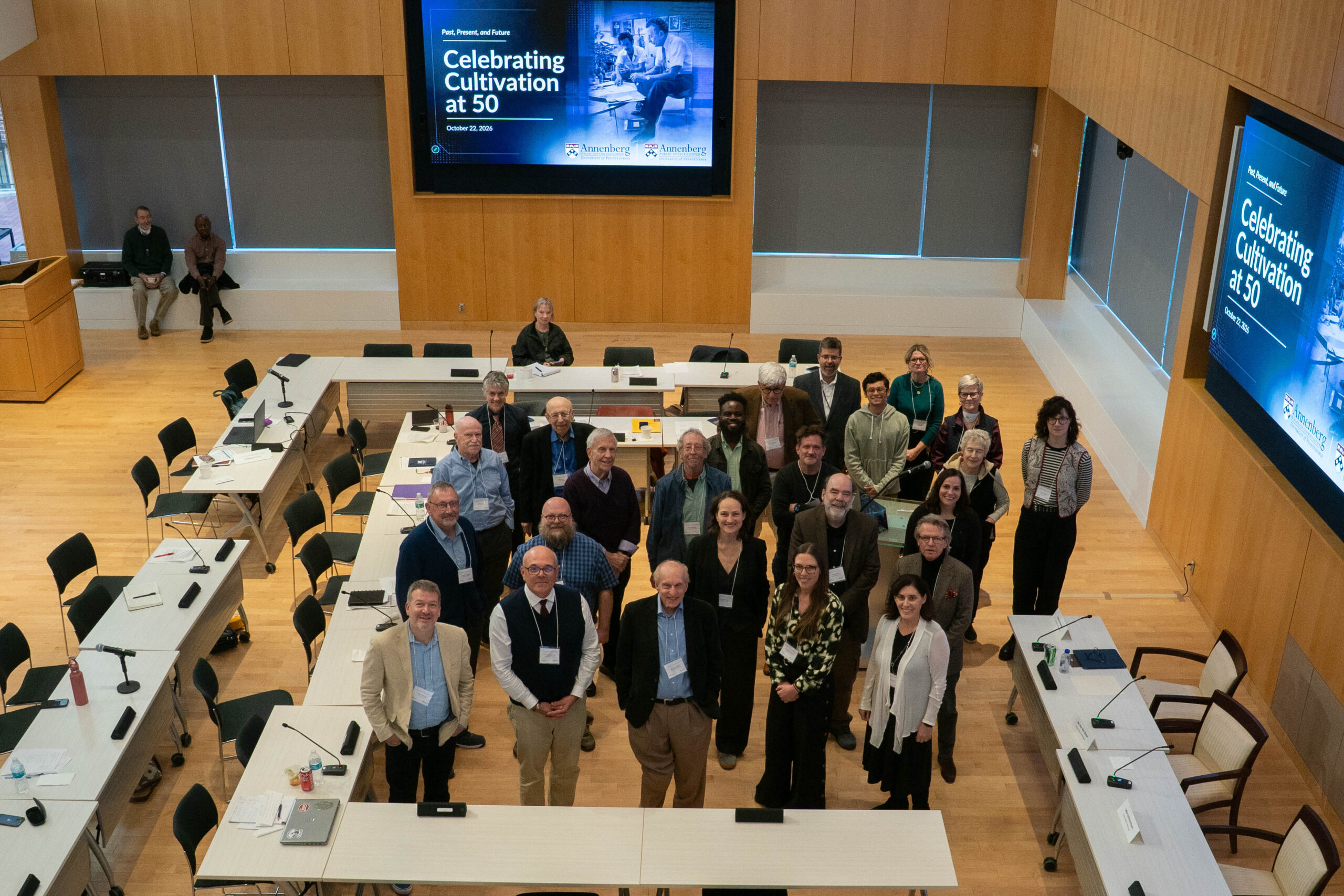
The daylong conference “Celebration of Cultivation at 50: Past, Present, and Future” was hosted by the Annenberg School for Communication at the University of Pennsylvania and the Annenberg Public Policy Center (APPC), and grew out of “Cultivation at 50,” a milestone article in Mass Communication and Society by Michael Morgan (ASC Ph.D. ’80), Richard Perloff, Andy Ruddock, and James Shanahan.
The day was also a reunion: much of the room shared decades of collaboration, debate, and friendship. “We wanted to bring together the people who built this theory and the people testing it today to ask where it goes next,” said Dan Romer, one of the conference organizers and director of APPC’s Annenberg Center for Advanced Study of Communication.
The origins of cultivation
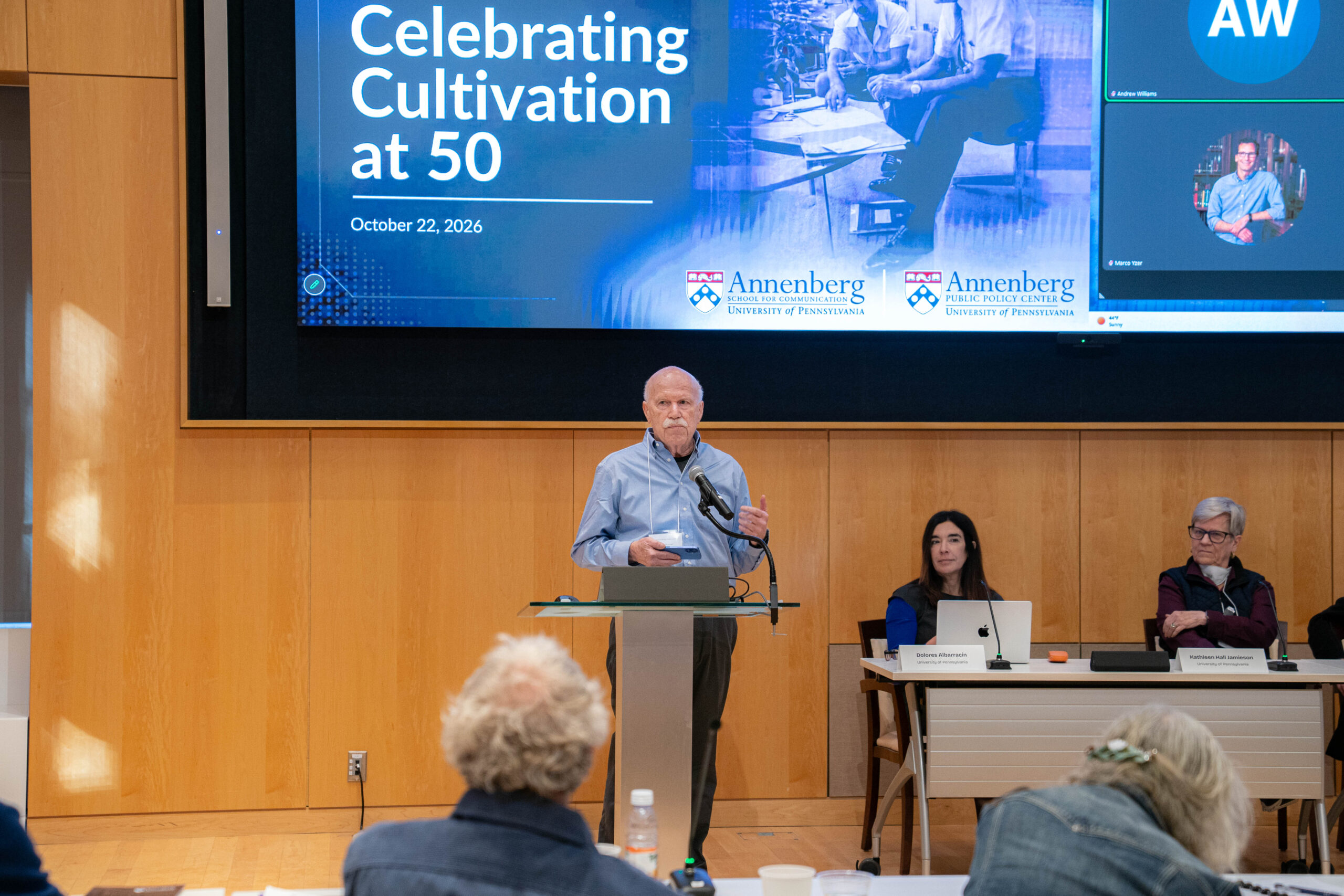
Keynote speaker Larry Gross, who helped build the theory, taught at Annenberg from 1968 until 2003 and worked alongside Gerbner on the Cultural Indicators project beginning in 1970. He recalled how, during the 1960s, reformers questioned the country’s reliance on economic measures such as gross national product as indicators of social progress. They argued that other measures were needed to understand the state of American life.
Gerbner brought that thinking to mass media. His contribution, Gross explained, was to develop a data-driven way to systematically track the stories television was telling, and what those recurring patterns might mean for the people watching.
To understand why Gerbner was so interested in the power of media, the conference’s first panel went further back, examining the experiences that shaped his thinking.
Katharine Gerbner, a historian at the University of Minnesota Twin Cities and Gerbner’s granddaughter, described a life in which the possibilities and power of media became apparent early.
Born in Budapest in 1919, Gerbner’s first publication was a poem in a Hungarian newspaper in 1937, the year he was denied a place at university under codes that limited the number of Jewish students. Gerbner reached out to newspapers to draw attention to his situation, which eventually helped him gain admission, an early lesson in what media could do.
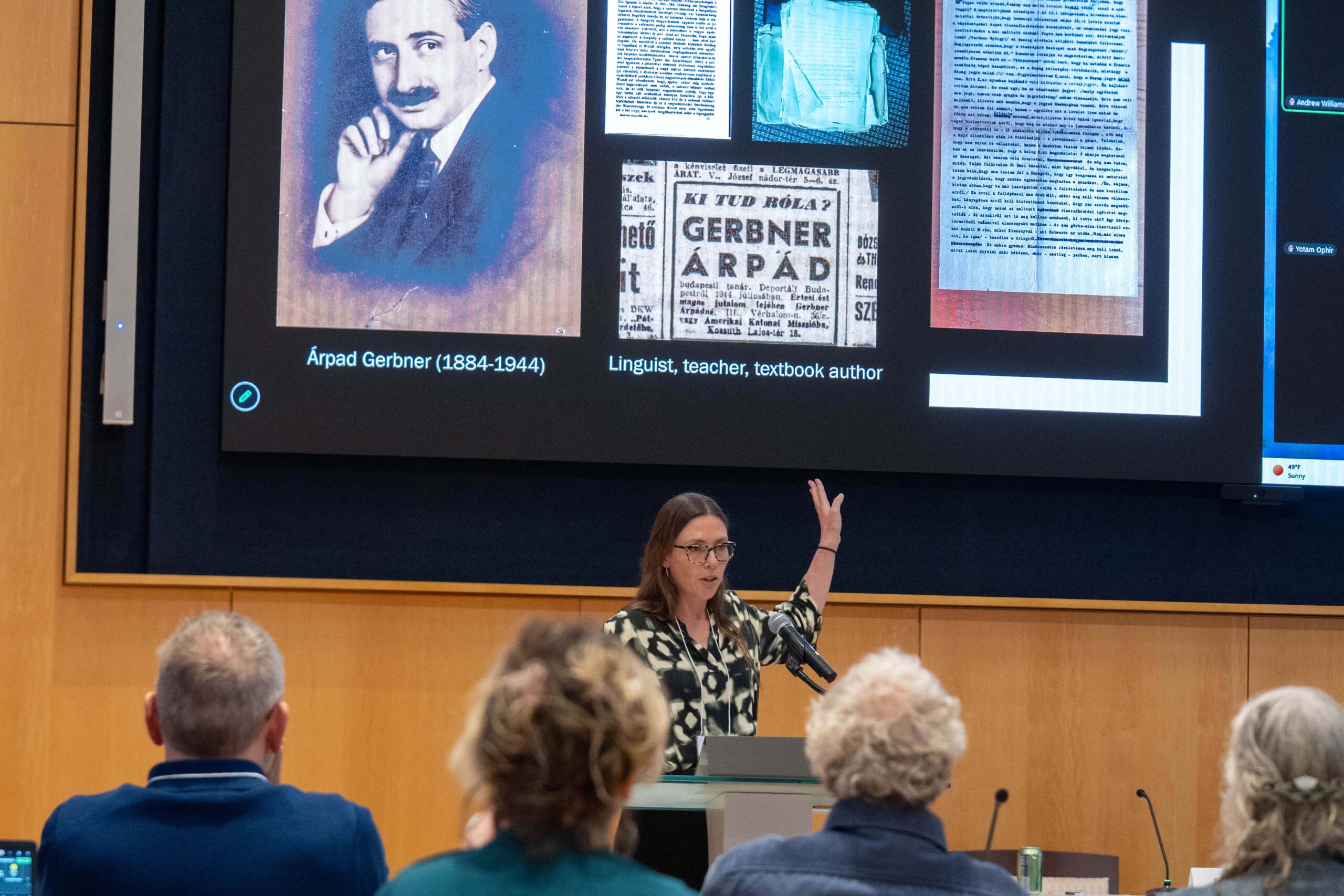
That habit of questioning and leveraging media followed him everywhere. In his granddaughter’s telling, Sunday dinners ran like seminars. As a kid, after she watched “The Little Mermaid,” her grandfather sat her down to talk about its sexism.
Other panelists expanded on Gerbner’s history through materials held in the Annenberg School for Communication Library Archives. Jeff Pooley, a research associate and lecturer at the School, drew from Gerbner’s papers, while Ruddock, of Monash University, traced Gerbner’s relationship with School founder Walter Annenberg through correspondence preserved in the collection.
The theory meets the digital age
The first half of the conference looked back at how cultivation theory emerged, while later conversations confronted a more difficult question: what happens to a theory built around mass television when there is no longer a single mass audience?
Morgan, a professor emeritus at the University of Massachusetts Amherst who earned his Ph.D. at Annenberg, said the fragmentation of media has made cultivation increasingly difficult to study. He noted that viewers once chose among three or four programs at a time, whereas now viewers have the option of, for instance, selecting from the 700,000 hours of YouTube videos uploaded every day. “It’s just become impossible to study the system,” he said. He expressed “very serious reservations” about applying cultivation to social media. “I think maybe we need a new theory or a new name or something modified.”
Others saw the possibility in the same changes. Shanahan, a professor at Indiana University who moderated the panel, said “there could be a new golden age of cultivation coming,” pointing to AI tools that now do in minutes what once took researchers years. Others at the meeting took up the question of what cultivation means today in other ways, from the psychological processes behind media effects to the spread of conspiracy beliefs, including with presentations by scholars from APPC, as well as alumni such as Robin Nabi (Ph.D. ‘98) and Bruce Hardy (Ph.D. ’10).
The anniversary paper strikes a balance between those views. Morgan, Perloff, Ruddock, and Shanahan conclude that cultivation methods may struggle with digital media, but the framework it has established is still vital to understanding shifts in media-centric societies: “It has weathered the storms and continues to be relevant to media today, if in a different way,” they write. “In a field where theories come and go, cultivation remains protuberant with prospective predictions about media, message effects, and power.”
This story by Jonathan Allan was originally published by the Annenberg School for Communication.