In June 1993, publisher, philanthropist, and ambassador Walter H. Annenberg announced what was then the largest gift to private education in U.S. history, $365 million, to several institutions. The gift included $120 million to his alma mater, the University of Pennsylvania – $100 million to endow the Annenberg School for Communication (ASC) and $20 million to create an Annenberg Public Policy Center (APPC), to be directed by Kathleen Hall Jamieson, the university’s Elizabeth Ware Packard Professor of Communication and then dean of the Annenberg School (1989-2003), who brought the gift to Penn.
Since its founding, the policy center has examined public opinion and the effects of fact-checking and other forms of communication across politics and civics, health and science, adolescent risk and climate. Under Jamieson, it has produced influential research on topics as diverse as civics education and campaign finance reform, children’s television programming and civility in Congress, suicide reporting guidelines for news media and messaging about vaccine policy and substance use.
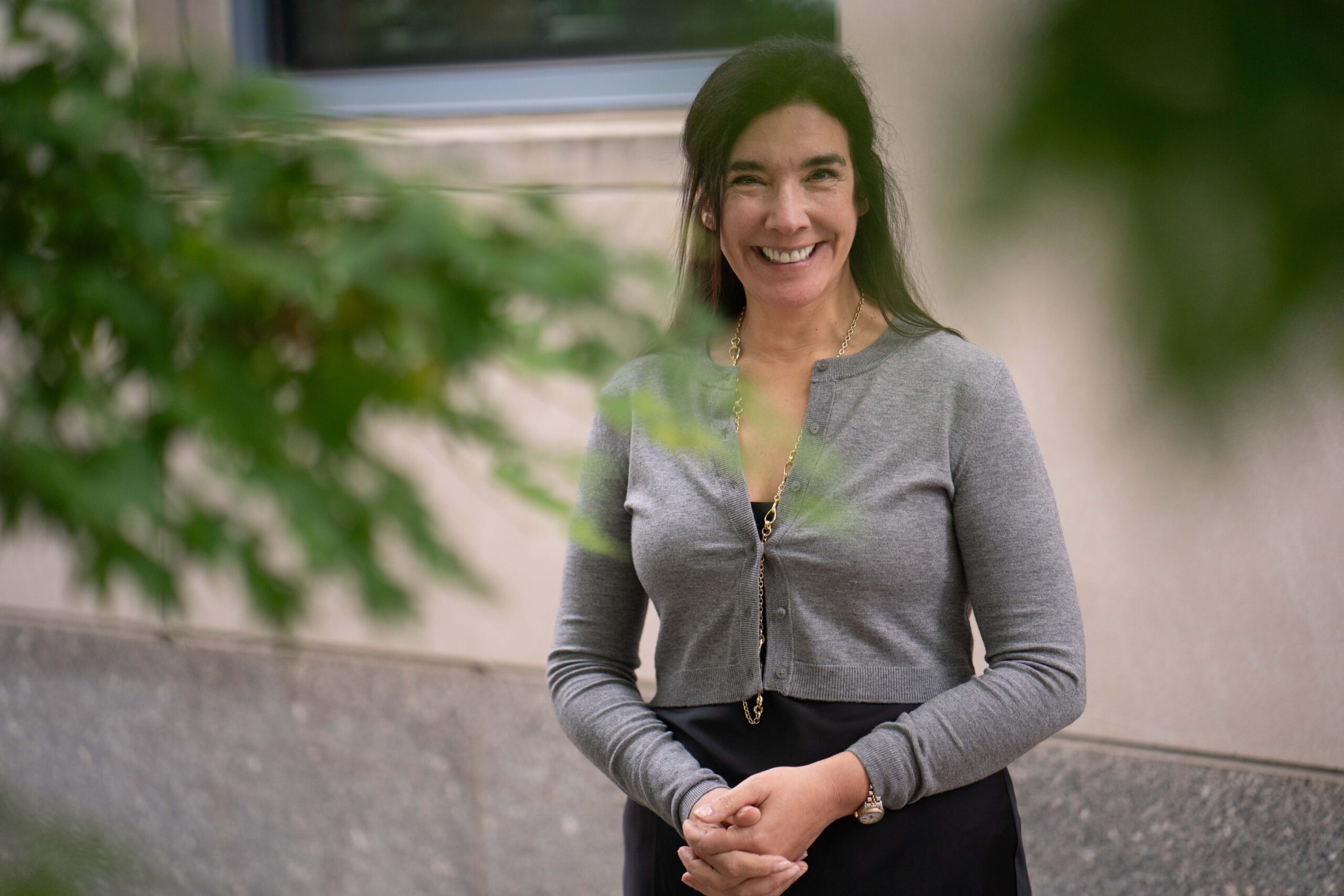
Following three decades of Jamieson’s leadership, on July 1st, 2026, Penn Integrates Knowledge (PIK) Professor Dolores Albarracín will assume the policy center’s directorship.
An award-winning social psychologist with appointments at the Annenberg School and the School of Arts and Sciences’ psychology department, Albarracín directs the Social Action Lab at Penn as well as the policy center’s Communication Science division.
“There is no scholar in the country more qualified to direct the policy center at this time than Dolores Albarracín,” said Jamieson, who will take on the title of director emerita and continue to supervise several research areas at APPC.
APPC’s activities
Over more than three decades as director, Jamieson developed a mission and secured leadership for eight permanently endowed program areas – three divisions, three institutes, and two initiatives – that have collectively defined APPC’s core activities.
In its earliest years, the center conducted background research for congressional retreats on comity and research on the effects of campaign spending on politics, the latter cited in a court ruling referenced by the Supreme Court decision in the 2003 case McConnell v. FEC. The center’s research on children’s television programming helped pave the way for the Federal Communication Commission’s 1996 adoption of the three-hour rule, which gave stations expedited license renewals if they broadcast at least three hours of quality children’s programming a week. The center worked with the Surgeon General and health and media groups on suicide-reporting guidelines for the media; on the landmark National Annenberg Election Survey during presidential elections to understand changes in Americans’ attitudes; and with The Annenberg Foundation Trust at Sunnylands on retreats with U.S. Supreme Court justices, focused on civics education.
In 2003, Jamieson and journalist Brooks Jackson founded FactCheck.org, “a ‘consumer advocate’ for voters that aims to reduce the level of deception and confusion in U.S. politics.” The center expanded its civics offerings to include Annenberg Classroom, a source of no-cost resources on the Constitution, and the Civics Renewal Network, a consortium of nonpartisan organizations offering high-quality educational resources. In the years surrounding its 20th anniversary, the center inaugurated a new area of research on the science of science communication, and created SciCheck, a feature of FactCheck.org, dedicated to checking false and misleading scientific claims. The years since have left it poised for even greater expansion.
Led by Penn professors, APPC’s research divisions currently focus on Communication Science (directed by Albarracín), Institutions of Democracy (directed by Matt Levendusky, the Stephen and Mary Baran Chair in the Institutions of Democracy at APPC, who has joint appointments at ASC and in political science at the School of Arts & Sciences), and Climate Communication (directed by ASC vice dean Emily Falk, a professor of communication, psychology, marketing and OID (operations, information, and decisions) who runs the Communication Neuroscience Lab).
Two of its institutes are the Leonore Annenberg Institute for Civics (directed by R. Lance Holbert, who is also a research professor at ASC), and the Annenberg Health and Risk Communication Institute (directed by Patrick E. Jamieson).
The center also includes two engagement initiatives: FactCheck.org (directed by Lori Robertson) and the Annenberg Center for Advanced Study in Communication (directed by APPC research director Dan Romer), which runs collaborative and outreach programs, including networks of postdoctoral fellows and distinguished research fellows, and programs for visiting scholars and professionals in residence.
Located on Penn’s campus in West Philadelphia, the center has since 2009 been based in a four-story layered glass-and-wood building designed by Pritzker Prize-winning architect Fumihiko Maki.
Jamieson’s continuing research at APPC

A scholar of rhetoric, Jamieson is an expert in political and science communication and serves as the program director for The Annenberg Foundation Trust at Sunnylands. She is the author or co-author of 18 books, most recently including Democracy Amid Crises: Polarization, Pandemic, Protests, and Persuasion (2023) with the Annenberg IOD Collaborative, Creating Conspiracy Beliefs: How Our Thoughts Are Shaped (2022), with Albarracín, and Cyberwar: How Russian Hackers and Trolls Helped Elect a President (2018), which won the 2019 R.R. Hawkins Award from the Association of American Publishers. She also co-edited The Oxford Handbook of Political Communication and The Oxford Handbook of the Science of Science Communication.
In 2020, the National Academy of Sciences awarded Jamieson its Public Welfare Medal for her “non-partisan crusade to ensure the integrity of facts in public discourse and development of the science of scientific communication to promote public understanding of complex issues.” In 2022, the Roper Center for Public Opinion Research awarded Jamieson the Warren J. Mitofsky Award for Excellence in Public Opinion Research, and the following year, she was elected to the Board of Directors of the American Association for the Advancement of Science.
At APPC, Jamieson will remain as director emerita, leading the Science of Science Communication Institute and the Annenberg Science and Public Health (ASAPH) survey, which won the American Association for Public Opinion Research’s 2026 Policy Impact Award. She will also continue her work with FactCheck.org and continue to conduct research and teach at the Annenberg School.
“APPC is an integral part of the Annenberg School,” said Dean Sarah J. Banet-Weiser of the Annenberg School for Communication, “and the center’s research has long engaged the most pressing issues of our time, from science and climate communication to politics and democracy. Kathleen’s vision for APPC has taken shape in deeply meaningful and impactful ways, and we are immensely grateful for her extraordinary leadership since the center’s founding.”
Jamieson noted, “I’m delighted to be able to concentrate my time on those areas of primary interest to me, including a continuing role in FactCheck.org and SciCheck. The center’s director and other leaders will chart their areas’ paths forward while remaining true to the founding mission sculpted by our founders – conducting research that explains the human impacts of communication and translating it into engagement that matters.”
Albarracín, the new director
Albarracín’s work is especially relevant to APPC because she has focused her career on understanding psychological processes related to communication while also finding ways to use this knowledge to reduce risky behavior.
“What we have in Dr. Albarracín,” Jamieson said, “is a person who has not only contributed importantly to theories that matter to the communication process but has also done so as she has addressed socially consequential problems – HIV/AIDS, opioid addiction, how you deal with a misinformation environment. She has made important contributions to virtually every classic area of the field of attitudes and persuasion: the attitude-behavior relation, the processes underlying persuasive communications, selective exposure to information, source effects and sleeper effects, and mood and persuasion.”
“Directing the policy center is a true honor, particularly following Kathleen’s illustrious term,” Albarracín said. “I am grateful to Kathleen and Dean Banet-Weiser for their trust and for the support of the Penn community. Today we’re confronted with challenges to communication policy, to the values that hold us together, to how public health operates in the U.S. We’re witnessing the public undermining of behaviors we always believed were good practices, like vaccination. Taking the helm at this point is important to me in upholding evidence-based practices.”
Albarracín’s communication research
A social psychologist who studies social cognition, communication, and behavioral change, Albarracín is the Amy Gutmann Penn Integrates Knowledge Professor at Penn, and a fellow of the American Academy of Arts and Sciences, the American Academy of Political and Social Science, and the American Association for the Advancement of Science. The author or co-author of six books, she has received numerous career awards, and in 2025 was a recipient of the BBVA Frontiers of Knowledge Award in Social Sciences.
Albarracín received her Ph.D. in social psychology at the University of Illinois at Urbana-Champaign under the supervision of the late Martin Fishbein, a social psychologist and ASC professor who founded APPC’s health communication program and also taught at the University of Illinois. “As a student of Marty Fishbein’s, I learned that the most important research questions involve behavior. This drives most of what I do,” said Albarracín, who also credits the late University of Illinois psychologist Bob Wyer. “However, as a student of Bob Wyer’s, I know that not all processes are reasoned and that understanding the psychological mechanisms of a phenomenon is as critical as keeping behavioral effects in mind.”
Albarracín’s research has shown that emotions influence attitudes and beliefs in ways that depend on cognitive processing conditions, leading to the rationalization of emotions when people experience distraction. She also demonstrated that confidence in one’s ability to defend one’s views can reduce selective exposure to attitude-consistent information and increase openness to opposing perspectives. In addition, her research revealed that subtle features of internal dialogue, such as whether people address themselves as “I” or “you,” and whether they ask questions or make statements, can influence motivation, self-regulation, and behavior.
In 2024, researchers from Albarracín’s Social Action Lab worked with people on the front lines of the HIV and opioid epidemics. The most significant of these efforts has been to carry out a randomized controlled trial on a social-behavioral intervention to curb the spread of HIV and hepatitis C in 13 U.S. states. The research, made possible by a 2019 Avant-Garde Award from the National Institute of Drug Abuse, entailed the creation of a vast community advisory board across the regions to help craft interventions. The team has also studied how authorities in these communities respond to crises as well as the social determinants of their own leadership behavior.
“My work as a social psychologist,” Albarracín said, “has always revolved around communication and persuasion, the study of attitudes – how attitudes and behaviors change over time, often in response to communication, policies, and interactions with other people. I’ve spent my career investigating particular processes related to those phenomena, and also how to use that knowledge to have a positive impact on society – through, for instance, the design and deployment of interventions to promote healthy behavior, altruistic behavior, and more generally to change behavior in social contexts and through social means.”
Albarracín’s new communication policy initiative
As the director of APPC, Albarracín will develop a new communication policy initiative to understand how policy communicates attitudes and how communicating policies impacts behavior. In describing the initiative, she said, “Past research has addressed either policy or communication, but less often how policies are communicated to achieve their goals. If a policy subsidizes low-income families, how is it communicated, and when does it fail to reach its intended users? If arts funding becomes available, how should that information be communicated to maximize participation and support creative work? What happens when new vaccination sites open, but the public does not know about them or feels reluctant to use them?”
The initiative will focus on private and public behavior. It will encompass research on how policies are communicated; natural experiments assessing the impact of communication efforts following the introduction of policies; and empirical research to develop and test new theories about how and when to communicate the introduction and implementation of policies to different communities. The center will begin a new grant program to fund interdisciplinary projects on these critical issues.
“We are delighted to welcome APPC’s new director, Dolores Albarracín,” Banet-Weiser said. “Dolores is an exceptional scholar whose work on communication, behavior, and public health is especially vital in this moment. I am particularly excited about her new communication policy initiative and look forward to working closely with her and her team as we think together about how to communicate policy more effectively to the communities it most directly impacts.”