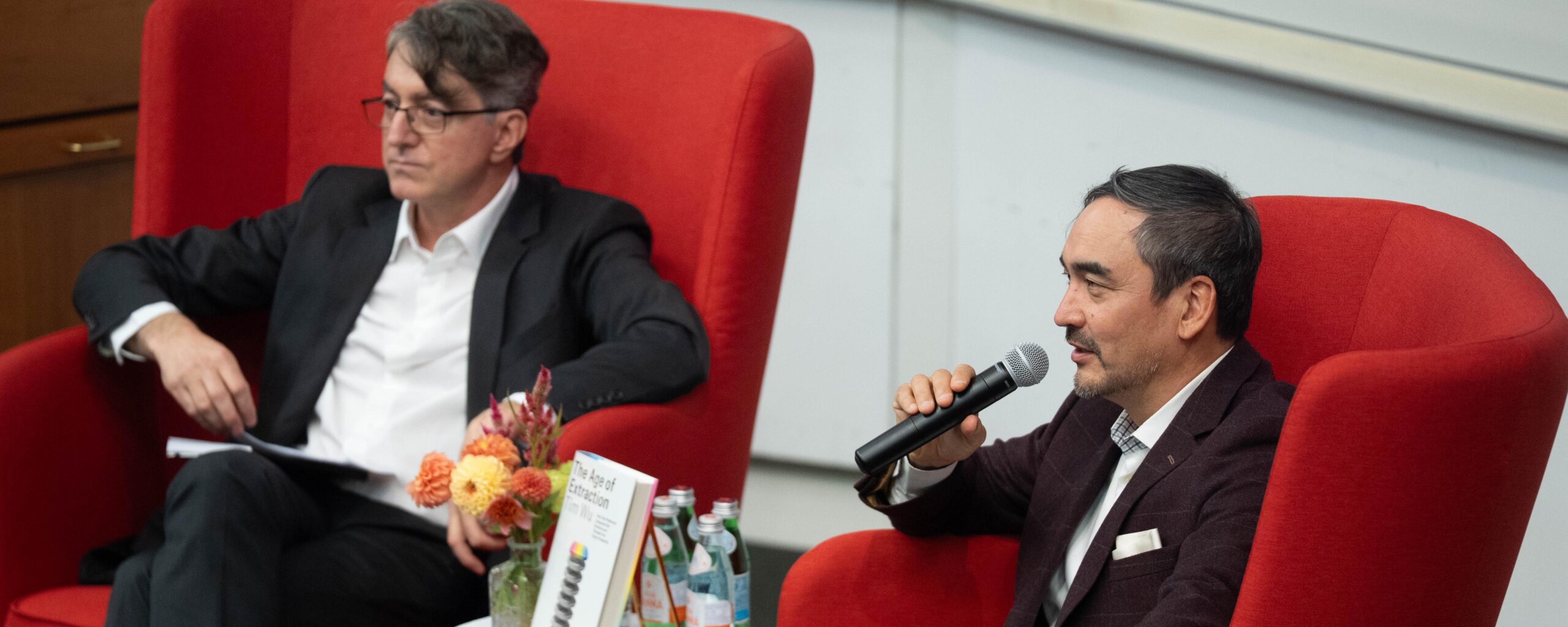
Right now, the media landscape looks grim. Local newspapers are shuttering, misinformation flourishes on Big Tech platforms, generative AI is disrupting creative industries, and media system ownership is becoming increasingly concentrated. But Tim Wu, the communications and legal scholar who coined the term “net neutrality,” says none of this was inevitable, and we can change course.
Wu, the Julius Silver Professor at Columbia University, was the guest of honor for this year’s Annenberg Lecture, jointly sponsored by the Annenberg Public Policy Center and the Annenberg School for Communication at the University of Pennsylvania. In conversation with Victor Pickard, the C. Edwin Baker Professor of Media Policy and Political Economy at the Annenberg School, where the talk took place, Wu discussed the history and political economy of communication platforms, from Bell Telephone to Meta, and possible paths toward more equitable media governance.
The conversation drew on themes from Wu’s trilogy of books that traces the history of communication: “The Master Switch: The Rise and Fall of Information Empires” in 2010, “The Attention Merchants: The Epic Scramble to Get Inside Our Heads” in 2016, and his new book, “The Age of Extraction: How Tech Platforms Conquered the Economy and Threaten Our Future Prosperity.”
“This is an opportunity to talk to an audience that really cares about communications and has thought deeply about the kind of questions I ask,” Wu said, noting that the evolution of communications has captured his attention since he was an undergraduate. It is this regard for history that keeps Wu hopeful that our information environment can improve: “Anyone who reads a lot of history ends up both incredibly pessimistic and incredibly optimistic, because frankly, the United States has been through worse,” he said.
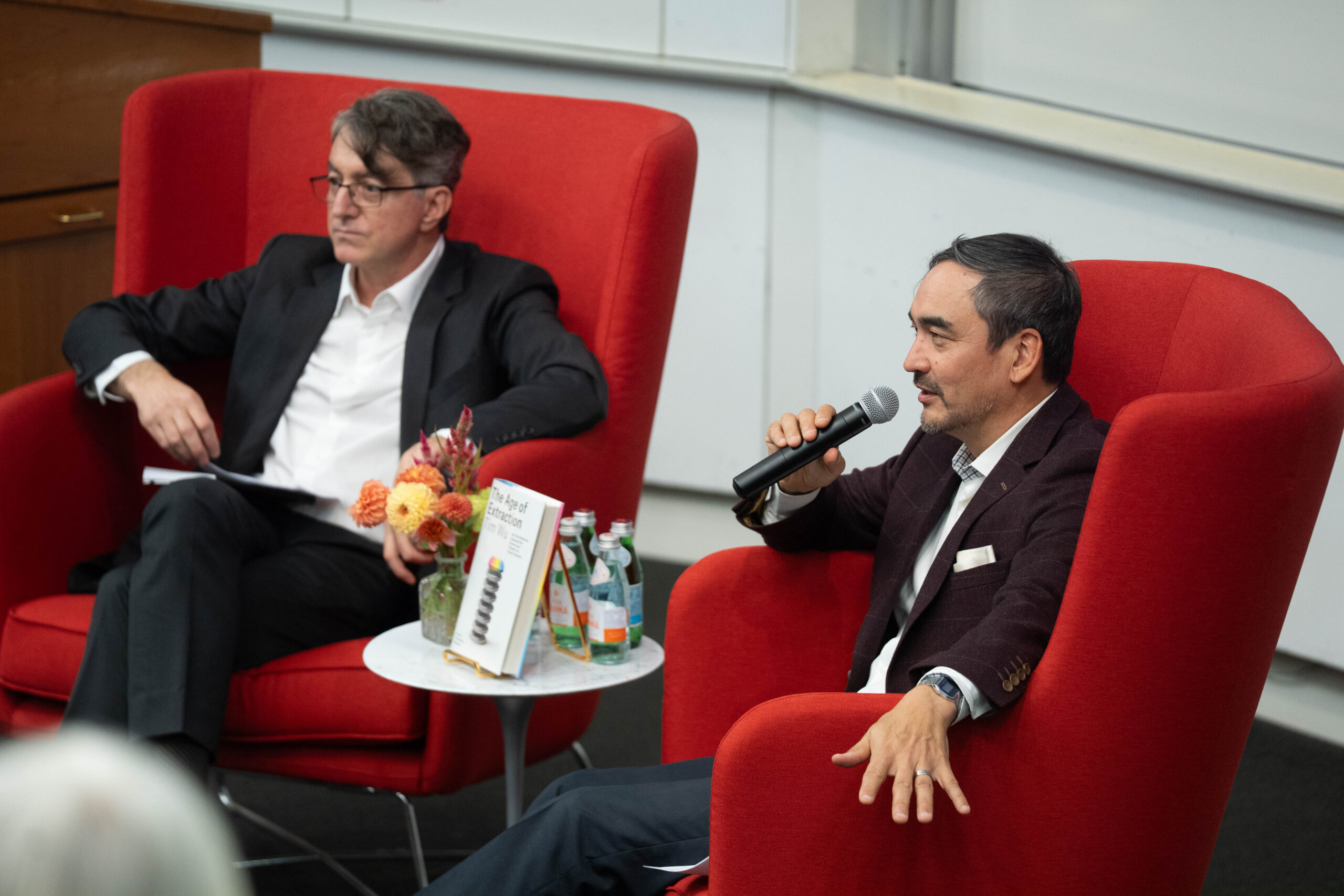
“In his work, Tim insists that we need to remember history if we are going to change the future, and rightly reminds us that we have designed our current technological environment; it didn’t spring up from nowhere,” said Annenberg Dean Sarah-Banet-Weiser. “And because we designed it, we can take a different course and insist on an environment that is more equitable, not only economically but also culturally and socially.”
From utopia to monopoly
Wu began writing “The Master Switch” after a brief stint working in Silicon Valley, where he was struck by the ahistoricism of the people in tech. “The constant idea that nothing like this has ever happened before, and like we’re living in entirely new times, and there’s just something completely different about this thing,” he said.
The book was an effort to explain the familiar patterns of innovation, competition, consolidation, and monopoly that have affected the U.S. information industries since the nation’s start, and a warning that the still-young internet was not immune to monopoly.
“Throughout history, there would be a big, important invention like the telephone, the invention of radio broadcasting, later on the internet, cable television, then an early nascent period where no one really knew what was going on, and the existing or dominant industry would try to destroy or control that nascent industry,” Wu explained. “… Then the great monopolists rise … It’s amazing that we have this belief that we’re going to be in a new, enlightened era that will overcome the barriers that have trapped humanity over and over.”
People wanted to believe that “the internet regards monopoly as like a disease,” Wu said, but media history suggested otherwise.
The lost promise of the internet
In his newest book, “The Age of Extraction,” Wu returns to the optimism of the 90s, when the burgeoning internet was seen as the ideal democratic platform that would bring peace and prosperity to all. Google’s motto was “don’t be evil.” Online platforms were made out to be places where small businesses could make it big, where loners could make friends, and where creative ideas could thrive.
“I was looking at this lost democratic promise,” Wu said. “Back then, no one thought that the platforms would make all the money,” he said. “They assumed that they would be benign, almost neutral, run like charities. The structural turning point came when all of the major internet operations of the 90s and early 2000s decided to just become regular companies.”
An outlier was Wikipedia, he said. “In 2006, Wikipedia had more traffic than Facebook … Every morning when [Wikipedia founder] Jimmy Wales woke up, he had the equivalent of a button next to his bed labeled billionaire, and he could have pushed that button at any time … But to his credit, and showing what is possible, he never pushed that button.”
Wu asked the audience to imagine an internet in which the leaders of its biggest platforms had made similar choices.“Maybe Facebook would not try to get you addicted to the site. Maybe there’s no newsfeed … Maybe there’s no Cambridge Analytica,” he said.
Unfortunately, platforms’ transition into conventional for-profit corporations redirected the dream of the democratic internet toward an economy increasingly centered on extraction and concentrated wealth, Wu said, leaving users with extraordinarily few public alternatives.
Pickard, whose work explores possibilities for a more democratic media system, commended Wu for reminding people that “the problems we’re dealing with today were not inevitable; there are historical antecedents and mistakes that we need to revisit to try to denaturalize our current system.”
Structure beats out good intentions
For Wu, the internet’s lost promise is not a reason to throw in the towel. “I think it’s never a good idea to give up hope,” he said. The dream of the 90s may not have come true, but he believes we can rebuild the internet and put digital platforms and their outsized influence on our media environment in check.
Rebuilding a healthier information economy, he argued, requires more than asking powerful technology companies to behave differently. He offered several paths forward: reviving antitrust enforcement to limit concentrated corporate power; treating major platforms more like public utilities, with expectations for fair access, service, and pricing; and building public alternatives to commercially controlled platforms.
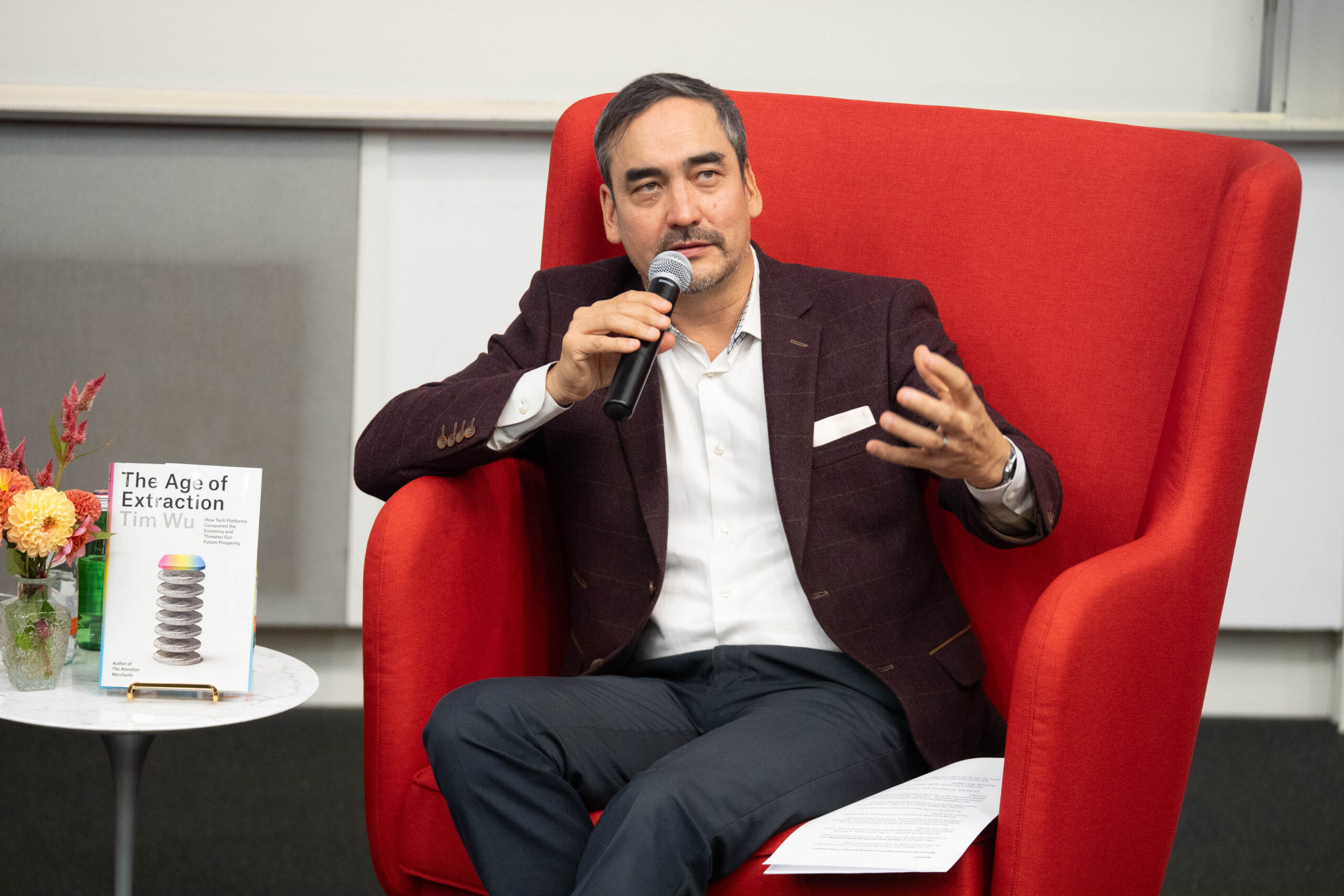 “This time around, we have the confidence in knowing that we have to use public power to get what we want if we want to have the kind of society, the kind of media environment, the kind of democracy that we deserve,” he told the audience.
“If there is a message from all three of my books, it’s that over the long term, structure beats out good intentions…If you like these open periods of flourishing, utopia, and good times, you have to build something. You have to engineer its defense and its lasting nature.”
The annual Annenberg Lecture, co-sponsored by the Annenberg School and the Annenberg Public Policy Center, brings leaders from academia, politics, public policy, and the media to Penn. It combines two previous lectures, the Walter and Leonore Distinguished Lecture in Communication, which began in 1992, and the Leonore Annenberg Lecture in Public Service and Global Understanding in 2006. Both series and the subsequent single lecture honor Ambassador and Mrs. Annenberg, without whose vision and support the Annenberg School and Annenberg Public Policy Center would not exist.
This story by Hailey Reissman was originally published by the Annenberg School for Communication.