Pertussis, also known as whooping cough, is a vaccination-preventable illness that has been on the rise in the United States. Following a several-year lull during the pandemic, cases of whooping cough rose sixfold in 2024 and remain high. As of Dec. 6, data show more than 26,600 U.S. cases reported this year, fewer than in the comparable period in 2024 but over four times higher than for all of 2023, according to the U.S. Centers for Disease Control and Prevention (CDC).
The CDC reports that “preliminary case report numbers [of pertussis] remain elevated in 2025 compared to immediately before the pandemic.” In some states, one must go back decades to find cases of whooping cough as high as those documented since 2020. The 1,475 cases in Oregon as of Dec. 10 surpassed “the previous annual record of 1,420 cases set in 1950,” according to The Oregonian. Kentucky, which had not registered any infant whooping cough deaths since 2018, experienced its third this year, according to Kentucky officials and cited by the Center for Infectious Disease Research and Policy (CIDRAP), at the University of Minnesota.
As cases rise, a nationally representative panel survey by the Annenberg Public Policy Center (APPC) of the University of Pennsylvania finds that many in the public remain unfamiliar with symptoms of the disease. Almost a third of respondents (30%) are not sure whether pertussis is the same as whooping cough (it is) and more than a third (35%) are not sure whether a vaccine exists to prevent it (it does). Both findings, from a survey of 1,637 U.S. adults conducted Nov. 17-Dec. 1, 2025, are statistically unchanged from an APPC survey on whooping cough a year earlier, in November 2024.
See the end of this release or the topline for further details.
What the CDC recommends
There is widespread agreement about the causes and risks of whooping cough.
“The outbreaks are fueled by falling vaccination rates, fading immunity, and delays in public health tracking systems, according to interviews with state and federal health officials,” CBS News reported in mid-November 2025. “Babies too young to be fully vaccinated are most at risk.”
The CDC recommends two combination vaccines to protect against whooping cough or pertussis, both of which have been shown in safety reviews to be safe and effective. The Tdap vaccine (tetanus, diphtheria, and acellular pertussis), for children seven and older and adults, is specifically recommended for preteens (at 11-12 years old); for pregnant women during the 27th-36th weeks of pregnancy; and for other adults who have not received the vaccine. The DTaP (diphtheria, tetanus and acellular pertussis) is recommended in a five-injection series for young children – babies at 2, 4, and 6 months; at 15-18 months; and between 4 and 6 years old.
“The MMR vaccine, which covers measles, mumps and rubella, is colloquially referred to as the measles vaccine,” APPC Director Kathleen Hall Jamieson has previously noted. “Instead of speaking about the DTaP and Tdap vaccines and using the unfamiliar term ‘pertussis,’ public health communicators should reiterate that our best defense against whooping cough is the whooping cough vaccine.”
Although most people know that a vaccine exists to prevent whooping cough, there are many who do not. The survey shows a statistically significant drop in those who say a vaccine to protect against whooping cough exists (57% vs. 63% in 2023).
Recommending vaccination to adolescents and adults
The CDC recommends vaccination for everyone against whooping cough, which is spread by coughing or sneezing. The illness may first resemble a common cold but can produce “rapid, violent, and uncontrolled coughing fits” a week to two weeks after symptoms appear. People who are vaccinated may still get whooping cough but generally have a milder illness.
The vast majority of U.S. adults (83%) say they would be likely to recommend that a child age 11 to 12 years old in their household or an adult in their family who is due for their 10-year booster get a Tdap vaccine, according to the survey. And over three-quarters (77%) say they think the Tdap vaccine is effective at offering protection against tetanus, diphtheria, and pertussis, although 17% are unsure. Just 13% say they are worried that they or someone in their family will contract whooping cough in the next three months.
Under half would recommend Tdap to someone who is pregnant
Until infants reach two months old and can be vaccinated, their protection comes from their mothers’ antibodies, which is why the CDC recommends that “pregnant women should get a dose of Tdap during every pregnancy, preferably during the early part of the third trimester, to help protect the newborn from pertussis.”
Yet less than half of Americans (46%) say they would be likely to recommend that someone who is pregnant take the Tdap vaccine, according to a separate, August 2025 national panel survey of 1,699 adults conducted by APPC. This represents no change from 2023.
Are whooping cough and pertussis the same disease? Many are unsure.
When asked in the current survey to choose between a series of definitions for a condition called pertussis, 6 in 10 adults (61%) correctly select whooping cough. Thirty percent, however, are not sure, and a small number (8%) say pertussis is something other than whooping cough.
Most don’t know Tdap vaccine protects against whooping cough
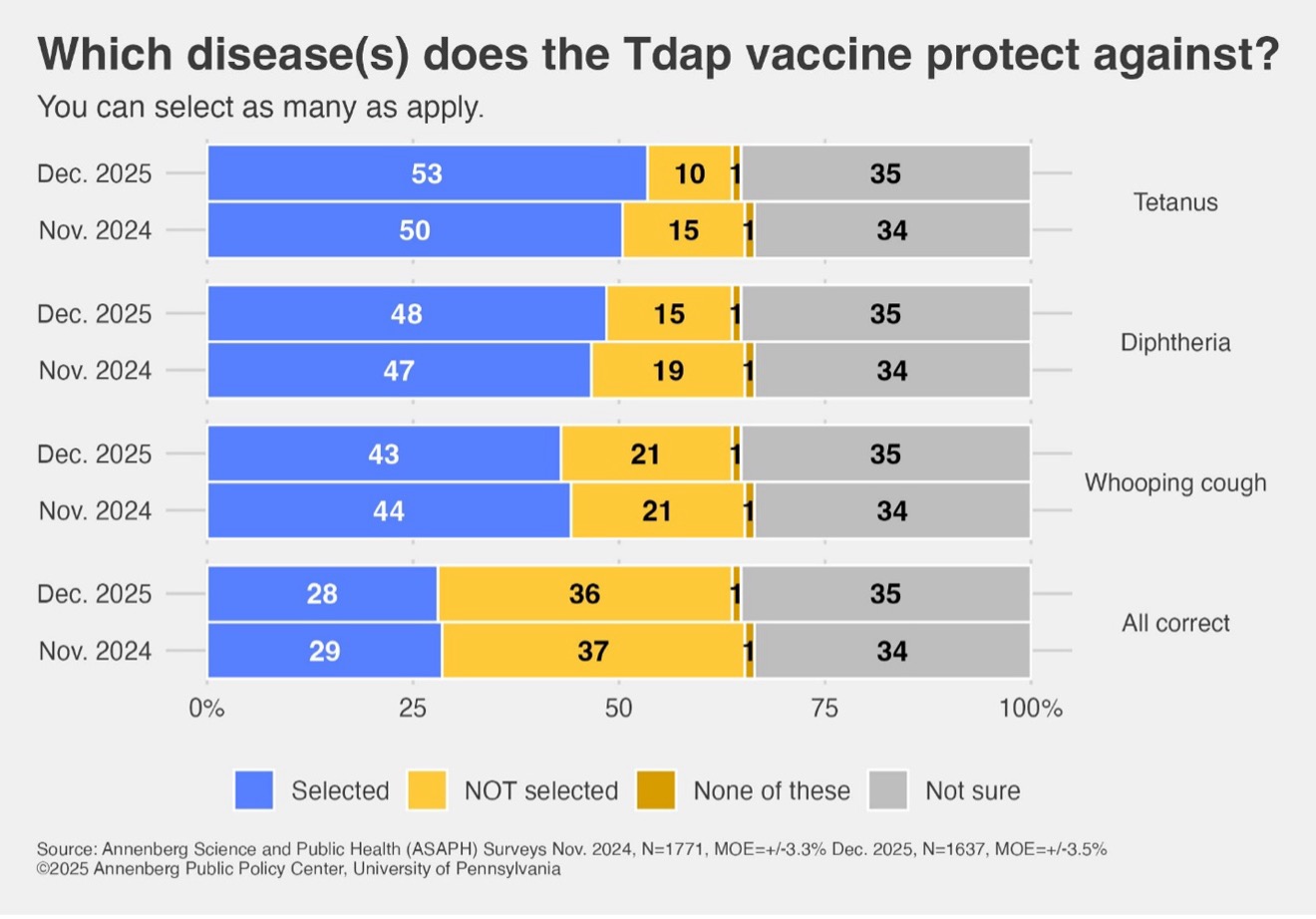
Although the Tdap vaccine can be given to people from age 7 up, only half of Americans or less know which diseases Tdap protects against. When survey respondents are provided with a list of diseases and asked which ones the Tdap vaccine protects against, a third of respondents (35%) say they are not sure.
Just 43% of those surveyed selected pertussis or whooping cough, 48% selected diphtheria, and 53% selected tetanus, all correct. The vast majority of respondents rightly rejected several incorrect choices – 13% said Tdap protects against polio, 8% said pneumococcal disease such as pneumonia or meningitis, 1% chose Zika, and 1% selected dengue. In total, almost 3 in 10 people (28%) know all three diseases that the Tdap vaccine protects against and did not choose the incorrect options.
Many people don’t know most symptoms of whooping cough
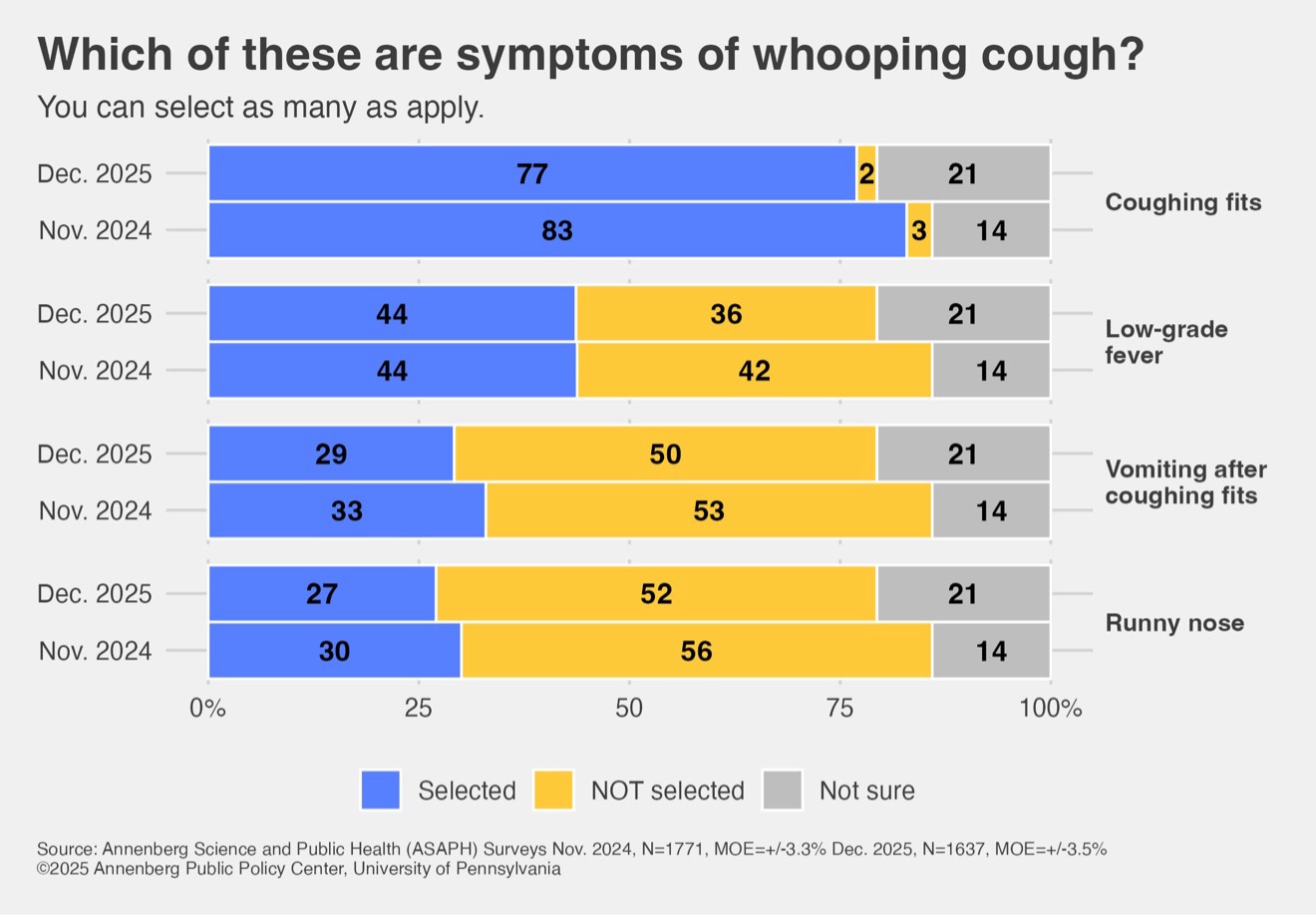
Many in the U.S. public lack familiarity with the symptoms of whooping cough. When survey respondents are shown a list of symptoms and asked which are for whooping cough, the only one widely recognized (77%) is coughing fits. However, the number who know this has decreased significantly from 83% in 2024. These coughing fits are often followed by a distinctive “whoop” sound when someone gasps for air.
This decrease was accompanied by a significant increase in respondents who say they are not sure of the symptoms (21% vs. 14% in 2024). Low-grade fever is correctly selected as a symptom by 44%; vomiting after coughing fits by 29%; and runny nose by 27%. Under a third of respondents selected symptoms that are not associated with whooping cough: 31% incorrectly chose headache and 30% incorrectly chose chills.
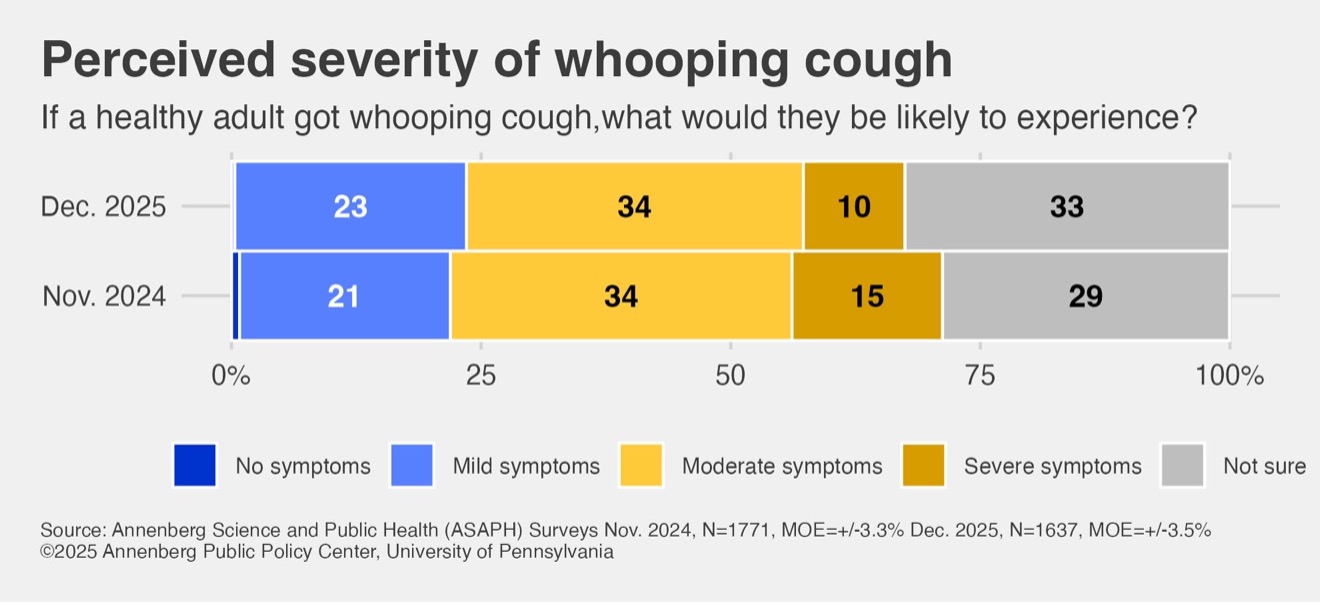
Fewer than half of those surveyed (44%) think that a healthy adult who got whooping cough would be likely to experience moderate (34%) or severe (10%) symptoms. This is a significant drop compared to 2024 when (49%) thought that a healthy adult suffering from the disease would experience moderate (34%) or severe (15%) symptoms. In the current survey, 23% think the adult would experience mild symptoms, and 33% are not sure.
APPC’s ASAPH survey
The survey data come from the 26th wave of a nationally representative panel of 1,637 U.S. adults conducted for the Annenberg Public Policy Center by SSRS, an independent market research company. Most have been empaneled since April 2021. This wave of the Annenberg Science and Public Health Knowledge (ASAPH) survey was fielded Nov. 17-Dec. 1, 2025. The margin of sampling error (MOE) is ± 3.5 percentage points at the 95% confidence level. All figures are rounded to the nearest whole number and may not add to 100%. Combined subcategories may not add to totals in the topline and text due to rounding.
Download the topline and the methods report.
The policy center has been tracking the American public’s knowledge, beliefs, and behaviors regarding vaccination, COVID-19, flu, RSV, and other consequential health issues through this survey panel since April 2021. APPC’s team on the survey includes research analyst Laura A. Gibson; Patrick E. Jamieson, director of APPC’s Annenberg Health and Risk Communication Institute; and Ken Winneg, managing director of survey research.
See other recent Annenberg health survey news releases:
- Support for hepatitis B vaccine: Although public overwhelmingly supports hepatitis B vaccine for a newborn, partisan differences exist (December 5, 2025)
- CDC vs. AMA on vaccine safety: Americans more likely to trust American Medical Association than CDC on vaccination safety (December 3, 2025)
- Measles and the MMR vaccine: Public not highly knowledgeable about safety of MMR vaccine or risks of getting measles (October 30, 2025)
- Vaccination during pregnancy: Under half in U.S. would recommend some routine vaccinations during pregnancy (September 30, 2025)
- West Nile virus: Despite increase in U.S. cases, worry about West Nile virus remains low (September 26, 2025)
The Annenberg Public Policy Center was established in 1993 to educate the public and policy makers about communication’s role in advancing public understanding of political, science, and health issues at the local, state, and federal levels. Connect with us on Facebook, X, Instagram, and Bluesky.