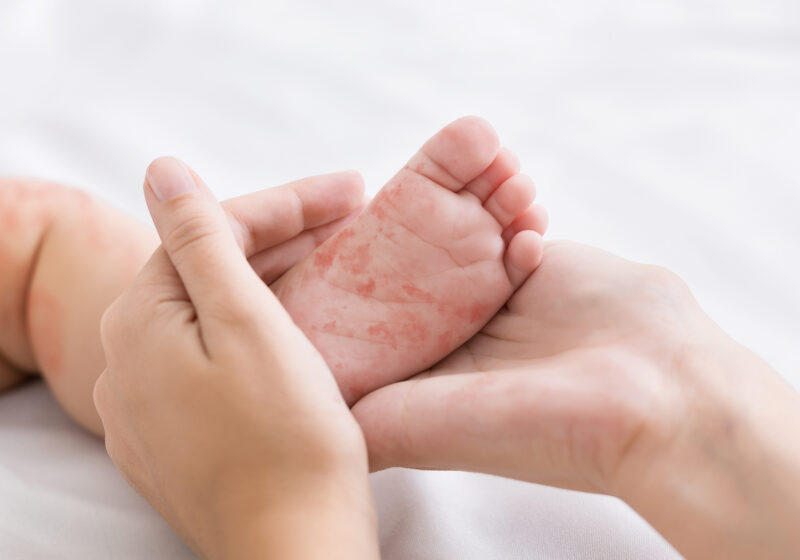
Mpox cases persist in U.S., but public awareness remains low

Four years after a major global outbreak of mpox, the United States continues to see a persistent, low level of cases of the viral disease. But Americans’ awareness and knowledge of mpox have changed little over the past couple of years, according to a new nationally representative survey conducted by the Annenberg Public Policy Center (APPC) of the University of Pennsylvania.
In the survey, which concluded in October, just 8% of U.S. adults say they have seen, read, or heard anything about mpox in the past month, down from 11% in July 2024 and dramatically down from 80% in July 2022, when the global mpox outbreak was gaining widespread attention.
The Centers for Disease Control and Prevention (CDC) says that since 2022 “cases have declined substantially in the United States; however, ongoing low-level transmission has persisted,” indicating a likely transition toward endemic circulation. As of Oct. 24, the CDC says 1,369 cases of mpox, also called monkeypox, have been reported in 2026.
The CDC says mpox is transmitted person-to-person by close (including intimate or sexual) contact with the rashes, scabs or bodily fluids of someone who has monkeypox; contact with contaminated materials, including clothing, bedding, towels, and dishes; or contact with small wild animals in West and Central Africa.
The Annenberg Science and Public Health (ASAPH) survey conducted Sept. 22-Oct. 5, 2026, among 1,842 empaneled U.S. adults, finds that many of the knowledge gaps identified in our 2024 mpox survey remain essentially unchanged. The 2024 survey found that public knowledge about mpox had fallen substantially from the heightened awareness during the 2022 outbreak.
Findings
Among the findings:
- Familiarity remains low: Just 24% say they are somewhat or very familiar with mpox, statistically unchanged from 23% in July 2024. Three-quarters (76%) say they are not too familiar or not at all familiar with it.
- Few worry about contracting it: Just 7% say they are somewhat or very worried about contracting mpox in the next three months, statistically unchanged from 5% in 2024 and far below the 21% who were worried in August 2022.
- Knowledge about a vaccine has not improved: Less than half (44%) know that a vaccine against mpox exists, virtually unchanged from 45% in 2024 and below 61% in August 2022. Nearly half (48%) are unsure whether a vaccine exists.
- Most unsure about mpox’s contagiousness relative to Covid-19: Only 18% correctly say mpox is less contagious than Covid-19, statistically unchanged from 17% in 2024. Nearly two-thirds (62%) are unsure. In August 2022, 41% knew mpox was less contagious.
- Knowledge about a group at elevated risk remains low: 33% know that men who have sex with men are at higher risk of mpox infection, unchanged from 34% in 2024 and about half the 63% who knew this in August 2022. More than half (53%) are unsure.
- Knowledge of transmission modes is unchanged: 49% know that sharing bedding, clothing, or towels used by someone with mpox presents a higher risk of infection, compared with 48% in 2024. And 51% recognize the risk associated with close face-to-face contact with an infected person, compared with 49% in 2024.
“The persistence of these knowledge gaps matters because the virus has not stood still,” said Ken Winneg, APPC’s managing director of survey research. “As the epidemiology of mpox changes, public understanding of who is at risk, how the virus spreads, and how vaccination can protect against it needs to keep pace.”
Some signs of increased knowledge
Although most measures changed little from 2024, the survey finds improvement in two areas:
- Nearly 3 in 10 Americans (29%) know that the mpox virus can spread through the placenta of a pregnant person who has mpox, an increase from 21% in July 2024. Still, nearly two-thirds (63%) are unsure. The CDC says monkeypox virus can be transmitted to a fetus during pregnancy, potentially posing risks to both the mother and newborn.
- Three-quarters (73%) know that people with mpox should isolate at home until the rash is gone, up from 68% in 2024. The CDC advises people with mpox to isolate until the rash has fully healed, the scabs have fallen off, and a fresh layer of intact skin has formed.
Willingness to get vaccinated remains high
Despite limited knowledge about mpox, most Americans say they would be likely to get vaccinated if exposed to the virus.
In the survey, 69% say they would be “somewhat” or “very” likely to get an mpox vaccine if exposed, virtually unchanged from 68% in 2024. Another 2% say they are already vaccinated. The proportion saying they would be “very” likely to get vaccinated increased significantly, however, from 38% in 2024 to 44% today.
Nearly three-quarters of Americans (73%) say the benefits of mpox vaccines outweigh their risks, compared with 70% in 2024, a difference that is not statistically significant.
The CDC recommends two doses of the JYNNEOS vaccine for maximum protection for people for whom mpox vaccination is recommended. The CDC says mpox vaccines are expected to protect against the disease and can also be administered after exposure to help prevent illness.
Misperceptions and uncertainty persist
The survey finds little change in beliefs about two unsupported claims involving mpox.
Sixteen percent say it is definitely or probably true that mpox was bioengineered in a laboratory, for which there is no evidence, statistically unchanged from 15% in 2024. Another 41% are unsure, while 43% correctly say the claim is probably or definitely false. According to FactCheck.org, a project of the Annenberg Public Policy Center, this claim has been debunked.
Seven percent incorrectly say that receiving the Covid-19 vaccine increases a person’s chances of getting mpox, statistically unchanged from 6% in 2024. Nearly two-thirds (63%) correctly reject the claim, compared with 58% in 2024, while 30% are unsure. FactCheck.org labels this a false claim.
About the survey
The latest wave of the Annenberg Science and Public Health (ASAPH) survey, Wave 31, was conducted for APPC from Sept. 22-Oct. 5, 2026, among 1,842 U.S. adults by SSRS, an independent research company. Interviews were conducted by web and telephone among a nationally representative probability sample drawn from the SSRS Opinion Panel, with the data weighted to represent the U.S. adult population. The margin of error is ±3.2 percentage points.
The Annenberg Public Policy Center has been tracking Americans’ knowledge, beliefs, and behaviors regarding vaccination, Covid-19, flu, RSV, and other consequential health issues through its ASAPH survey and other national samples since April 2021. In addition to Winneg, the survey team includes Patrick E. Jamieson, director of the Annenberg Health and Risk Communication Institute, which oversees the survey; research analyst Laura A. Gibson; and Kathleen Hall Jamieson, APPC’s director emerita.
For additional information, download the topline and methodology report.
See other recent Annenberg health survey news releases:
- Measles and the MMR vaccine: U.S. loses measles elimination status as knowledge gaps about disease and vaccine persist (Nov. 18, 2026)
- Cancer risk from alcohol: Public knowledge that alcohol causes cancer rebounds (Oct. 27, 2026)
- MAHA and its policy concerns: One in 4 Americans supports MAHA, but three times as many share food-related concerns (Oct. 22, 2026)
- 988 Lifeline: Knowledge of the 988 Suicide Lifeline remains low (Oct. 9, 2026)
- RFK Jr. and the measles vaccine: About 1 in 3 Americans say RFK Jr. recommends measles vaccine (Sept. 29, 2026)
The Annenberg Public Policy Center was established in 1993 to educate the public and policy makers about communication’s role in advancing public understanding of political, science, and health issues at the local, state, and federal levels.