U.S. loses measles elimination status as knowledge gaps about disease and vaccine persist
As the United States loses its status as a country that has eliminated measles, a new nationally representative Annenberg Public Policy Center (APPC) survey finds many Americans still lack basic knowledge about the disease and the vaccine that prevents it.
Since 2000, the United States held measles elimination status, meaning that a strain of the virus had not been transmitted continuously and without interruption in the country for at least 12 months. On Nov. 17, 2026, the Pan American Health Organization announced that the United States no longer met the criteria for measles elimination status.
The U.S. is currently experiencing the largest measles resurgence in decades. As of Nov. 12, 5,412 confirmed measles cases were reported in the United States in 2026, according to the Centers for Disease Control and Prevention (CDC). In 2025, less than half that number, 2,290 cases, were reported in the U.S. for the whole year.
Against that backdrop, a November 2026 Annenberg Science and Public Health (ASAPH) survey of adults drawn from the SSRS Omnibus survey finds that nearly two in three Americans (64%) agree that it is false to say that “vaccines given to children for diseases like measles, mumps, and rubella cause autism.” But 1 in 6 people (17%) regard that statement as true and 19% report that they are not sure whether it is true or false.
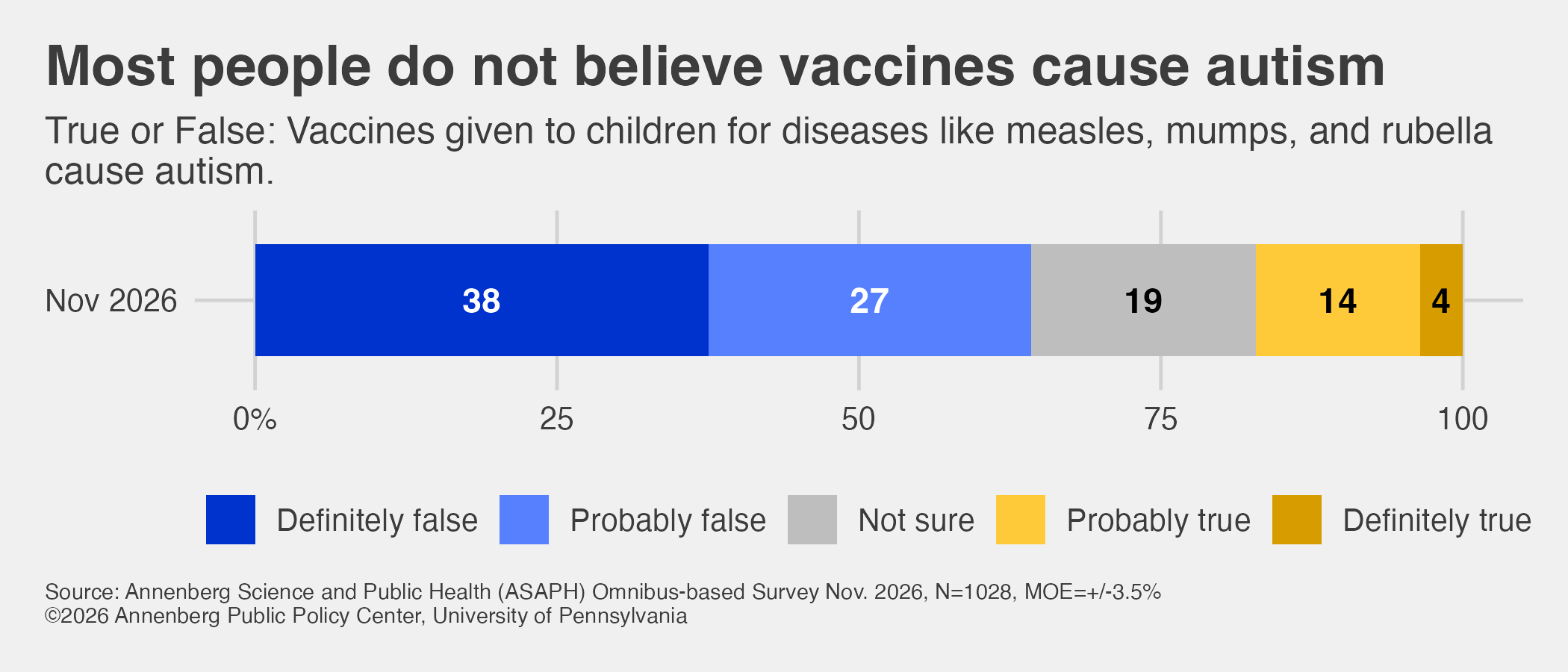
These findings are in line with past APPC surveys. In four surveys over two years (September 2024 to August 2026), with a different survey sample of empaneled U.S. adults, our ongoing ASAPH national probability survey showed similar proportions of Americans who say it is false to connect childhood vaccines with autism (65%-68%), while slightly fewer incorrectly say the statement is true (12%-14%) and 19%-22% report that they are not sure.
The current November 2026 survey also shows that about half of respondents (49%) think that children who are fully vaccinated are “about as likely” to show signs of autism as children who are not fully vaccinated, while 11% think fully vaccinated children are “more likely,” 14% believe they are “less likely,” and 26% are not sure of the likelihood.
The scientific evidence does not support a causal relationship between vaccines and autism. In 2004, the National Academy of Medicine (then named the Institute of Medicine) determined that “the body of epidemiological evidence favors rejection of a causal relationship between the MMR vaccine and autism evidence.” The World Health Organization’s Global Advisory Committee on Vaccine Safety reaffirmed in 2025 that the available high-quality evidence shows no causal link between vaccines and autism. FactCheck.org, a project of the Annenberg Public Policy Center, has written that there is no evidence for the claim.
Annenberg researchers have found that holding false beliefs about vaccines, including that measles, mumps, and rubella (MMR) vaccine causes autism, is associated with a reduced likelihood of recommending that those eligible take the MMR vaccine.
Most uncertain about measles knowledge
Many Americans do not realize how deadly measles can be to children. Most respondents in the current November 2026 survey are uncertain how many children who get measles are likely to die as a result of the disease, with 59% saying they are not sure. Only 9% correctly choose “about 1 in 1,000,” the response that is closest to the CDC’s estimate that 1 to 3 of every 1,000 children infected with measles will die from respiratory and neurologic complications. Nearly a quarter of those surveyed (23%) choose lower rates, and 9% choose higher rates.
Americans also show uncertainty about the number of doses of the measles vaccine children need. In the November survey half (49%) say they are not sure. A third (34%) know that children need two doses of the MMR vaccine for full protection.
The CDC recommends that children get a first dose of the MMR vaccine at 12 to 15 months old and a second dose between ages 4 and 6 years old. The CDC says one dose is 93% effective at preventing measles and two doses are 97% effective.
Majority remain not confident in Robert F. Kennedy Jr.
Public confidence in U.S. Health and Human Services secretary Robert F. Kennedy Jr. is unchanged from our earlier surveys in 2025-26. In the November 2026 survey, six in 10 (61%) say they are not confident that Kennedy is providing the public with trustworthy information about matters concerning public health, while 4 in 10 (39%) say they are confident. In seven surveys over two years (February 2025 to August 2026), our national probability surveys show confidence in Kennedy to be stable, with 60%-63% not confident and 37%-39% confident.
“The announcement that the U.S. has lost its measles elimination status confirms what we already knew,” said Kathleen Hall Jamieson, director of the policy center’s Science of Science Communication Institute and the ASAPH and ASK surveys. “Those who refused the MMR vaccine for themselves or their children and those who misled them into doing so have produced the tragic effects that science predicted would occur when community immunity dropped below the threshold needed to protect those who are not able to be vaccinated or refused to be.”
About the survey
The survey data come from two types of Annenberg Science and Public Health (ASAPH) surveys. The current, omnibus-based November 2026 survey is a nationally representative sample of 1,028 U.S. adults conducted for APPC by SSRS, an independent market research company. The sample was drawn from SSRS’s probability-based online opinion panel and fielded Nov. 6-8, 2026. It has a margin of sampling error (MOE) of ± 3.5 percentage points at the 95% confidence level.
The ongoing ASAPH panel surveys are also conducted for APPC by SSRS from probability samples originally drawn from the SSRS Opinion Panel, with the data weighted to represent the U.S. adult population. The ASAPH panel is separate from the SSRS Omnibus survey and has been fielded in more than 30 waves since April 2021. All figures are rounded to the nearest whole number and may not add to 100%. See the topline for additional information.
Download the topline with the omnibus-based November 2026 data and ASAPH panel data referenced here. Download the methodology statement for the current survey.
The policy center has been tracking the American public’s knowledge, beliefs, and behaviors regarding vaccination, Covid-19, flu, RSV, and other consequential health issues through the Annenberg Science and Public Health (ASAPH) and separate national samples since April 2021. APPC’s health survey team includes Ken Winneg, managing director of survey research, research analyst Laura A. Gibson, and Patrick E. Jamieson, director of the Annenberg Health and Risk Communication Institute.
See other recent Annenberg health survey news releases:
- Cancer risk from alcohol: Public knowledge that alcohol causes cancer rebounds (Oct. 27, 2026)
- MAHA and its policy concerns: One in 4 Americans supports MAHA, but three times as many share food-related concerns (Oct. 22, 2026)
- 988 Lifeline: Knowledge of the 988 Suicide Lifeline remains low (Oct. 9, 2026)
- RFK Jr. and the measles vaccine: About 1 in 3 Americans say RFK Jr. recommends measles vaccine (Sept. 29, 2026)
- Climate change and illness: In hottest summer on record, 2 in 3 Americans say climate change is increasing heat-related illnesses (Sept. 17, 2026)
The Annenberg Public Policy Center was established in 1993 to educate the public and policy makers about communication’s role in advancing public understanding of political, science, and health issues at the local, state, and federal levels.