In most of the nation’s 435 congressional districts, the general election is really not a contest. With the vast majority of U.S. House seats considered safe for one party or the other, the primary is the election that usually determines who goes to Congress — and it is the election Americans know the least about. A new book co-authored by a researcher at the Annenberg Public Policy Center (APPC) of the University of Pennsylvania finds that voters are rarely the most important influence on the outcome.
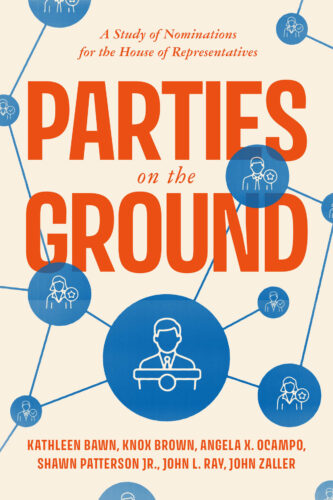 “Parties on the Ground: A Study of Nominations for the House of Representatives” (University of Chicago Press, September 2026) finds that the organized groups anchoring each party’s coalition do the work of vetting candidates, coordinating behind them, and supplying the money and volunteers a nomination requires. Their goal, the authors find, is not ideological purity but reliable representation: a nominee who will faithfully represent their interests.
Which groups those are varies tremendously from district to district. In one race the decisive player may be the U.S. Chamber of Commerce or a national feminist organization; in another it may be a network of local Tea Party or faith-based activists, a building-trades union, or a county physicians’ group. Across the 55 nominations the authors studied, the most important players were a wide cross section of the country’s interest and activist groups — not a standing national slate acting on either party’s behalf.
“This book is what happened when we went and watched nominations on the ground,” said co-author Kathleen Bawn, professor of political science at UCLA. “What groups told us is that they were looking for someone they considered ‘one of us’ – someone who would pick up the phone and do the work of championing their interests.”
In addition to Bawn, the book was co-authored by Knox Brown, assistant professor of political science at Tulsa Community College; Angela X. Ocampo, assistant professor of Social and Cultural Analysis at the University of Texas at Austin; Shawn Patterson Jr., a research analyst at APPC; John L. Ray, senior director of polling for YouGov Blue at YouGov; and John Zaller, professor emeritus of political science at UCLA.
Key findings
The study examined all 55 winnable open-seat House nominations in the 2013-14 election cycle, drawing on 346 field interviews, a content analysis of local newspaper coverage, campaign finance data, and exit surveys of voters in four contests. The book finds that:
- Groups want agents, not ideologues: The policy-demanding groups that participate in House nominations care most about candidates committed to the groups’ particular agendas. They care much less about liberal-conservative ideology.
- Vetting and vouching: Groups have developed practices for evaluating candidates based on observed behavior and personal reputation rather than news coverage or candidates’ self-presentation.
- Groups coordinate across organizational lines: Policy demanders frequently coordinate with one another, and with local party officials, to increase their clout in the nomination process.
- Winning campaigns are anchored in one group or alliance: Most winning candidates anchor their campaigns in major support from a single policy-demanding group or an association of like-minded groups.
- Primary voters have limited information: Without party labels to distinguish the candidates, and with little media coverage of the contests, primary voters have a limited ability to use primaries to give policy direction to their parties.
A study of nominations that are rarely watched up close
Primaries are notoriously difficult to study. They are held at different times, under different rules, in hundreds of separate places, and the influence of local leaders varies widely from district to district. The authors took on that problem with an unusually labor-intensive research design, interviewing activists, party officials, candidates, donors, journalists, and consultants in 50 of the 55 races — an average of nearly seven interviews per nomination.

“Reformers created the primary to hand nominations to the voters, and on paper that is exactly what happened,” said Shawn Patterson Jr., a research analyst at APPC who works with the center’s Institutions of Democracy division. “But what we found is that most primary voters don’t have the information necessary to tell the candidates apart. The decisive work happens earlier, among the organized interests that pay very close attention. By the time voters reach the voting booth, a great deal of the nomination has already been settled.”
A Congress of “champions”
The result, the authors argue, is a Congress of “champions”: members who arrive in Washington as committed advocates for the groups that helped elect them. That pattern, the book argues, shifts the study of representation away from the general election and toward the nomination stage, where the bargaining that shapes a member’s priorities largely takes place.
“We argue that parties are best understood as coalitions of policy demanding groups, and that real group leverage comes at the nomination stage,” said John Zaller, professor emeritus of political science at UCLA.
Advance praise
“Parties on the Ground will change the way people think about American elections. Using rich qualitative data from hundreds of in-depth interviews, this book reveals that long before voters choose from the candidates on the ballot, interest groups and party leaders jostle over who those candidates will be. These highly local political processes are mostly invisible to voters but are an important, understudied part of American democracy.” — Sarah Anzia, author of “Local Interests: Politics, Policy, and Interest Groups in US City Governments”
“Congressional primaries are enormously important as they effectively determine the winner in a large majority of districts — yet they’re often understudied. These detailed case studies provide a host of new insights into the nomination process that will shape future research on parties, interest groups, and other electoral processes. Parties on the Ground represents a major, indeed a landmark contribution to the literature on congressional elections.” — Gary C. Jacobson, author of “Presidents and Parties in the Public Mind”
“A sobering and persuasive look at whether primary elections serve the democratizing purposes for which they were designed. Based on extensive interviewing and close examination of 55 winnable open seat Congressional races, the authors explore the critical ways that various interest groups shape primary outcomes and contemplate what that means for political representation in the US.” — Bruce Cain, Stanford University
About the book
“Parties on the Ground: A Study of Nominations for the House of Representatives” | University of Chicago Press | September 2026 | 368 pages | Chicago Studies in American Politics
More information is available from the publisher.
The Annenberg Public Policy Center of the University of Pennsylvania was established in 1993 to educate the public and policy makers about communication’s role in advancing public understanding of political, science, and health issues at the local, state, and federal levels.