Publications
-
Digital Media and Risks for Adolescent Substance Abuse and Problematic Gambling
Digital media provide increased opportunities for both marketing and social transmission of risky products and behavior. We briefly review what is known about adolescent exposure to favorable presentations of addictive substances, such as alcohol, tobacco, and marijuana, as well as behaviors such as gambling, on social and other online media. Our understanding of these influences and whether they require greater regulation is still developing, and recommendations for future research to address these gaps in our understanding are described.
-
Executive Function Capacities, Negative Driving Behavior and Crashes in Young Drivers
Motor vehicle crashes remain a leading cause of injury and death in adolescents, with teen drivers three times more likely to be in a fatal crash when compared to adults. One potential contributing risk factor is the ongoing development of executive functioning with maturation of the frontal lobe through adolescence and into early adulthood. This review points to an urgent need for systematic research to inform development of more effective training and interventions.

-
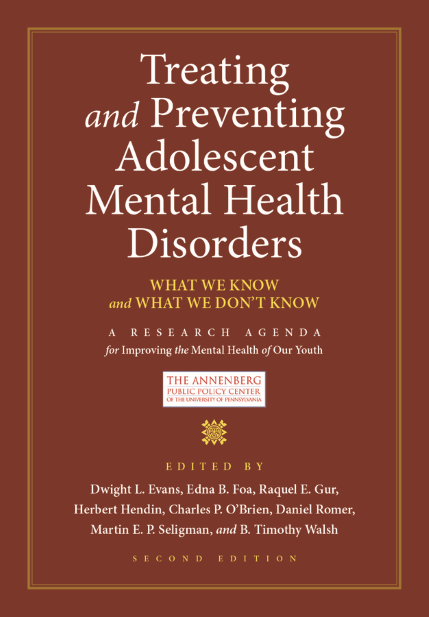
Treating and Preventing Adolescent Mental Health Disorders
The second edition of Treating and Preventing Adolescent Mental Health Disorders: What We Know and What We Don’t Know provides a substantive update to the acclaimed original published in 2005, with new sections on gambling and internet addiction, as well as DSM-5 diagnostic criteria. The volume updates the work of seven panels of experts in such areas as adolescent anxiety disorders, schizophrenia, depression and bipolar disorder, eating disorders, substance and alcohol abuse, and suicide prevention, as well as positive youth development.
-
Beyond stereotypes of adolescent risk taking: Placing the adolescent brain in developmental context
Recent neuroscience models of adolescent brain development attribute the morbidity and mortality of this period to structural and functional imbalances between more fully developed limbic regions that subserve reward and emotion as opposed to those that enable cognitive control. We challenge this interpretation of adolescent development by distinguishing risk-taking that peaks during adolescence (sensation seeking and impulsive action) from risk taking that declines monotonically from childhood to adulthood (impulsive choice and other decisions under known risk).
-
Effects of Pictorial Warning Labels for Cigarettes and Quit-Efficacy on Emotional Responses, Smoking Satisfaction, and Cigarette Consumption
This article presents the results of a clinical trial testing the impact on smoking during and after a 28-day period of naturalistic exposure to pictorial versus text-only warnings. The authors conclude that pictorial warning labels proposed by FDA create unfavorable emotional reactions to smoking that predict reduced cigarette use compared to text alone, with even smokers low in self-efficacy exhibiting some reduction. Predictions that low self-efficacy smokers will respond unfavorably to warnings were not supported.
-
Counteracting the Influence of Peer Smoking on YouTube
YouTube, a popular online site for user-generated content, is emerging as a powerful source of peer modeling of smoking. Although exposure to adolescent YouTube smokers increased perceived prevalence among some participants, it simultaneously increased beliefs about smoking’s adverse health outcomes and negative attitudes toward smoking, effects that were associated with reductions in injunctive norms of social acceptability. Interventions that communicate the severity and scope of health risks associated with smoking may undercut the descriptive normative effects of peer modeling of smoking on social media sites such as YouTube.
-
Alcohol, Sex, and Screens: Modeling Media Influence on Adolescent Alcohol and Sex Co-Occurrence
Results suggest that for both White and Black adolescents, exposure to media portrayals of alcohol and sex combinations is positively associated with adolescents’ attitudes and norms. These relationships were stronger among White adolescents. Intention was predicted by attitude, norms, and control, but only the attitude–intention relationship was different by race group (stronger for Whites).
-
The Continuing Rise of Gun Violence in PG-13 Movies, 1985 to 2015
The Motion Picture Association of America created the parental guidance for children under age 13 years (PG-13) movie rating in 1984 to “strongly” caution parents about content that may not be suited for children of that age. According to that industry-supported group, "There may be depictions of violence in a PG-13 movie, but generally not both realistic and extreme or persistent violence."
-
The Importance of Relevant Emotional Arousal in the Efficacy of Pictorial Health Warnings for Cigarettes
Warning labels for cigarettes proposed by Food and Drug Administration (FDA) were rejected by the courts partly because they were thought to be emotionally evocative but have no educational value. To address this issue, we compared three types of smoking warnings: (1) FDA-proposed warnings with pictures illustrating the smoking hazards; (2) warnings with the same text information paired with equally aversive but smoking-irrelevant images; and (3) text-only warnings.
-
Smoking and Pictorial Warning Labels: What Does the Evidence Show?
Although U.S. legislation mandated the use of pictorial warnings in 2009, efforts to implement the labels by the FDA have been stymied by tobacco-industry court challenges. This issue brief reviews research into the use of graphic or pictorial warning labels on cigarette packages as a means to highlight the risks of this product.
