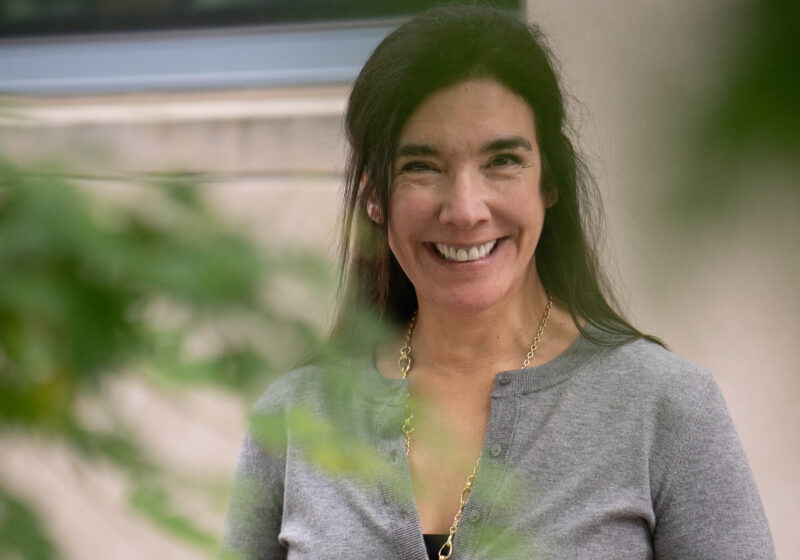
Dolores Albarracín Honored with BBVA Foundation Frontiers of Knowledge Award

Dolores Albarracín (opens in a new tab), the Amy Gutmann Penn Integrates Knowledge University Professor at the University of Pennsylvania (opens in a new tab) and director of the Communication Science Division of the Annenberg Public Policy Center, has been named one of five recipients of the BBVA Foundation Frontiers of Knowledge Award in Social Sciences (opens in a new tab) for her research increasing “our understanding of how attitudes can be changed, particularly with regard to persuasive messages,” the award committee says.
The BBVA Foundation (opens in a new tab), based in Spain, supports scientific research and cultural creation through grants, disseminates knowledge and culture, and recognizes talent and innovation through awards. Social sciences is one of eight Frontiers of Knowledge Awards categories, each of which comes with a 400,000-euro prize to be split among the awardees. This is the 17th edition of the awards.

A social psychologist who studies social cognition, attitudes, and behavioral change, Albarracín is a Penn Integrates Knowledge Professor (opens in a new tab) who has published more than 200 articles and chapters and six books, including “Action and Inaction in a Social World: Predicting and Changing Attitudes and Behaviors” and “Creating Conspiracy Beliefs: How Our Thoughts Are Shaped.”
“My research has been guided by the following questions: How do we change behavior through persuasion? When does persuasion begin with changes in convictions, and when does it end with changes in beliefs that originate in particular emotions? How can we promote exposure to messages audiences fear and resist?” Albarracín says. “Answering each of these questions involves identifying the psychological processes at play and producing policy recommendations that benefit society.
“We have used this knowledge,” she says, “to develop large-scale programs to change the behavior of communities in the U.S. This international award will strengthen our motivation to make social science discoveries at a time when our research and funding are threatened by our government. It is a tribute to the work of my lab and the contributions of my colleagues who are winning the award with me.”
Much of her research has health implications, the BBVA Foundation notes, and for decades, Albarracín has received National Institutes of Health (opens in a new tab) funding to apply her findings in areas such as HIV and smoking prevention.
She is a fellow of the American Academy of Arts and Sciences, American Association for the Advancement of Science, American Psychological Association, Association for Psychological Science, Society for Experimental Social Psychology, and American Academy of Political and Social Science.
The other new honorees of the Frontiers of Knowledge Award in Social Sciences are Icek Ajzen (opens in a new tab) of the University of Massachusetts Amherst (opens in a new tab), Mahzarin Banaji (opens in a new tab) of Harvard University (opens in a new tab), Anthony Greenwald (opens in a new tab) of the University of Washington (opens in a new tab), and Richard Petty (opens in a new tab) of the Ohio State University (opens in a new tab). The award citation says the contributions of the five scientists can help policymakers and others “prevent negative societal consequences such as polarization, ethnic prejudices, and unfounded stereotypes.”
This article was first published (opens in a new tab) in Penn Today (opens in a new tab) on March 11, 2025.