Publications
-
Unrealistic Fatalism in U.S. Youth Ages 14 to 22: Prevalence and Characteristics
Because youth exhibiting fatalism are at risk for not staying in school and suicidal planning, they should be identified at an early age for referral to programs that are effective in treating youth with hopelessness and suicidal tendencies.
-
An Assessment of the Relationship between Condom Labels and HIV-Related Beliefs and Intentions
The aim of this article is to examine the impact of the FDA’s proposed condom package labeling on HIV-related beliefs about condom effectiveness, on intentions to recommend condoms for friends to use, and intentions to use condoms.
-
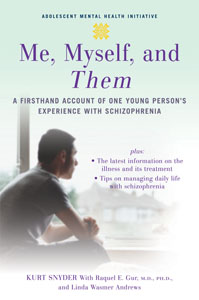
Me, Myself, and Them
During his second semester at college, Kurt Snyder became convinced that he was about to discover a fabulously important mathematical principle. In time, his thoughts took a darker turn, and he became preoccupied with the idea that cars were following him, or that strangers wanted to harm him. Kurt's mind had been hijacked by schizophrenia. In Me, Myself, and Them, Kurt, now an adult, looks back from the vantage point of recovery and describes the debilitating changes in thoughts and perceptions that took hold of his life during his teens and twenties.
-
Teachers as Builders of Respectful School Climates: Implications for Adolescent Drug Use Norms and Depressive Symptoms in High School
Positive school climates have been found to have favorable effects on adolescent health risk behaviors and mental health outcomes. However, the mechanisms by which teacher behavior may promote such effects in high schools have not been extensively studied.
-
Next to Nothing
More than simple cases of dieting gone awry, eating disorders such as anorexia and bulimia are among the most fatal of mental illnesses. Carrie Arnold developed anorexia as an adolescent and nearly lost her life to the disease. In Next to Nothing, she tells the story of her descent into anorexia, and of how she was able to seek help and recover. Now an adult, Arnold uses her own experiences to offer practical advice and guidance to young adults who have recently been diagnosed with an eating disorder, or who are at risk for developing one.

-
Validating an Index of Adolescent Sexual Behavior Using Psychosocial Theory and Social Trait Correlates
Using a web-based survey of adolescents 14-16 years of age, a hierarchical index of heterosexual behavior was developed with excellent psychometric properties. The easiest sexual behavior to perform was "deep kissing" and the most difficult was "receiving anal sex" for females and "giving anal sex" for males.

-
What You Must Think of Me
For the 15 million Americans with social anxiety disorder, the fear of being scrutinized and criticized can reach disabling proportions. Such was the case for Emily Ford, who shares her firsthand experiences in these pages. Her true story of fear, struggle, and ultimate triumph is sure to resonate with other socially anxious teenagers and young adults. Emily's story is coupled with the latest medical and scientific information about the causes, diagnosis, treatment, and self-management of social anxiety disorder.

-
Monochrome Days: A First-Hand Account of One Teenager’s Experience With Depression
If you are one of the nearly 20 percent of adolescents who experience the symptoms of major depression before the end of high school, then you are probably already familiar with the sadness, isolation, and confusion that depression can bring. Monochrome Days was written specifically for you. It is the firsthand story of Cait Irwin, who was diagnosed with major depression at the age of 14, and who nearly lost her battle with the illness before she was able to receive the treatment she so desperately needed.

-
Adolescent Psychopathology and the Developing Brain
Recent advances in our understanding of the human brain suggest that adolescence is a unique period of development during which both environmental and genetic influences can leave a lasting impression. The Annenberg Public Policy Center's Adolescent Risk Communication Institute held a conference on this interdisciplinary area, focusing on two questions: What neurodevelopmental processes in children and adolescents could be altered so that mental disorders might be prevented? What interventions or life experiences might be able to introduce such changes?

-
Adolescent Psychopathology and the Developing Brain: Integrating Brain and Prevention Science
Recent advances in our understanding of the human brain suggest that adolescence is a unique period of development during which both environmental and genetic influences can leave a lasting impression.